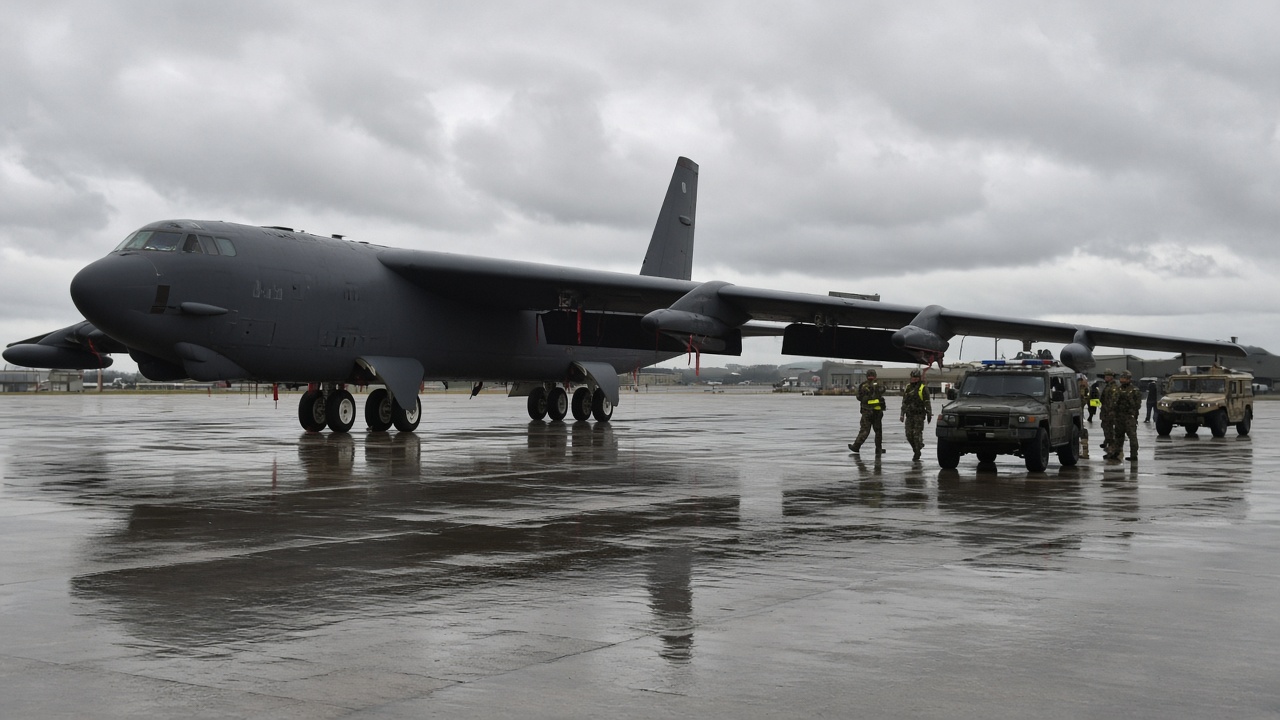
The United States has withdrawn all of its bombers from RAF Fairford in Gloucestershire, a U.S. defence official confirmed on Sunday, pulling strategic aircraft off the base that has served as a launch pad for Middle East missions since London approved their use against Iranian targets earlier this year. The move comes two weeks after counter-terrorism police arrested six men following suspicious vehicle activity near the airfield on 27 September, an episode Prime Minister Andy Burnham said showed “strong indications” of Iranian involvement, a charge Tehran denies.
What the U.S. announced
In a statement reported by the BBC on Sunday evening, a U.S. department official said bombers stationed at Fairford had returned to their home stations in the United States. Washington did not publish a detailed justification, but Whitehall sources told British broadcasters they did not dispute that the withdrawal responded to the September security incident rather than a routine rotation.
The BBC quoted officials describing the decision as operational, taken by the U.S. military and communicated through alliance channels rather than as a political reprimand of the UK. Even so, the departure removes the most visible American strike asset from English soil at a moment when both governments are managing public anxiety about foreign-directed plots near military infrastructure.
The Fairford investigation
Gloucestershire Police and Counter Terrorism Policing launched a major response on 27 September after reports of three suspicious vehicles close to the base. Five men were initially arrested near the airfield and later released on bail, a decision that drew criticism from U.S. President Donald Trump, who said Washington “would not have released them” and claimed the allies “know everything about them.”
On Saturday, authorities charged a sixth man—a dual UK–Iranian national arrested in London on Thursday—with preparation of terrorist acts, according to the BBC. That charge escalated the case beyond trespass or intelligence-gathering suspicions and kept Fairford in headlines as families in nearby villages recalled evacuations ordered during the September alert.
Burnham has stopped short of publishing evidence tying Tehran to the plot, but his public language aligned with U.S. warnings about Iranian retaliation for strikes launched from UK territory. Iran’s foreign ministry has rejected the allegations as baseless.
Why Fairford matters
RAF Fairford is one of the few European bases cleared to host U.S. long-range bombers, including B-52s that flew sorties toward Iran after the UK granted Washington defensive strike permissions. The arrangement placed Britain in the direct line of reprisal threats from Tehran and its proxies, even as the government insisted strikes were narrowly scoped.
Removing bombers reduces the immediate target set on Gloucestershire but does not end U.S.–UK cooperation. Refuelling tankers, intelligence flights and naval assets can still support operations from other locations; however, sortie length and response times change when heavy bombers must launch from CONUS bases.
Domestic fallout
Opposition MPs are likely to press Burnham on whether bail decisions reflected evidential thresholds or diplomatic pressure after Trump’s comments. Home Office and Crown Prosecution Service officials typically refuse to discuss active terror cases, leaving the government to balance alliance management with judicial independence.
Local councils and emergency services, meanwhile, must explain why residents learned of major incidents through social media before official updates—a recurring complaint in rural bases surrounded by farmland and commuter villages.
What to watch
Investigators will track whether charged suspects had overseas handlers, a question that determines if the plot is treated as state-directed sabotage or a smaller autonomous cell. The U.S. Air Force will decide whether to return bombers once security reviews finish, a timetable neither capital disclosed on Sunday.
For now, empty Fairford aprons mark the most concrete consequence of the September scare: American strategic aviation has stepped back from the Cotswolds, even as both countries keep fighting wars thousands of miles away.