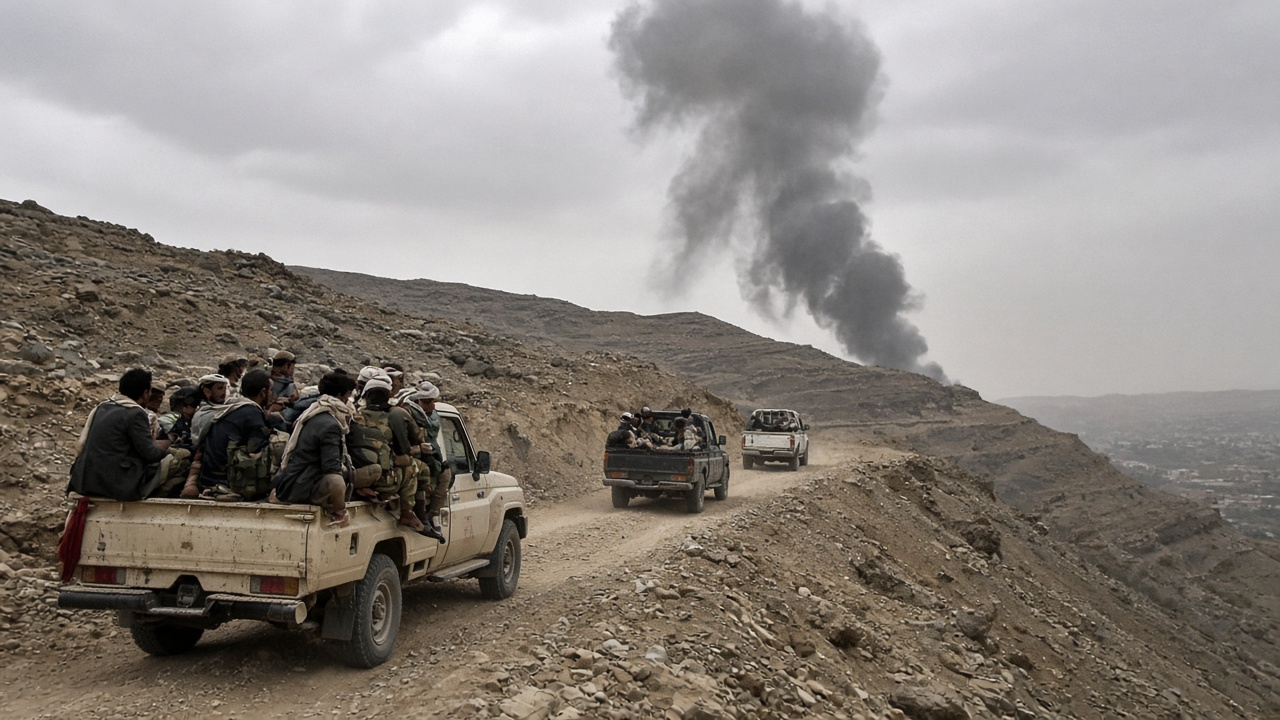
Yemen's internationally recognised president, Rashad al-Alimi, declared the start of military operations on Sunday to retake territory still held by the Iran-aligned Houthis, hours after the Saudi-led coalition reported 97 air and artillery strikes that killed at least 260 rebel fighters near Taiz.
In a televised address from Riyadh, al-Alimi said the goal was to "extend the authority of the state and its institutions across the entire national territory," a sharp escalation in rhetoric after the Houthis' September offensive along the Red Sea coast. The announcement followed a weekend of cross-border fire in which the rebels claimed successful hits on Saudi Aramco facilities while the coalition and Yemeni government forces answered with waves of strikes on Sanaa, Saada and front-line provinces.
What changed on the Taiz axis
Early on Sunday, the coalition said its forces had carried out 97 "precise targeting operations" against Houthi reinforcements on the Tor al-Baha front and the Taiz axis, using warplanes, drones, artillery, missiles and snipers. Colonel Majed Abdullah al-Nazili, spokesman for Yemen's government forces, said the raids hit at least 260 fighters and destroyed or disabled 44 military vehicles.
The tally could not be independently verified, and the Houthis rarely confirm losses. Even so, the scale of the coalition statement underscored how quickly fighting has re-accelerated since a 2022 truce collapsed in July and the rebels seized the port of Mocha and islands near the Bab al-Mandeb strait last month.
On the ground, the picture around Taiz — still held by anti-Houthi forces — looked grimmer for the government. Three Yemeni military sources told AFP that the Houthis had cut a vital supply route linking Taiz with Aden, the interim capital, effectively encircling the city even without fully capturing it. Farea Al-Muslimi, a Chatham House research fellow, told the agency the rebels had achieved the military objective of isolating Taiz from Aden.
Aramco claims and Saudi response
The weekend exchange began with Houthi military spokesman Yahya Saree saying on Saturday that ballistic missiles and drones had struck Aramco sites in Riyadh and the Khurais oil region, causing fires. Witnesses and AFP images showed smoke rising near an Aramco facility south of Riyadh on 3 October. Turki al-Maliki, spokesman for the Saudi-led coalition, later called the Riyadh targeting claims "misleading," language Riyadh has used before when disputing rebel narratives.
Saudi Arabia has not publicly detailed damage from the latest claimed strike, but the pattern — Houthis targeting the kingdom's oil infrastructure while the coalition pounds Yemen — mirrors the economic pressure both sides have tried to inflict since the wider Middle East war drew renewed attention to shipping lanes and energy sites. The Houthis also said this week they had attacked a power station in Medina, and last month claimed strikes on Aramco facilities at Yanbu on the Red Sea coast.
What al-Alimi's vow means next
Al-Alimi's broadcast did not spell out a timeline or list of cities, but analysts said the speech would not have aired without Saudi approval. Riyadh remains the principal backer of his Presidential Leadership Council, and Saudi air power has again become the decisive edge as ground lines shift around Taiz and the Red Sea coast.
Houthi-run Al-Masirah TV said coalition strikes wounded at least two people on Sunday, and smoke rose over Sanaa as government-aligned forces continued attacks on the capital the rebels have held since 2014. Yemen's war has already displaced hundreds of thousands since fighting restarted this summer, and aid agencies warn that any push to retake Sanaa or the northern heartland of Saada would run through densely populated territory still grappling with famine-scale need.
For now, the immediate test is whether the coalition's Taiz-axis raids can loosen the Houthi stranglehold on Aden's supply lines — or whether al-Alimi's pledge of full territorial control commits his backers to a longer, costlier campaign than either side could afford when the truce still held.