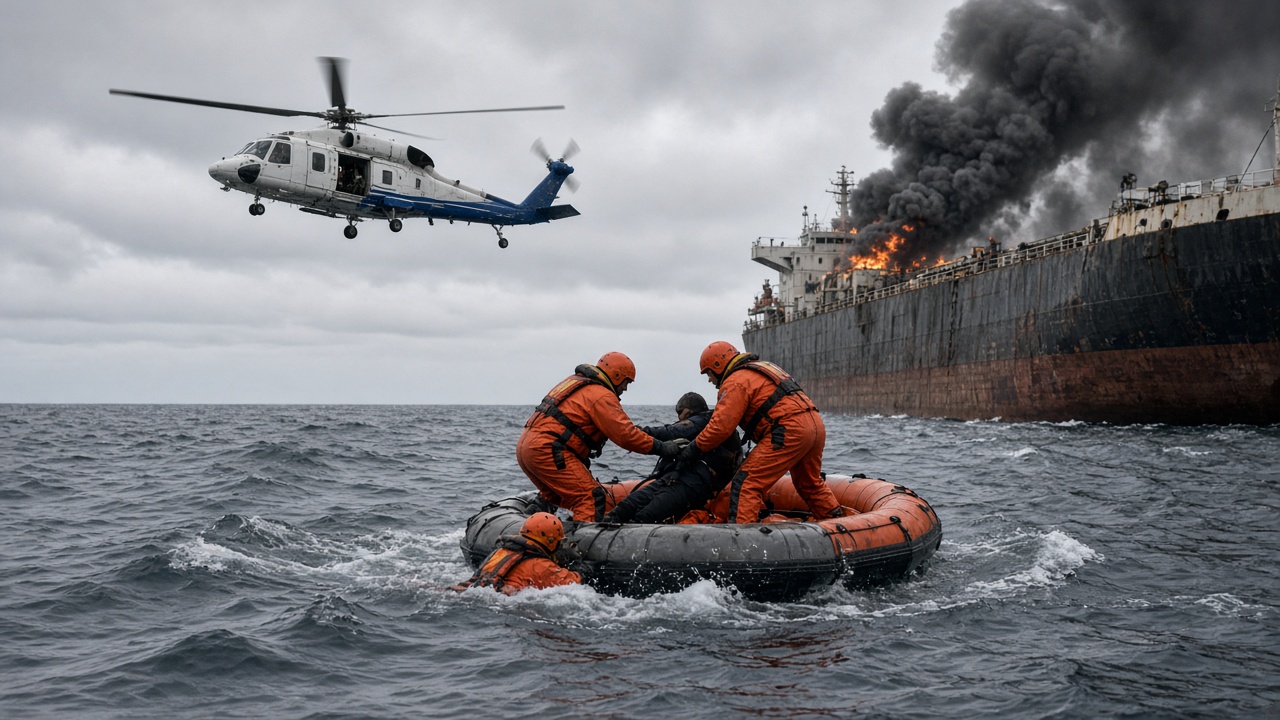
Romanian authorities mounted a large air-and-sea rescue on Monday after a Turkish-owned cargo ship carrying corn from Ukraine was hit by at least one drone, caught fire and sank in the Black Sea, killing two crew members and leaving one sailor unaccounted for.
The vessel went down about 20 miles from the Romanian coast, according to officials quoted by Euronews Romania. Eleven survivors were pulled from the water by Romanian ships and helicopters; three others were wounded. Search teams continued to look for the missing crew member as night fell over the western Black Sea.
What Romania says happened
Interior Ministry footage released Monday showed rescue craft alongside burning wreckage and agents helping crew members aboard. Romanian authorities have not publicly named who they believe launched the attack, saying the investigation is ongoing.
The ship was Turkish-flagged and was hauling grain loaded at a Ukrainian port, part of the commercial corridor that global leaders have tried to keep open despite more than three years of war. Any strike on a civilian bulk carrier in international waters raises immediate questions about insurance, rerouting and whether shippers will accept the risk premium that follows each new incident.
Kyiv blames Moscow
Ukrainian President Volodymyr Zelenskyy said the attack was carried out with two Russian drones against a civilian ship in neutral waters. He described the sinking as part of a pattern in which Russia, in his words, chooses terror over normal maritime navigation and called for more pressure to restore global food security.
Moscow did not immediately issue a detailed response to Monday’s sinking in the accounts reviewed by InfoHandle. Russia has previously denied targeting civilian shipping while accusing Ukraine of using the grain corridor for military advantage. The gap between those narratives is why neutral investigators—and the market for war-risk insurance—matter as much as any single statement from a capital.
Why grain routes still matter
Black Sea exports remain a backbone for Ukrainian farmers and for importers across the Middle East and North Africa. When a laden bulker burns and sinks, the damage is measured in lives first, but the second-order effect shows up in freight quotes and in diplomatic fights at the United Nations over safe passage.
Monday’s episode also lands amid a wider pattern of drone activity around NATO’s southeastern flank. Romania has intercepted stray unmanned aircraft near its border with Ukraine before, and energy infrastructure in the sea has been probed with maritime drones in recent months. Each new hit on commercial traffic tightens the link between front-line fighting and grocery inflation thousands of miles away.
What happens next
Bucharest is expected to keep search assets on station while forensic teams work to confirm the ship’s identity, cargo manifest and exact position at the time of the blast. Turkey, as flag state, and Ukraine, as cargo origin, will both press for accountability even if a criminal attribution takes weeks.
For insurers and charterers, the practical question is whether Monday’s loss becomes another data point in a slow squeeze on Black Sea routes—or the incident that forces a fresh round of escorts, inspections or war-risk surcharges before the next convoy sails.