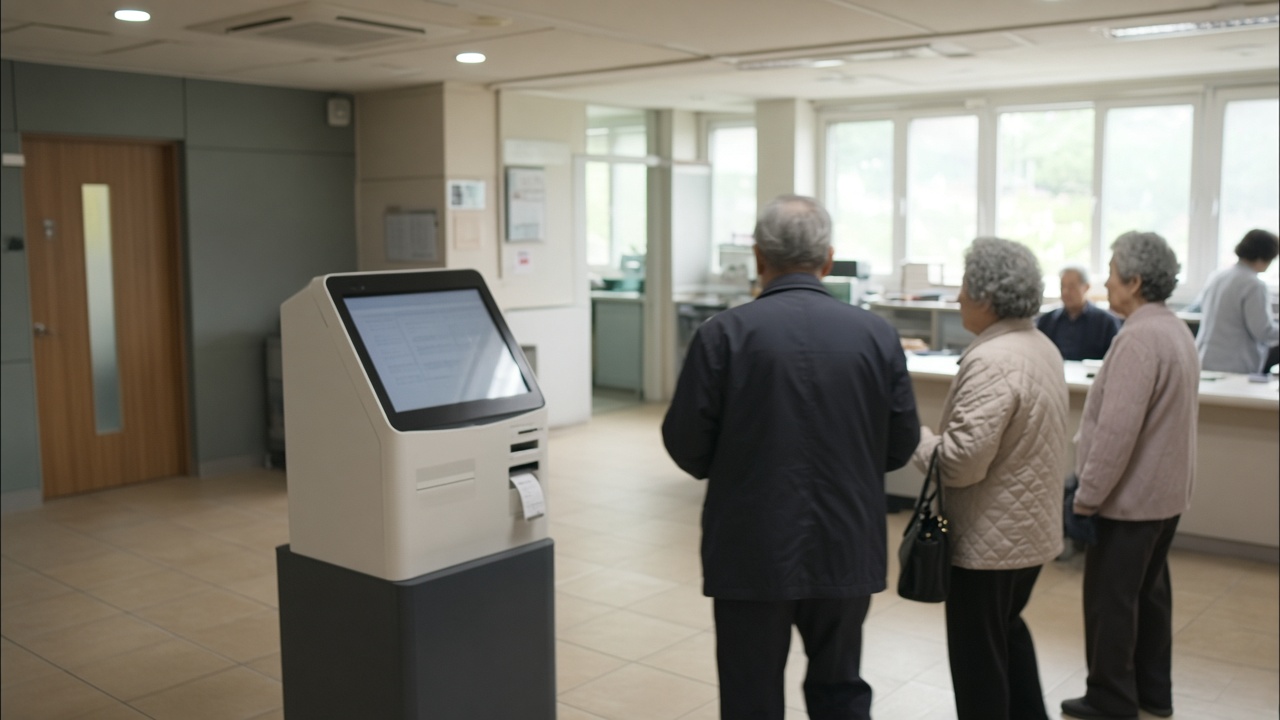
Prime Minister Han Seong-sook used Saturday’s Gaecheonjeol ceremony to promise municipal AI service terminals in rural town halls, part of the Lee Jae Myung government’s “AI-basic society” agenda to keep seniors and low-income households from being shut out of digitized welfare applications. The hardware pilot—paired with on-prem inference stacks rather than consumer chat apps—aims to let residents complete voice-guided filings for local subsidies without traveling to county seats or relying on grandchildren’s smartphones.
What the pilot entails
Interior Ministry briefers said the first wave targets townships in North Jeolla and Gangwon provinces where broadband is available but smartphone penetration among residents over 70 lags national averages. Each kiosk runs a constrained language model vetted for public-sector tone, connected to back-end databases through government identity rails already used for resident registration services. Officials stressed that prompts and responses stay inside municipal data centers to address privacy complaints that cloud-based assistants mishandle national ID numbers.
Han’s speech framed culture and technology as complementary: widening empathy through shared cultural programs while ensuring AI transitions do not “isolate anyone,” a line that echoed campaign promises to subsidize training for digital novices.
Implementation partners
Regional cloud vendors and telecom operators bid separately for terminal maintenance contracts; Naver Cloud and KT subsidiaries have prior experience with district-office chatbots in metropolitan Seoul. The pilot deliberately avoids importing general-purpose models that hallucinate eligibility rules—engineers must map each welfare program to verified decision trees with human handoff when cases fall outside training scope.
Civic technologists welcomed on-prem designs but asked for open APIs so local startups could extend services without vendor lock-in. Disability advocates requested tactile interfaces and screen-reader paths, noting that voice-only flows exclude hearing-impaired users unless captions are mandatory.
Risks and oversight
Personal Information Protection Commission staff will audit logging practices before terminals go live, checking whether voice recordings are minimized and deleted on schedule. Opposition lawmakers questioned whether the rollout duplicates budgets already allocated to “digital government” projects launched under the prior administration.
Fake service hotlines spike during long holidays; pairing physical terminals with verified government branding is partly a fraud-prevention play. Police agencies reported smishing waves mimicking banks over the Gaecheonjeol break, a reminder that any new interface must ship with plain-language warnings about impersonation scams.
Timeline and metrics
Ministry officials target installations before winter heating subsidy applications peak, with satisfaction surveys conducted through community health posts. Success will be measured in completed filings per terminal week, not vanity chat volume—a metric public servants said prevents vendors from optimizing for entertaining but useless conversations.
For rural mayors, the pledge is tangible hardware arriving after years of slides about smart cities centered on Seoul. Whether the terminals reduce car trips to county offices will determine if the AI-basic society slogan translates into fewer bus rides for elderly residents, or becomes another photo opportunity on a foundation-day stage.