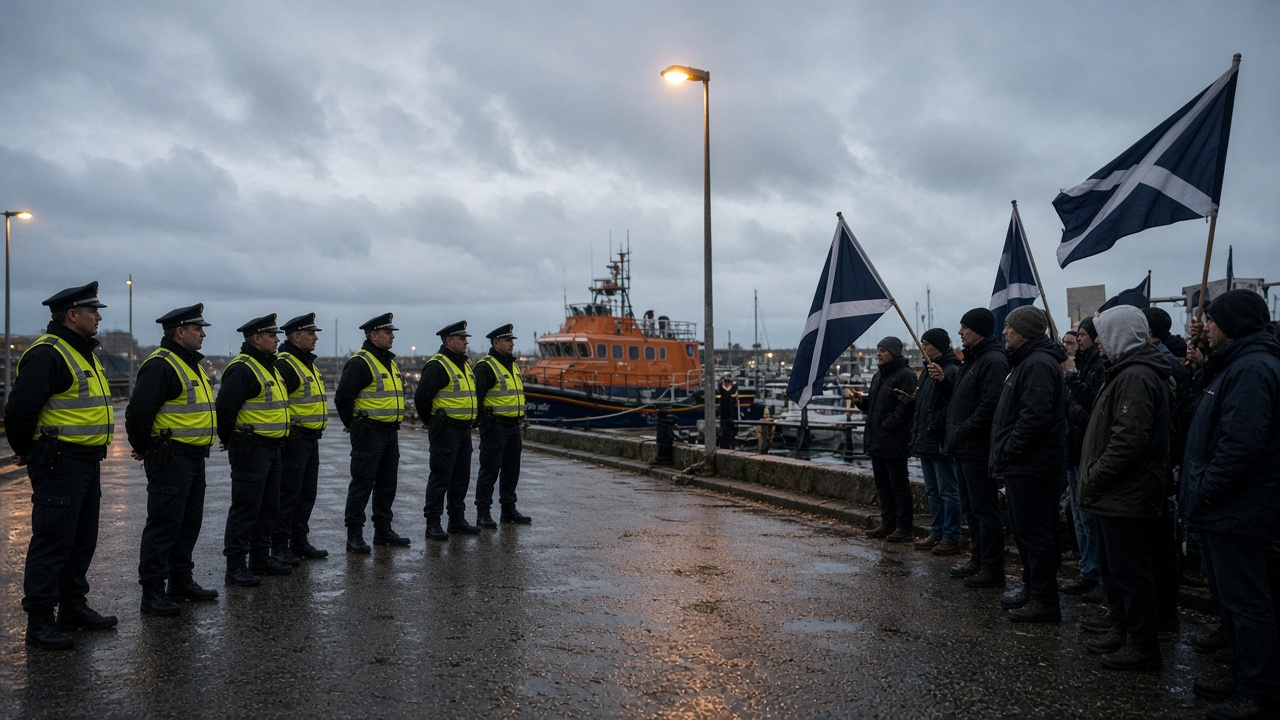
Twelve people were in custody Monday after a standoff between anti-migration demonstrators and police at a marina in Gosport, Hampshire, where authorities brought ashore 149 people picked up during a mid-Channel rescue—the second large landing this far west on England’s south coast in recent years.
The Home Office confirmed the rescue involved the Royal National Lifeboat Institution working alongside a French vessel. Coaches later carried the arrivals to a processing site in Kent. Separately, French officials said two men died and two women suffered extensive burns during the small-boat journey, underscoring how the politics on the quay and the mortality at sea unfolded on the same October weekend.
What happened in Gosport
About 150 protesters gathered Sunday into early Monday, according to the BBC. Some set off flares; a few scuffles broke out with officers who had deployed under Public Order Act conditions, including restrictions on face coverings. Police said a small number of officers were treated for minor injuries at the scene but that no member of the public was seriously hurt.
Video accounts described demonstrators blocking police vans while chanting slogans demanding deportations. Hampshire Police said the arrests—eleven men and one woman—included suspicion of assaulting an officer, affray and racially aggravated public-order offences. All remained in custody pending charging decisions.
A longer western route
Tracking data cited by broadcasters suggests the inflatable craft may have left near Utah Beach in Normandy on Sunday morning, part of a newer and longer western corridor that ends closer to Portsmouth than the traditional Dover landings. In September, more than 100 people came ashore at Eastney in Portsmouth, again drawing protests and a heavy police presence.
For local councils and the Border Security Command, the geography matters: landings west of Sussex pull Royal Navy, coastguard and police resources into harbours that were not the primary focus a decade ago. Sunday’s operation also drew criticism from policing representatives who said each large protest strains budgets that were already stretched.
Deaths on the French side
While Gosport argued over who should step off the gangway, French maritime authorities were dealing with the human cost of the same voyage. LBC and other outlets reported that two men died and two women were hospitalised with severe burns after their boat encountered trouble in French waters. The details of how the fire started were still being established Monday, but the juxtaposition—fatal casualties at sea and a street-level confrontation in Hampshire—is now familiar to ministers briefing on Channel crossings.
Political pressure
Prime Minister Keir Starmer’s government has promised faster removals and tougher criminal penalties for people-smuggling networks, but each visible landing gives the opposition another scene to weaponise. Reform UK and Conservative MPs have used Portsmouth-area arrivals to demand more Border Force capacity; campaign groups counter that militarising small harbours risks escalating violence without cutting the underlying demand to reach the UK.
Home Office officials declined to provide a minute-by-minute timeline Monday, citing operational security. What is clear is that Gosport will not be the last western port to host both a rescue and a protest if smugglers keep testing longer routes.
What comes next
Hampshire Police said investigations into Sunday’s disorder continue, including review of body-worn camera footage. The 149 people taken ashore will move through the usual asylum screening pipeline in Kent, a process that can take days before any individual’s status is known.
For residents along the Solent, the immediate question is whether marine planners and chief constables treat Gosport as a one-off or begin standing up the same forward command posts already familiar in Dover and Folkestone—another sign that the Channel crisis is no longer confined to the eastern edge of the map.