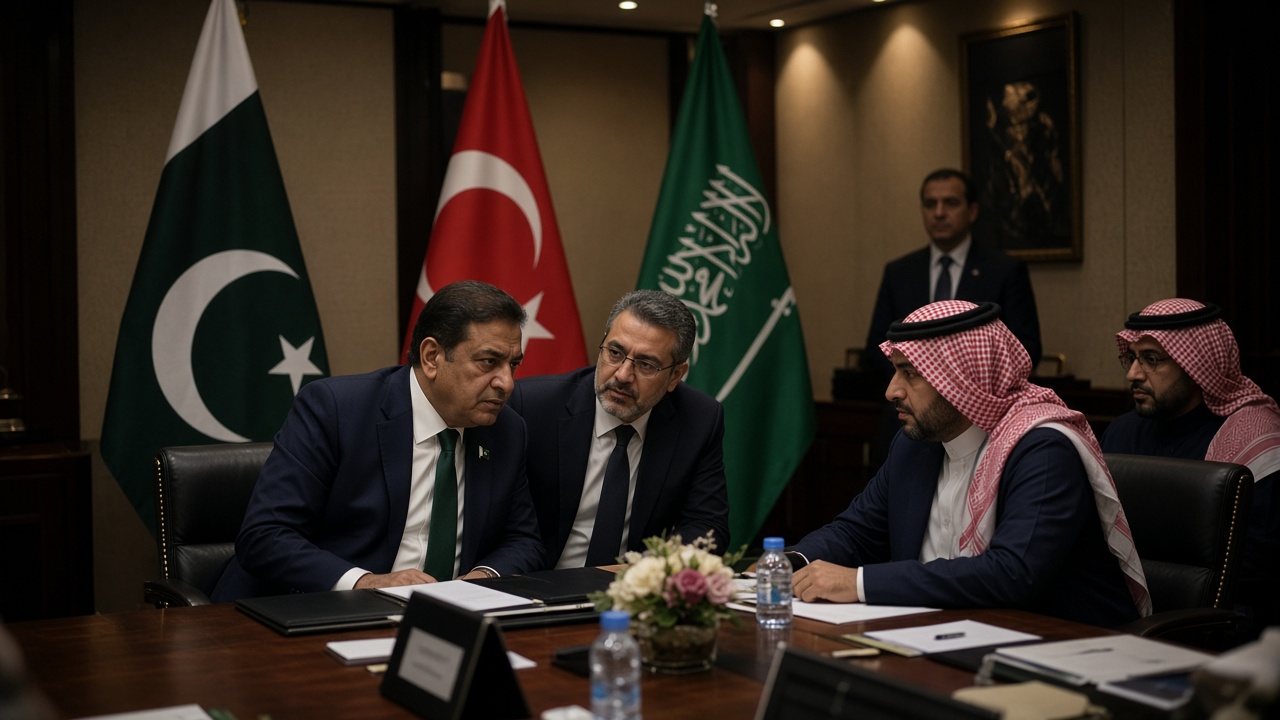
Pakistan and Turkey pledged on Monday to send troops to Saudi Arabia under the Mecca defense pact signed in August, activating a mutual-assistance clause after weeks of Houthi cross-border attacks and a sharp expansion of fighting inside Yemen. Representatives of the three governments met in Riyadh as loud explosions were reported in the capital and a Houthi spokesman said the group had hit King Khalid International Airport, an Aramco refinery in Rabigh and other sites in the kingdom’s south.
What the pact commits
The joint statement from Saudi Arabia, Pakistan and Turkey did not spell out troop numbers or missions. It said the parties agreed “to take the necessary measures to provide the agreed military forces and capabilities and ensure their rapid deployment in the Kingdom.” The arrangement grew out of an August signing in Mecca that binds the three states to come to one another’s aid if attacked.
For Riyadh, the timing is acute. Iran-backed Houthis have resumed strikes on Saudi energy infrastructure and declared a maritime blockade on Saudi shipping as they battle the internationally recognized Yemeni government. A Saudi energy-sector source told AFP that an attack on Sunday had again halted pumping on the East-West pipeline to the Red Sea, a critical export route while tensions over the Strait of Hormuz have already tightened global supply.
Fighting on two fronts
Inside Yemen, the Saudi-backed coalition said 100 warplanes flew dawn sorties on Monday and that naval forces struck Houthi targets in Hodeida, including weapons depots and booby-trapped boats. Coalition spokesman Turki Al-Malki said on X that the strikes thwarted a planned attack on southern Red Sea waterways. The Yemeni military said it carried out more than 1,000 strikes and opened an offensive toward Houthi-held Sanaa while pro-government forces advanced along the Bab al-Mandeb coast toward Mocha.
Houthi claims about damage in Riyadh and at Aramco facilities could not be immediately verified. Saudi authorities and Aramco did not immediately comment on Monday’s assertions. The group had seized large stretches of Red Sea coastline last month in Yemen’s deadliest fighting in years, raising alarms about oil and cargo traffic through Bab al-Mandeb.
Markets and diplomacy
The wider Middle East war has already lifted crude prices. Speaking in London on Monday, Saudi Aramco chief executive Amin Nasser warned that global oil inventories were “scarily thin” and that “the system is already straining.” UN Secretary-General Antonio Guterres said through a spokesman that he was “deeply concerned by the sharp escalation in fighting” and condemned continued Houthi cross-border attacks on Saudi Arabia.
Yemen’s civil war predates the current regional conflict, but UN figures cited by diplomats show more than 184,000 people displaced in recent weeks as the 2022 ceasefire collapsed in July. Pakistan and Turkey had already condemned earlier Houthi strikes on Saudi holy sites; Monday’s deployments mark the first public move to put the Mecca pact’s military language into practice rather than issue statements alone.
What comes next
Analysts in Gulf capitals will watch whether foreign troops deploy to air-defense, port security or advisory roles, and whether Houthi leaders treat the move as a deterrent or a provocation that widens the war. For shipping insurers and Red Sea carriers, the immediate question is whether coalition gains near Mocha reopen lanes the Houthis have threatened, or whether retaliatory strikes keep the East-West pipeline and export terminals on high alert through the week.