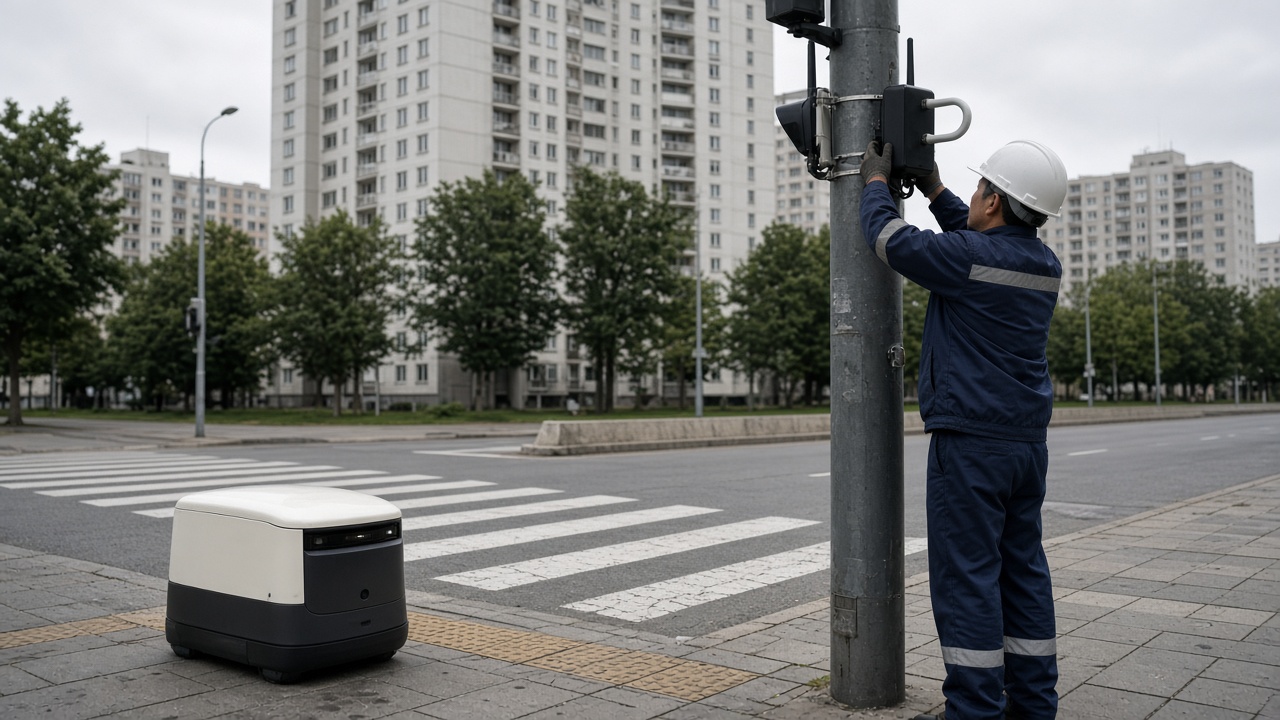
Singapore’s Land Transport Authority is preparing a pedestrian crossing in Punggol Digital District with radio-frequency identification gear so autonomous robots can legally trigger green-man signals before they roll across traffic lanes. The move is part of a broader trial that will eventually put food-delivery and security patrol bots on public paths—and forces regulators to solve a mundane problem first: how a machine presses the button.
How the crossing would work
In response to questions from The Straits Times, LTA said it plans to install RFID antennas at a signalised crossing in the district. Delivery and patrol robots participating in the trial would carry RFID tags; when they approach the junction, the tag would wirelessly activate the pedestrian phase so the machines can cross with the same protection as walkers. The authority did not name the exact intersection but tied the hardware to ongoing work in Punggol Digital District, which the government has billed as the country’s largest smart-robotics test bed.
The concept is narrower than full vehicle autonomy on open roads. Robots would still be confined to approved routes and low speeds, but they would no longer depend on human minders to hit crossing buttons at every kerb. That detail matters because eight companies—including Grab and DHL—have signed on to automate cleaning, patrolling and food delivery in the district, with large-scale trials targeted to start by the end of 2026.
Safety rules attached to the trial
LTA said each robot must pass safety assessments before deployment, travel at low speed and remain highly visible, including by emitting light signals. Operators must keep authorised personnel monitoring the fleet, and routes require approval. The authority stressed that expansion beyond Punggol would depend on trial outcomes and operational needs, leaving open whether RFID-assisted crossings become a national template or a one-off fix for a waterfront township built around tech tenants.
For residents, the near-term impact is mostly signage and pilot traffic: a handful of crossings may cycle more often as bots test the RFID link. For logistics firms, a reliable crossing trigger is a gating item. Without it, last-metre delivery robots would stall at every major road, undermining the economics of autonomous handoffs from central kitchens or parcel hubs in the district.
Who is involved
The October disclosure builds on a May announcement that eight firms would collaborate with agencies on district-wide robotics trials. Grab and DHL declined to add detail when contacted by the newspaper, but both names signal that consumer-facing delivery—not only industrial cleaning—is in scope. Government technology planners have pitched Punggol as a live environment where startups and multinationals can stress-test urban bots under Singapore’s strict road rules.
RFID is a deliberate choice over computer-vision-only crossing detection. It gives the traffic controller a binary, auditable signal that a registered trial unit is present, which simplifies liability if a pedestrian and a robot arrive at the same time. LTA did not say whether audio or tactile cues for visually impaired residents would be adjusted during robot-heavy periods, a point accessibility advocates often raise when new automatic phases are added.
What comes next
Engineering work on the antennas is underway; LTA has not published a completion date. Once the crossing is live, operators will need to certify that their tags interoperate with the traffic-light controller and that fail-safe behaviour—such as stopping if the signal does not change—is built into fleet software. Only then can the end-2026 trials move from warehouse demos to curbside meal runs and security loops that cross real arterials.
If the Punggol pilot succeeds, other new towns with similar digital districts may ask for the same RFID layer. If it stumbles, Singapore still learns whether autonomous logistics can coexist with signalised junctions without rewriting the Highway Code. For now, the city’s robot ambitions hinge on a humble upgrade at a single crossing: letting a delivery bot legally ask for the green man.