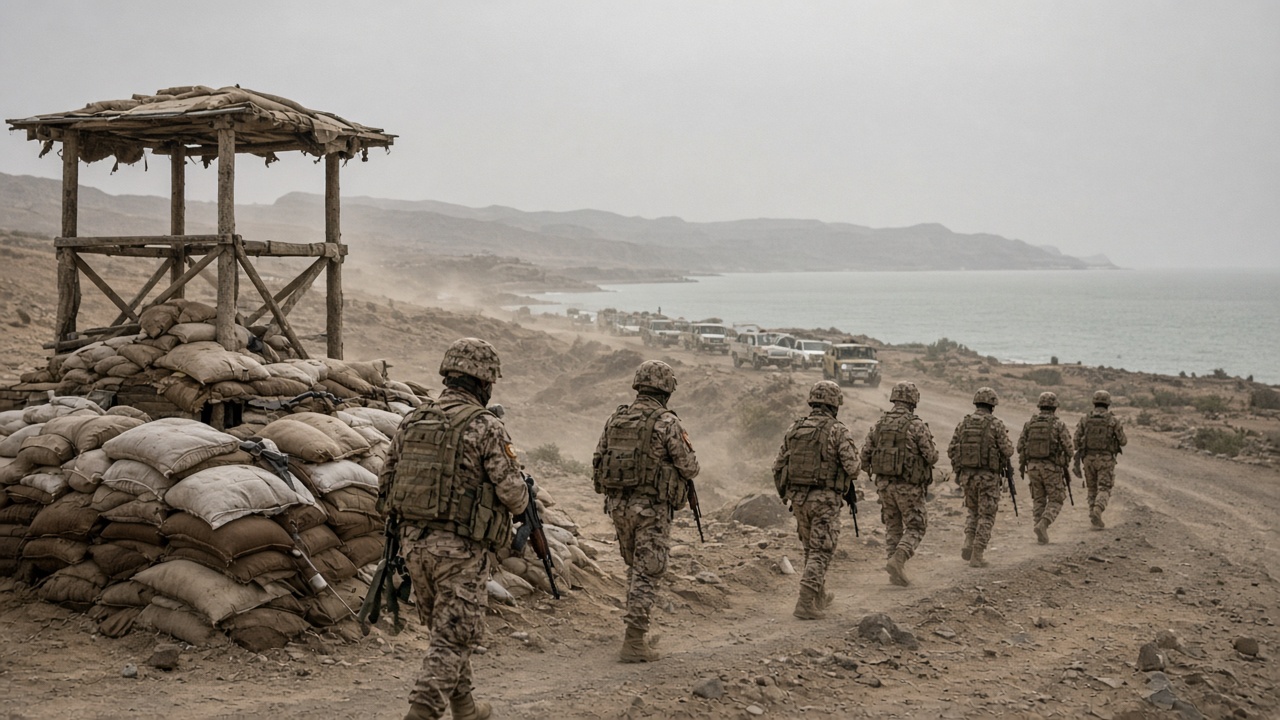
Yemen’s internationally recognised army said on Monday that it had reclaimed the Dhubab district and positions overlooking the Bab al-Mandeb strait, the latest claim in a widening push against Iran-aligned Houthi fighters after Rashad al-Alimi opened a major offensive on Sunday.
The Saudi-backed military said Homeland Shield Forces and Giants Brigades units advanced under air cover, seizing ground that an army source told state news agency Saba cut supply routes toward the waterway. A separate announcement later in the day claimed a “strategic offensive” toward Sanaa, the capital the Houthis have held since 2014. Al Jazeera could not independently verify the battlefield accounts.
What commanders say changed
The Dhubab claim follows mid-September Houthi gains near Mocha and islands in the strait, which sits between the Red Sea and the Gulf of Aden and carries a large share of global shipping traffic. Anti-Houthi forces had largely stabilised those lines before al-Alimi, who chairs Yemen’s Presidential Leadership Council, ordered the new operation.
Brigadier General Majid Abdullah Al-Nuzaili said on Sunday that government forces had launched 1,122 strikes across several provinces, using aircraft, drones, missiles and artillery. He claimed 1,747 Houthi fighters were killed in those attacks, a figure that could not be corroborated from outside the theatre.
Coalition air cover and the strait
Shortly after Monday’s ground announcement, the Saudi-led coalition said an air campaign was under way. Spokesman Major General Turki al-Maliki told reporters that 100 fighter jets were supporting Yemeni forces and that the coalition had secured “air protection” of the Bab el-Mandeb strait while hitting hundreds of Houthi targets. He did not specify which bases or munitions were used.
The coalition intervened in 2015 after the Houthis seized Sanaa and forced the recognised government toward Aden. A truce framework collapsed in July, and fighting since mid-September has displaced civilians along fragmented front lines. Aid agencies have warned that expanded operations could deepen hunger in a country already facing one of the world’s worst humanitarian crises.
Diplomacy in Riyadh
The battlefield moves coincide with Pakistani Deputy Prime Minister and Foreign Minister Ishaq Dar’s arrival in Saudi Arabia for talks under the Mecca Joint Defence Agreement signed in August by Riyadh, Islamabad and Ankara. Pakistan’s foreign ministry said Defence Minister Khawaja Asif and army chief Asim Munir would join Monday’s meeting with Saudi and Turkish counterparts.
Dar said last week that the talks would also examine a proposal for political engagement with the Houthis as an alternative to military action, following an approach by Iran. Tehran’s foreign minister, Abbas Araghchi, said separately that there was “no military solution” to the conflict with the United States while insisting Iran remained ready to return to war if attacked. Al Jazeera correspondent Michael Appel said the Yemen war was expected to dominate the Riyadh agenda even as civilians remain trapped between shifting front lines.
What comes next
Independent verification of territorial control near Bab al-Mandeb typically lags by days, and both sides have historically contested each other’s maps. Shipping insurers and Red Sea carriers will watch whether coalition claims translate into fewer Houthi missile or drone launches toward commercial lanes. For the recognised government, holding Dhubab would mark a rare coastal gain after September’s Houthi push; for the Houthis, any loss near the strait would threaten revenue from ports and smuggling routes they rely on to sustain long-range strikes.
United Nations envoys have not announced a new ceasefire track since the July breakdown. Humanitarian workers in Aden and Taiz said Monday that field hospitals were bracing for additional casualties if the Sanaa-directed offensive intensifies, though patient loads had not yet spiked in reports reaching aid coordinators by midday in the Gulf.