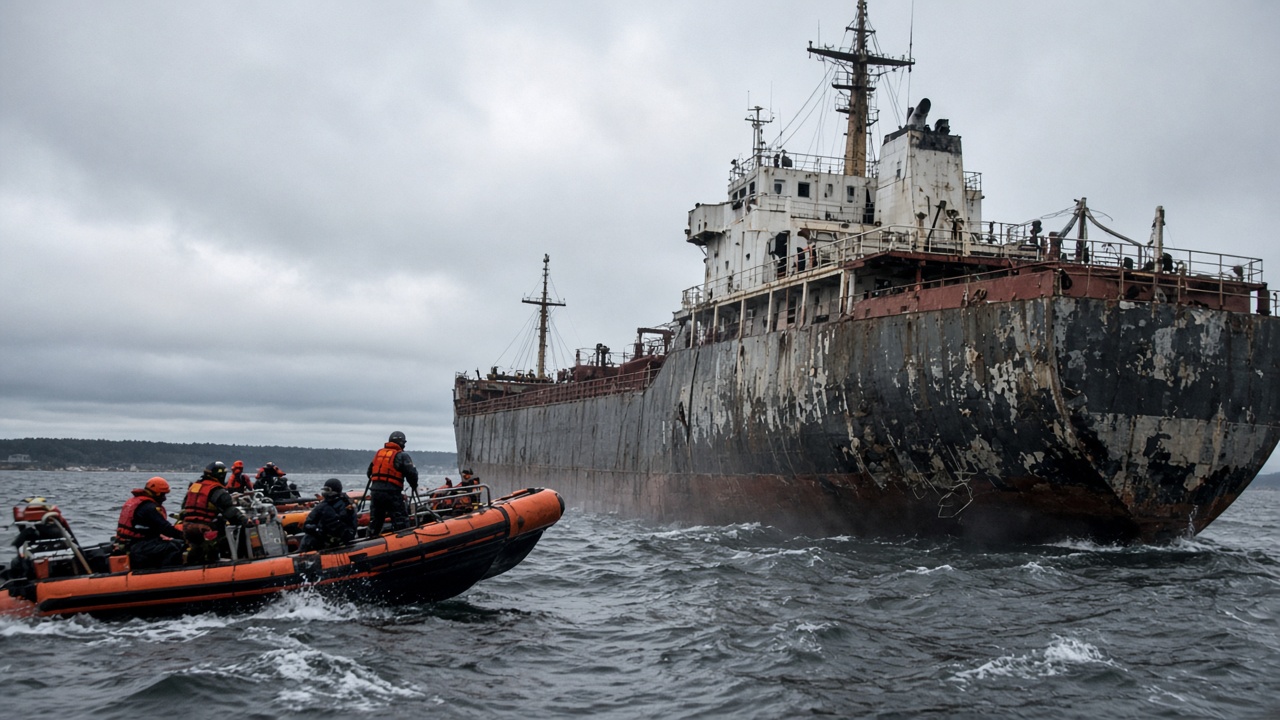
Drone strikes hit two commercial ships in the Black Sea off Bulgaria early Tuesday, sinking one vessel and leaving its crew missing while 18 sailors from a second ship were rescued with injuries, Sofia said as Prime Minister Rumen Radev convened an emergency government meeting.
Radev was scheduled to open the session with a public statement at 11:15 a.m. local time after what Bulgarian officials and shipping trackers described as the first reported attack on merchant traffic inside the NATO member’s maritime zone since the wider Black Sea shipping crisis intensified.
Two ships, one sunk off Varna
Public broadcaster BNR quoted Rumen Nikolov, who leads rescue operations in the port city of Varna, as saying crews from the sunken ship were still unaccounted for while survivors from the other vessel had been pulled from the water.
Maritime.bg identified the lost hull as the Togo-flagged Alfa Watan and the damaged ship as the Palau-flagged Able. According to the site, a fire broke out aboard the Able after the strike, prompting all 18 crew members to abandon ship. They were taken aboard the Bulgarian ferry Dioscuria; some arrived with injuries, Nikolov said.
Ship-tracking data cited by Euronews showed the Alfa Watan sailing under Togo’s flag toward Romania’s port of Sulina. Its last reported position, shortly after 1 a.m. Tuesday, was roughly 70 nautical miles off Bulgaria’s coast.
Origin still unknown
Bulgarian authorities have not publicly attributed the drones. Maritime.bg and government statements stressed that investigators had not yet established where the weapons were launched or who controlled them.
The strikes landed one day after a separate drone attack on a Turkish-owned grain carrier in the Black Sea. That vessel caught fire and ultimately sank, with Romanian-led rescue efforts coordinating the response. Together, the incidents extend a pattern of long-range strikes against civilian hulls that has shadowed grain corridors and insurance markets across the sea since the war in Ukraine widened attacks on ports and export routes.
NATO coastline, rising pressure on insurers
Bulgaria’s Black Sea coastline sits inside the alliance’s eastern flank, and any strike on shipping inside its exclusive economic zone carries political weight beyond the immediate rescue operation. Alliance officials in Brussels have repeatedly warned that repeated hits on commercial traffic raise the cost of cover and can reroute cargoes away from smaller states that lack deep salvage capacity.
Varna, Bulgaria’s largest maritime gateway, is now hosting both the search for missing crew and the forensic work needed to trace debris and flight paths. Until Sofia publishes a fuller account, shippers face another day of uncertainty about whether the Black Sea’s western approaches remain a viable lane for bulk carriers.
What happens next
Radev’s emergency council is expected to coordinate with naval commanders and transport ministries on salvage rights, victim support and any request for allied intelligence sharing. Diplomats said Bulgaria would also need to brief NATO envoys quickly if evidence points to a cross-border launch.
For now, the immediate task is human: account for the Alfa Watan crew, treat the injured sailors from the Able, and keep other vessels in the area clear of drifting wreckage. Secondary questions—who fired, and whether Bulgaria will seek enhanced air-defence cover for its offshore lanes—will follow once investigators finish their first pass through radar logs and recovered fragments.