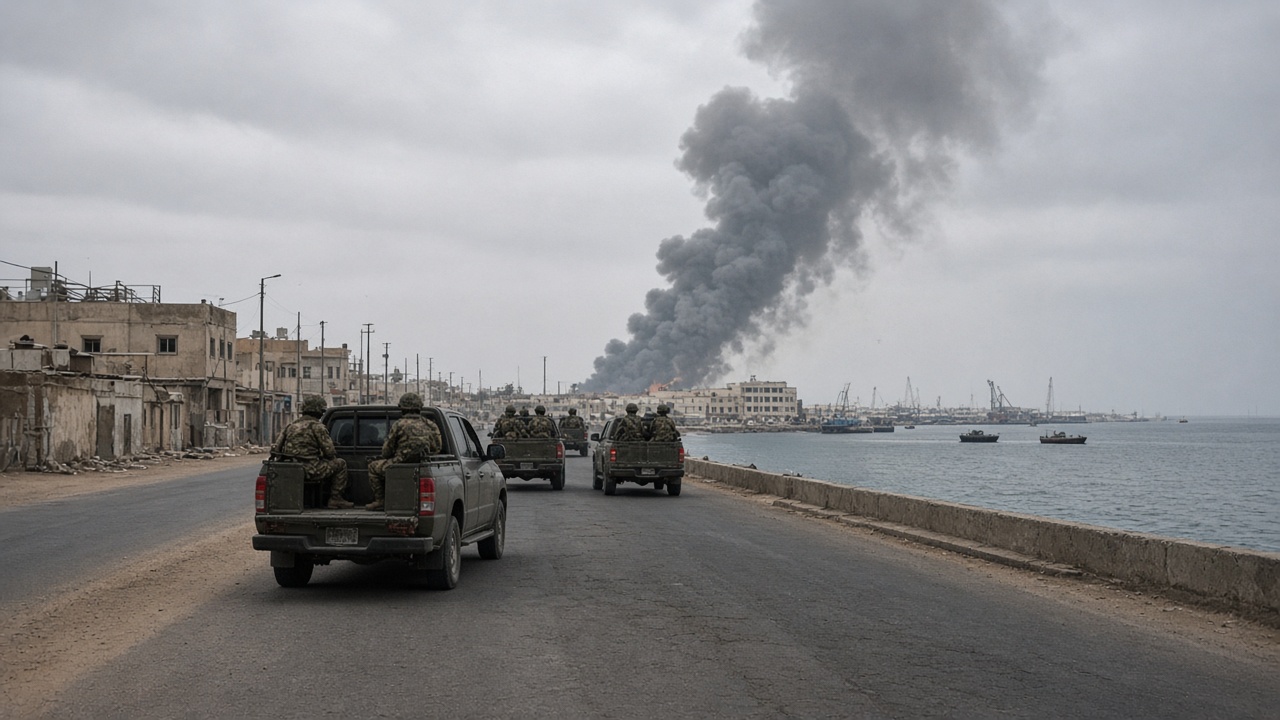
Forces aligned with Yemen’s internationally recognized government said Tuesday they had retaken Mokha, a Red Sea port that sits on one of the shortest paths between Gulf crude exports and European markets. The advance came under Operation Yemen Dawn, which Saudi officials said involved roughly one hundred coalition aircraft supporting ground units pushing north toward the Bab el-Mandeb strait.
Euronews and CNBC, citing Yemeni military statements and regional officials, described the capture of Mokha’s waterfront as a bid to loosen the Iran-backed Houthis’ grip on shipping lanes that insurers and charterers have watched nervously since the wider Middle East war spread beyond Iran in February. The port had changed hands repeatedly during Yemen’s long civil conflict; holding it again gives Aden-based authorities a foothold closer to the choke point where the Red Sea meets the Gulf of Aden.
Ground push and air cover
Reporting from the coast on Monday showed Yemeni reinforcements moving along the road between Aden and Mokha as strikes hit Houthi positions near Dhubab, just north of the strait. Saudi-backed commanders framed the operation as the largest coordinated offensive since a four-year ceasefire collapsed, reviving a war that had largely frozen even as fighting elsewhere in the region intensified.
The United Nations said Secretary-General António Guterres was “deeply concerned by the sharp escalation in fighting” and condemned continued Houthi cross-border attacks on Saudi Arabia. The World Health Organization put recent violence at 959 dead and more than 4,200 wounded, with about 174,000 people displaced inside Yemen and more than 3,000 fleeing across the water to Djibouti, according to agency tallies cited in regional coverage.
Strikes across the kingdom
While ground units pressed the coast, the Houthis claimed a separate barrage against Saudi infrastructure. Spokesman Yahya Saree said drones, ballistic missiles and cruise missiles targeted King Khalid International Airport in Riyadh, an Aramco refinery at Rabigh and military sites across southern Saudi Arabia. Saudi Arabia’s General Authority of Civil Aviation confirmed attacks on airports in Jazan and Najran on Monday evening, reporting three light injuries and limited damage.
The dual narrative—government gains near the strait and Houthi long-range fires into the kingdom—mirrors the risk traders have priced into Brent crude, which traded near one hundred dollars a barrel Tuesday even as contracts slipped slightly in morning sessions. Any sustained disruption near Bab el-Mandeb or the Persian Gulf would ripple quickly through tanker schedules that had only begun to stabilize after months of rerouting.
Allies and deterrence pledges
Foreign and defence ministers from Pakistan and Turkey agreed with Saudi Arabia on Monday to deploy military forces under mutual defence arrangements and to activate what Riyadh called “deterrence measures” against Houthi attacks. The pledges land in a week when a tanker in the Strait of Hormuz reported an engine-room fire after an unknown projectile strike, according to the United Kingdom Maritime Trade Operations centre, which warned vessels to transit with caution.
Washington’s war against Iran and its partners has already pulled in bases from Gloucestershire to the Gulf. Tuesday’s Mokha headline does not by itself reopen Hormuz or the Red Sea to normal traffic, but it marks a deliberate attempt to contest Houthi control of the western Yemen coast at the moment Riyadh is absorbing hits on its own airports. Diplomats will watch whether the offensive can hold territory without triggering another cycle of reprisals that keeps oil above triple digits deep into the northern hemisphere winter.