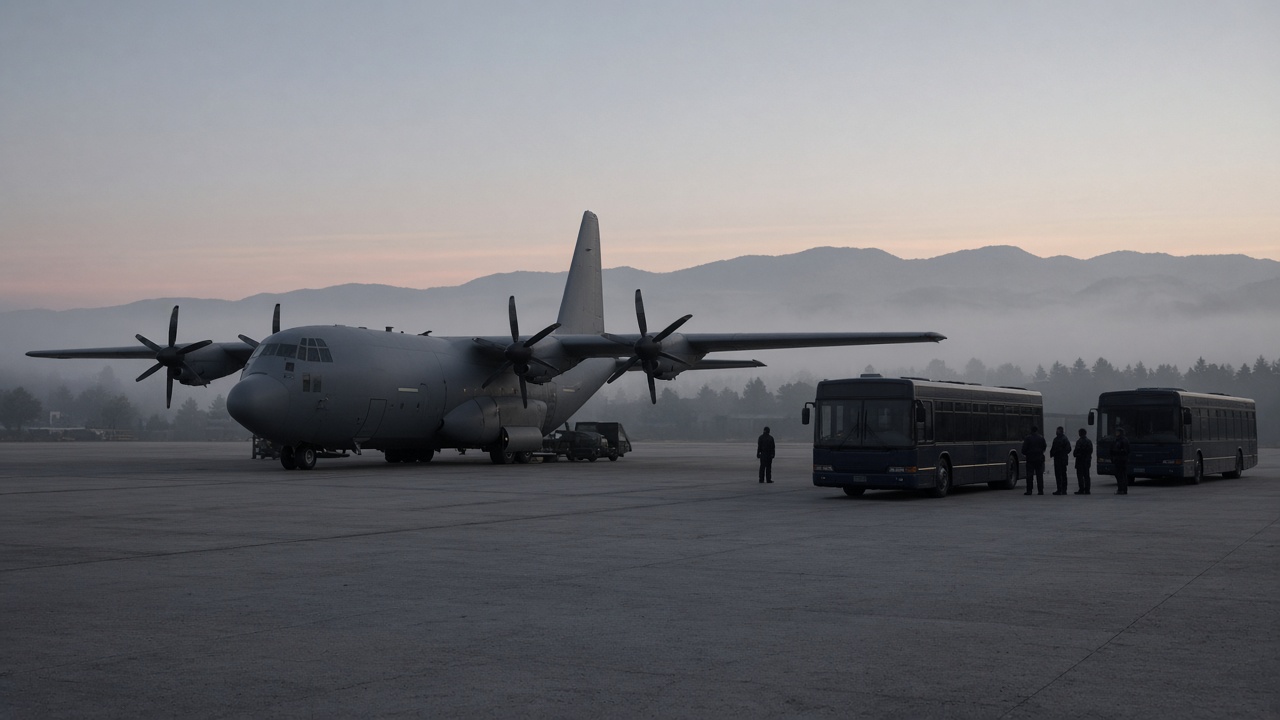
Indian authorities on Monday airlifted 150 Bangladeshi nationals from a holding camp in Jammu and Kashmir to West Bengal’s Bagdogra airport, the first batch in a deportation drive that officials say could eventually remove about 600 people identified as staying illegally in the valley.
Police and civil administrators said the group was flown on a special Indian Air Force aircraft and handed to Border Security Force personnel for pushback across the frontier. Another 150 nationals are slated for removal on Tuesday, according to officials briefed on the operation.
How the survey worked
The Jammu and Kashmir administration told a high-level Union Home Ministry committee on demographic change that a joint survey with state police had located roughly 600 Bangladeshi citizens across multiple districts. Those individuals were consolidated at a Srinagar police-run camp before transport south, officials said.
The Home Ministry constituted the High-Level Committee on Demographic Change (HLCDC) earlier this year to map unauthorized migration in border states. Kashmir’s inclusion reflects longstanding anxieties in the Bharatiya Janata Party–led central government about shifting population patterns after the 2019 revocation of the region’s special constitutional status.
Human-rights groups have historically challenged mass deportations where detainees lack individualized hearings or access to legal counsel. Officials counter that the survey verified nationality documents and that Bangladesh has cooperated on readmission in prior cases, though Monday’s statement did not publish names or charges against individuals.
Security and politics
Using an IAF flight underscores both the remoteness of the valley and the sensitivity of moving large groups through civilian airports. Bagdogra, near the Siliguri corridor, is a standard staging point for BSF operations along the India–Bangladesh border in West Bengal and Assam.
Opposition parties in Srinagar have not yet mounted a coordinated response, but deportation waves often become fodder in Delhi’s assembly debates over citizenship law and the National Register of Citizens. The BJP has campaigned nationally on identifying “infiltrators,” while regional parties warn against profiling Bengali-speaking Muslims who hold legitimate Indian papers.
Monday’s operation lands the same week the Supreme Court is scrutinizing Election Commission procedures in a separate fight over voter rolls. The confluence keeps migration and citizenship at the center of India’s autumn political calendar even as six state by-elections proceed on Tuesday.
What happens next
Officials said the remaining detainees at the Srinagar camp would be moved in phased flights to avoid overcrowding at border transit points. The BSF typically coordinates with Dhaka through diplomatic channels before formal repatriation, a process that can take days if paperwork is disputed.
For Kashmir residents, the visible military logistics — air force transports over the Pir Panjal range — are a reminder that security policy and demographic enforcement remain tightly linked in a region still recovering from years of insurgency and heavy troop deployments.
The Union Home Ministry had not published a public headcount by late Monday, leaving local administrators to field questions about whether additional surveys are planned in Jammu division or Ladakh. Any expansion would likely require fresh HLCDC approvals and budget for detention facilities, steps that could draw court challenges if due-process gaps persist.