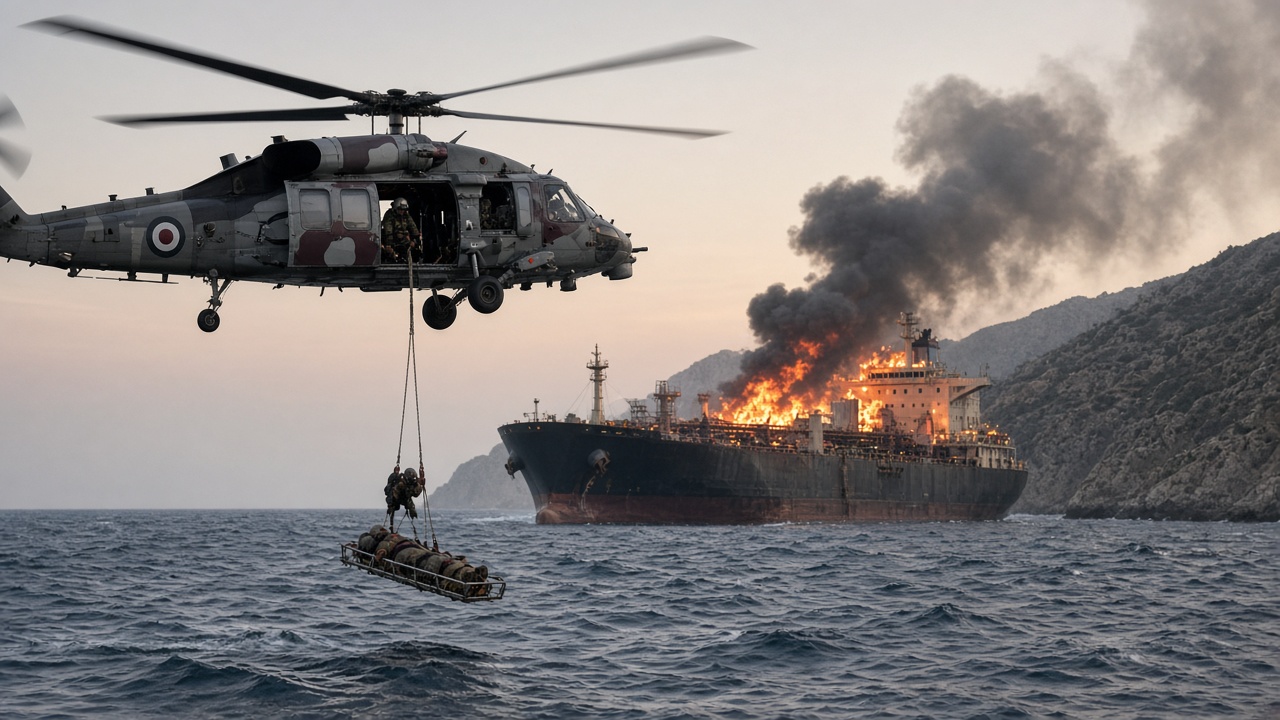
Oman's air force evacuated ten crew members from the Panamanian-flagged oil tanker On Peace on Tuesday after an attack left the vessel on fire in waters just off the country's Musandam peninsula, the Ministry of Defence said. The strike occurred about nine nautical miles from the port of Limah, at the mouth of the Strait of Hormuz, where commercial traffic has faced repeated security incidents since fighting involving Iran, Israel and the United States escalated earlier this year.
The ministry said injured sailors were flown to Khasab hospital in Musandam governorate and received treatment there. It did not identify the attacker or the weapon used. Shipping trackers and regional security officials have treated the episode as part of a wider pattern of projectile and drone incidents against merchant vessels transiting one of the world's busiest energy corridors.
What Oman and India reported
In a statement circulated on social media, Oman's defence establishment described a coordinated medevac once the fire aboard On Peace made continued care on board untenable. The vessel's operator had not issued a full public casualty accounting at the time of the evacuation, but India's Ministry of External Affairs said twelve of the nineteen crew members on board were injured when a projectile hit the ship, and that seventeen of the nineteen sailors were Indian nationals.
New Delhi said eleven of the twelve injured were Indian citizens. The ministry called continued attacks on shipping "a cause of deep concern" and repeated its appeal for an immediate halt to strikes on commercial traffic. Indian officials have been pressed at home to protect seafarers, who make up a large share of global merchant marine crews and have borne an outsized share of risk in the Gulf since insurance premiums and rerouting costs climbed.
The On Peace incident followed a string of reported approaches, boardings and hits in October alone. The United Kingdom Maritime Trade Operations centre, which advises shippers in the region, has logged multiple advisories this month warning masters to exercise extreme caution when operating east of the Strait of Hormuz.
Why the strait matters now
More than a fifth of the world's seaborne oil typically passes through Hormuz. When security incidents cluster, charterers delay sailings, war-risk insurance spikes and some owners divert cargoes around the Arabian Peninsula at higher cost and delay. Analysts tracking the market said Brent crude traded above $100 a barrel on Wednesday as traders priced in the latest tanker attack alongside missile exchanges elsewhere in the Gulf.
Iran has used its control over the strait in past crises, and the current war has revived fears that any single hit on a laden tanker could trigger environmental damage, crew casualties and a broader shutdown of transit. Oman has positioned itself as a neutral mediator in regional conflicts and maintains close security ties with both Western navies and Gulf Arab states; Tuesday's medevac highlighted Musandam's role as a first-response node when incidents occur close to Omani waters.
What happens next
Omani authorities did not say whether On Peace remained under tow, at anchor or awaiting salvage. Fire suppression and damage assessment will determine whether the ship can resume its voyage or must offload cargo. Investigators from the flag state, the owner and likely the ship's classification society will seek to document the strike site and preserve evidence for insurers and any future legal claims.
For the evacuated crew, the immediate priority is medical stabilization and repatriation once doctors clear them. India's consular network in the Gulf routinely handles such cases, and officials in New Delhi said they were monitoring welfare arrangements. Diplomats from other governments may join if additional nationalities are confirmed among the remaining crew still aboard or already ashore.
Commercial operators, meanwhile, will watch whether insurers widen exclusion zones or demand armed escorts for Hormuz transits. A single medevac off Limah does not by itself close the strait, but it adds to the ledger of attacks that shipping lines must weigh when scheduling October loadings from Gulf export terminals.