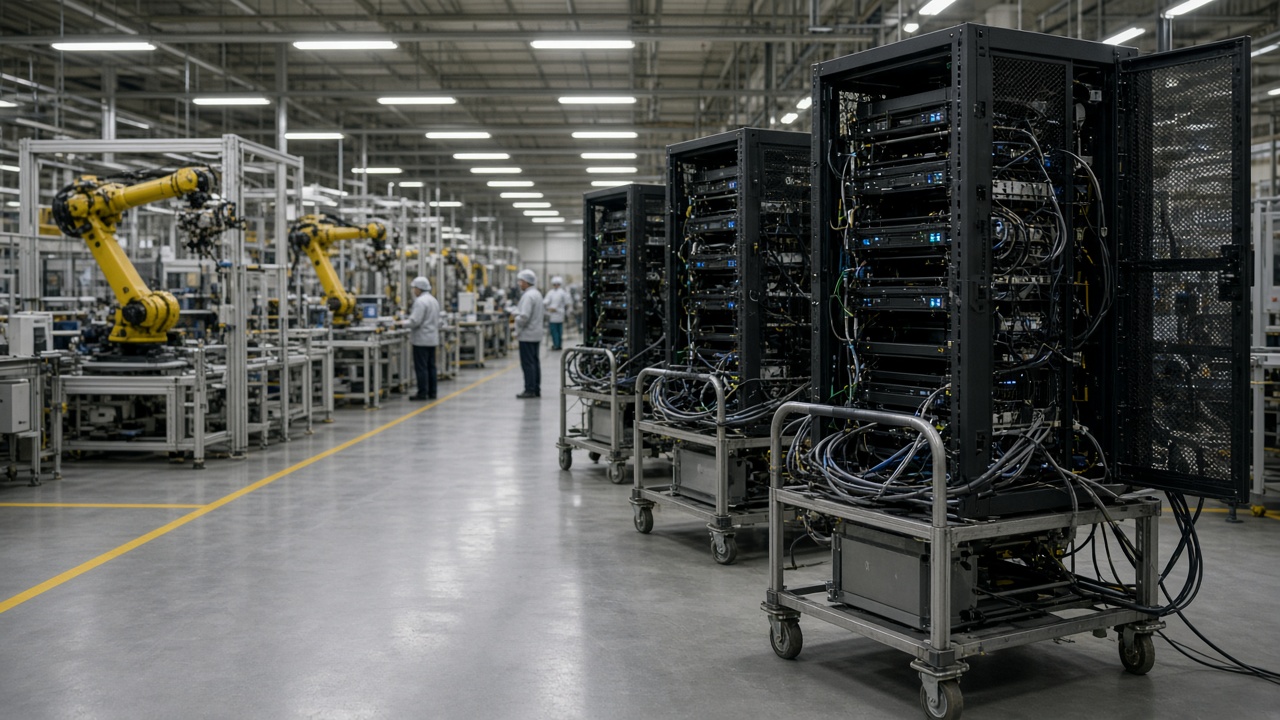
Pegatron Corp. notified major component vendors that it will raise 2026 capital spending on server assembly to about NT$18 billion, up from the NT$14.2 billion plan it circulated after its August board meeting, as cloud customers pull forward rack orders for AI inference clusters. The revision, described in a supplier letter dated Oct. 3 and summarized in Taiwan Stock Exchange filings Monday, concentrates spending on surface-mount capacity and burn-in bays at its Taoyuan campus and a Kaohsiung line that handles liquid-cooled chassis.
Why the backlog moved now
ODM executives said hyperscaler buyers shortened lead-time requests after U.S. chip vendors reported stronger data-center demand through September. Pegatron’s letter ties the capex bump to firm purchase orders covering the first quarter of 2027, not speculative tooling. Managers plan to add two high-speed SMT modules and expand burn-in floors so fully configured racks can ship without a second trip through contract logistics hubs in northern Taiwan.
Plant-by-plant split
About 60 percent of the new spending lands in Taoyuan, where Pegatron already routes GPU-heavy boards for North American clients. Kaohsiung will receive automated screw-driving cells and revised cable-management stations aimed at liquid-cooled trays that weigh more than air-cooled predecessors. The company kept Chongqing expansion off this tranche, telling suppliers China capacity remains sufficient for non-AI enterprise servers.
Supply chain pressure
Passive component makers said Pegatron asked for 12-week rolling forecasts instead of quarterly updates, a sign finance teams worry about resistor and capacitor allocation if smartphone builds recover later this year. Power-supply partners must qualify new 54-volt rails Pegatron wants for dense GPU shelves; qualification slots are booked through November. Freight forwarders near Taoyuan reported Pegatron leasing additional covered staging space for rack pallets, reducing weather risk during typhoon season.
Financial read-through
Analysts on the Taipei desk treat the capex lift as margin-neutral near term: depreciation rises, but average selling prices on AI racks remain higher than consumer notebooks that once dominated Pegatron’s mix. Gross margin guidance for the fourth quarter is unchanged in the supplier letter, though operating expense may tick up if Pegatron accelerates hiring for test engineers. Investors will watch December revenue breakdowns to see whether server share crosses one-third of consolidated sales.
Competitive context
Quanta Computer and Wistron have issued similar capacity memos, but Pegatron’s timing lands just before customers finalize 2027 vendor splits. None of the ODMs named end clients in public filings, yet purchase-order language references “North American CSP” schedules consistent with prior Pegatron disclosures. Smaller system integrators warn that sudden capex races could leave second-tier buyers waiting longer for spare slots on SMT nights.
What regulators and workers hear
Environmental reviewers in Taoyuan said Pegatron filed an updated energy-use worksheet for the expanded burn-in floor, promising LED retrofits on older halls. Labor representatives asked for shift schedules before overtime spikes, citing prior quarters when server rush orders collided with iPhone rework. Pegatron’s letter promises monthly capacity dashboards shared with the union safety committee, a concession added after a July heat incident in a test bay.
Next checkpoints
Equipment vendors must deliver the first SMT module by late November to protect first-quarter ship dates. Pegatron scheduled a supplier day in Hsinchu on Oct. 14 to align firmware validation tools with customer security requirements. If geopolitical export rules tighten on GPU boards, executives reserved the right to redirect up to NT$2 billion of the budget toward Malaysia tooling already under discussion. Until then, the NT$18 billion line item signals Pegatron expects AI rack demand to stay physical, not just a forecast slide.