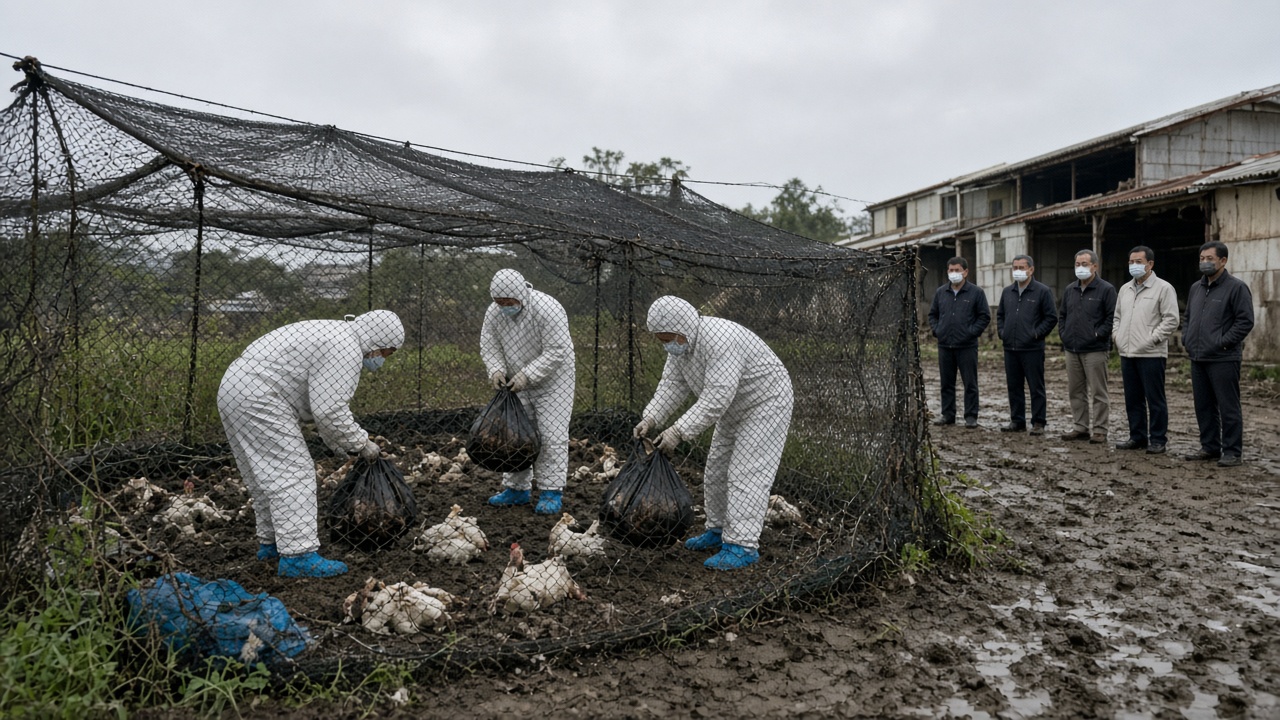
Taiwan’s agriculture ministry opened a national poultry emergency desk Monday after confirming a fifth highly pathogenic H5N6 avian influenza case and detecting the virus at a traditional-market vendor in Chiayi, extending a outbreak that began on eastern duck farms and has now reached western slaughter channels.
Monday’s confirmations
Council of Agriculture Minister Lin Tsung-hsien asked the Executive Yuan to stand up a level-one response center ahead of an afternoon coordination meeting, according to briefings reported by agricultural trade press. Before the session ended, officials said a black-bone chicken vendor in Chiayi had tested positive, marking the first market-level detection in the current wave.
Deputy Minister Chen Chi-chung said follow-up sampling of 2,500 forty-day-old ducklings at a farm linked to an earlier Hualien case also returned positive, bringing the confirmed count to five active detections in the cluster officials are tracking. A fifth positive tied back to Hualien ducklings found within one kilometer of a farm owned by a breeder already under investigation, the Animal and Plant Health Inspection Agency said.
Enforcement and compensation
After the meeting, Chen outlined four immediate lines of action: forward command posts in affected counties, higher culling compensation, tighter poultry transport and slaughter restrictions, and stepped-up raids on illegal private slaughter. Investigators are reviewing whether discarded ducklings near the Hualien farm were improperly disposed of; if proven, penalties could reach NT$5 million to NT$100 million under Taiwan’s animal disease laws.
Western Taiwan had already seen movement bans around Hualien and Yilan, with slaughter permitted only after negative tests inside five-kilometer zones. The Chiayi market hit raises the prospect of tracing frozen carcasses and vendor supply chains across county lines during the Lunar New Year poultry peak.
Human health monitoring
The Health Ministry said Monday that 89 people with exposure histories in Yilan, Hualien and Tainan remained under symptom monitoring and that none had shown signs of avian influenza infection. Earlier contact tracing around a Hualien duckling die-off cleared 244 people, while dozens more in Yilan and Tainan are scheduled to finish monitoring between mid-February dates officials listed over the weekend.
H5N6 is highly lethal in birds and has caused sporadic human cases in mainland China, making Taiwan’s dual-track veterinary and clinical surveillance politically sensitive even when no patients are identified.
Market and farmer impact
Poultry groups warned that repeated transport halts could squeeze supplies of native chickens and ducks while white-broiler lines—exempt from some September slaughter bans—continue to dominate supermarket shelves. Farmers in clouded-leopard country along the east coast argued that migratory-bird season makes open-house native flocks especially vulnerable.
The emergency desk is expected to publish daily case maps and enforcement tallies. Veterinarians will sequence new isolates to see whether the Chiayi and Hualien viruses match, a result that will determine how long nationwide movement curbs stay in force.