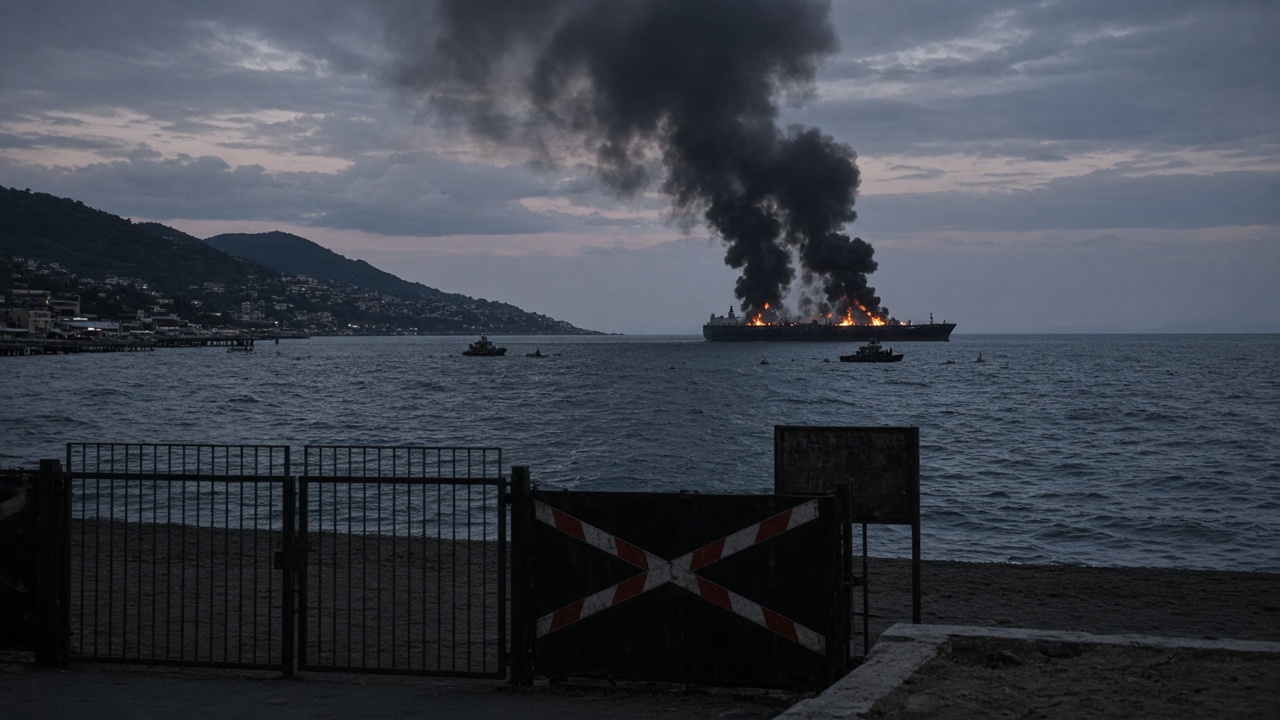
A Liberian-flagged oil tanker burned in the Black Sea within sight of Sochi on Tuesday evening after what Russia’s transport authority described as an assault by unmanned boats, sending a towering column of smoke over one of the country’s best-known seaside resorts while all 23 sailors aboard were brought ashore without reported casualties.
The Russian Transport Ministry identified the vessel as the Aframax Rio and said the crew consisted entirely of Indian nationals. In a Telegram post, the ministry said emergency teams would try to extinguish the blaze once the intensity dropped, and regional officials in the Sirius settlement reported that public beaches were closed as a precaution.
What Moscow reported
The ministry characterized the incident as a “gigantic fire of oil” and circulated imagery of bright flames on the horizon and thick black smoke drifting toward the Krasnodar coast. Social media users in Sochi, a city of nearly half a million people that hosted the 2014 Winter Olympics, shared similar videos from apartment balconies and promenades.
Russian authorities did not, in their initial statements, name a responsible party. Ukraine has repeatedly struck Russian energy infrastructure and maritime targets during the war, and President Volodymyr Zelenskyy posted photographs on Wednesday that he said showed a tanker fire near Sochi, though Kyiv did not immediately issue a formal claim of responsibility for this specific attack.
Same night as escalations on land
The tanker fire unfolded on the same calendar day as one of the war’s deadliest barrages against Ukrainian cities, with officials in Kyiv reporting more than 20 civilians killed in overnight missile and drone strikes, including a large death toll from an apartment block hit in Chernihiv region. Moscow said it targeted industrial and port facilities tied to Ukraine’s drone and missile production.
Simultaneously, Russian officials said air defenses intercepted nearly 900 Ukrainian drones aimed at regions including Moscow and occupied Crimea, while Ukrainian authorities reported fresh strikes on Zaporizhzhia and continued pressure on river crossings Kyiv relies on for daily commuting. Both capitals have warned in recent days that the tempo of long-range attacks is rising again after weeks of diplomacy that failed to produce a ceasefire.
Shipping risk in a narrowed sea lane
Commercial traffic in the Black Sea has been perilous since Russia’s full-scale invasion of Ukraine in 2022, with each side treating the other’s exports and fuel shipments as legitimate targets. Ukraine has framed attacks on Russian oil terminals and tankers as proportional responses to strikes on its power grid and residential blocks, while Moscow has hit grain carriers and port infrastructure along NATO’s southeastern flank, including near Romania.
Previous Ukrainian hits on southern Russian oil infrastructure have closed beaches, produced visible slicks and, in some cases, left residents reporting oily residue in rainfall. Tuesday’s blaze off Sochi adds a high-visibility maritime incident to that pattern at a moment when Zelenskyy says Kyiv is preparing countermeasures against another large Russian aerial campaign.
Rescue and next steps
With every crew member accounted for, the immediate humanitarian question is whether pollution spreads along the Krasnodar shoreline. The transport ministry’s timeline suggests firefighting at sea will wait until conditions allow safer approach. Insurers, flag-state inspectors and Indian consular officials will likely press for a damage survey once the hull cools.
For NATO members watching Black Sea security, the episode is another reminder that the conflict’s economic front extends beyond Ukrainian ports. Whether this fire becomes a confirmed Ukrainian operation or remains unattributed, it keeps commercial crews—many of them from South Asia—in the crosshairs of a war fought increasingly with drones and robotic boats as well as ballistic missiles.