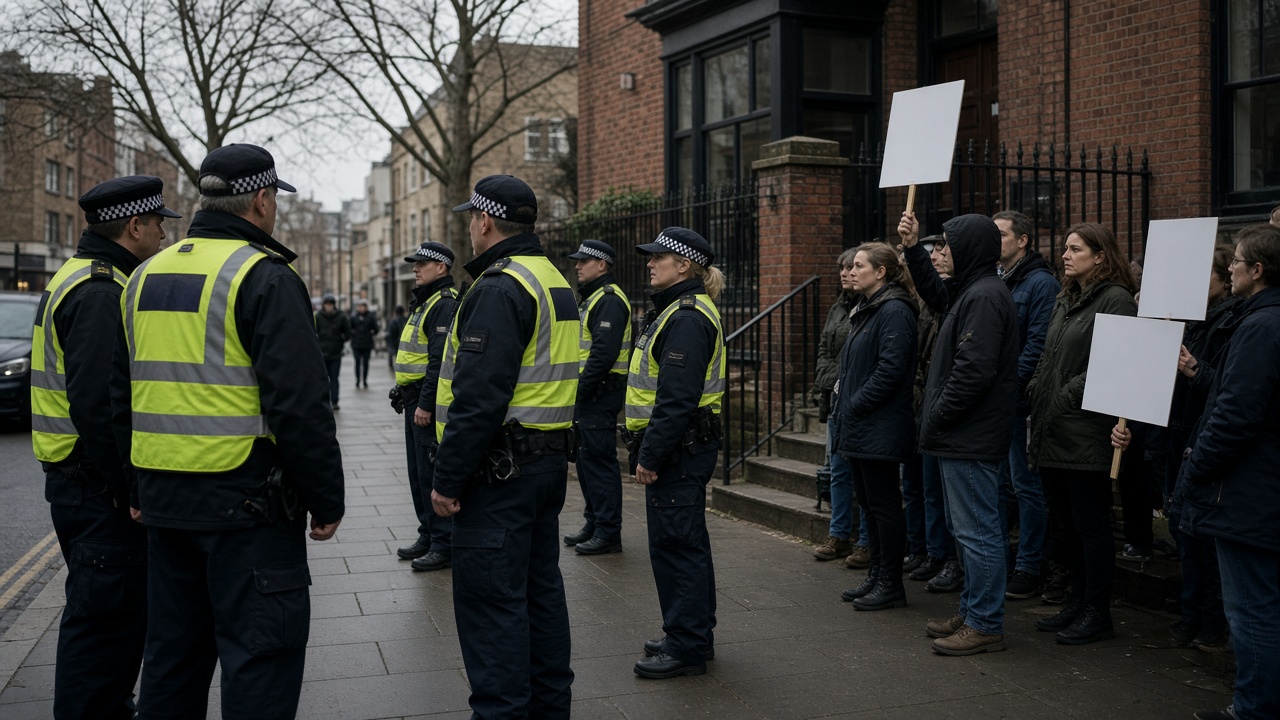
London police arrested five people on Wednesday on suspicion of inciting racial hatred after a protest formed outside the headquarters of the Board of Deputies of British Jews in Camden, the Metropolitan Police said, as the capital marked three years since the 7 October 2023 Hamas attack on Israel with competing demonstrations and heightened security.
The force described the gathering outside the community group’s offices as a “spontaneous protest” and said officers intervened when participants chanted slogans “calling for intifada.” All five remained in custody while detectives reviewed body-worn camera footage and witness statements. The Board of Deputies thanked police for a “swift” response and said the organisation “would not be threatened or intimidated.”
Anniversary tensions across the city
Wednesday’s arrests unfolded against a wider pattern of marches and vigils tied to the anniversary. Pro-Palestinian student coalitions marched through central London despite police requests that one University of London-organised route be cancelled; officers reported scuffles near Russell Square where counter-protesters carrying Israeli flags confronted marchers before being separated by lines of officers.
The Board planned its own vigil later on Richmond Terrace, near Whitehall, adding another focal point for security planners already managing road closures and intelligence briefings on possible flashpoints. Jewish communal groups had warned for weeks that anniversaries could bring both solemn remembrance and provocative slogans at unrelated protests.
Legal threshold and speech offences
Inciting racial hatred is a serious statutory offence in England and Wales, carrying potential prison terms when prosecutors prove intent or likelihood of stirring hatred against a racial group. Police did not name those arrested or specify ages, citing live inquiries. Legal observers note that chants referencing “intifada”—an Arabic term associated with Palestinian uprisings—have featured in prior arrests when combined with context suggesting encouragement of violence against Jewish communities.
Civil liberties groups often argue that policing speech at protests requires careful documentation because slogans can be interpreted differently by participants and by courts. The Met’s statement emphasised the location—a building housing the country’s largest elected Jewish representative body—rather than detailing every phrase heard on the pavement.
Community response
In its statement, the Board of Deputies framed the incident as an attempt at intimidation rather than legitimate political debate. It reiterated support for peaceful advocacy but drew a line at language it considers threatening to British Jews going about daily life. Other communal charities have similarly pressed politicians to distinguish between criticism of Israeli government policy and rhetoric they say normalises harm against diaspora Jews.
Pro-Palestinian organisers, meanwhile, contend that blanket bans on phrases silence political speech about occupation and resistance. That argument is unlikely to comfort neighbours who watched Wednesday’s standoff from Camden offices, where security staff locked doors while officers formed a cordon.
What investigators will examine next
Detectives must decide within custody time limits whether to charge, release under investigation or apply for extensions while digital evidence is recovered. Any charges would probably land in the Crown Court given the gravity of the allegation. Separately, public order teams will review whether additional conditions should be imposed on forthcoming marches this weekend.
For Londoners, the day underscored how the Middle East conflict continues to echo through British policing, university campuses and synagogue security budgets three years after the initial attack. With five people in cells and more demonstrations scheduled, Scotland Yard faces the familiar balance of keeping streets open while preventing incidents that could escalate into wider communal violence.