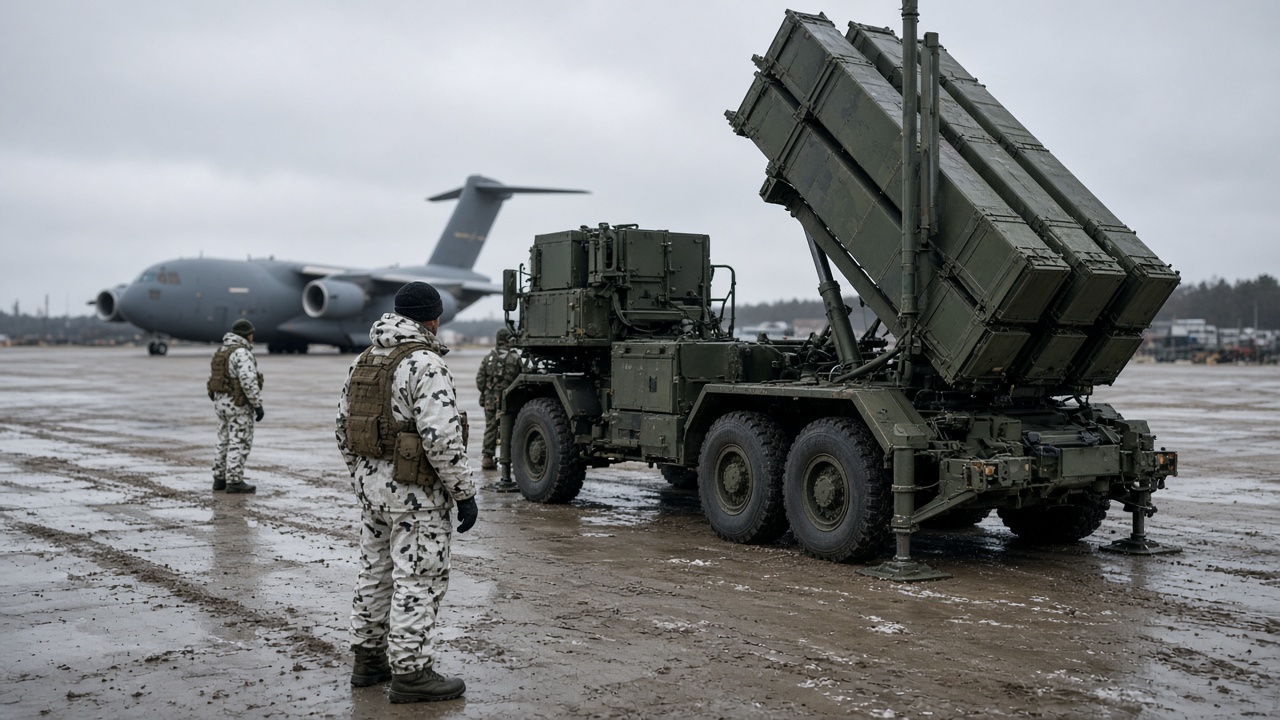
Sweden will deploy a Patriot air-defense battery and about 100 troops to southeastern Poland starting 1 December, the Swedish Armed Forces and government said Tuesday, in a mission aimed squarely at protecting the Rzeszów-Jasionka corridor that NATO uses to route weapons, vehicles, and humanitarian cargo into Ukraine.
Prime Minister Ulf Kristersson said Sweden is contributing advanced capabilities for the second time this autumn alongside Gripen fighters already flying NATO air-policing tasks over Poland. The Patriot detachment will operate under NATO Air Command as part of the alliance’s integrated air and missile defense, replacing a Dutch Patriot rotation that has been covering the same hub.
Why Rzeszów matters
Polish and Swedish officials describe the airport complex near Rzeszów as one of the busiest transshipment points for Ukraine-bound assistance. Swedish authorities estimate roughly 18,000 tonnes of equipment pass through the hub each month, and NATO planners say more than four-fifths of allied military donations to Kyiv cross Polish territory before reaching the front.
That concentration makes the site an attractive target. Swedish military leaders said this week that threats to the hub can come from the air—including drones and ballistic weapons—as well as from sabotage on the ground. Defense Minister Pål Jonson told reporters that repeated Russian efforts to disrupt Western support for Ukraine underscored why NATO allies are stacking layered defenses around the node.
What Sweden is sending
The deployment will be led by the Air Defence Regiment (Lv 6) with support from Blekinge Air Wing, according to the armed forces. The Patriot system is a long-range, road-mobile interceptor designed to engage aircraft, cruise missiles, and some ballistic threats; Sweden acquired its batteries after Russia’s 2022 full-scale invasion of Ukraine accelerated Stockholm’s rearmament program.
Government planners said the rotation is approved through the end of 2026, with preparations underway to extend into the first half of 2027 depending on the next administration’s budget decisions. Swedish public broadcaster SVT reported the mission could last up to seven months once the handover from the Netherlands is complete.
NATO’s eastern flank layering
Polish Deputy Prime Minister and Defence Minister Władysław Kosiniak-Kamysz welcomed the Swedish commitment and thanked the Netherlands for its prior coverage. Other systems already guard the area, including Polish short-range interceptors and additional NATO assets stationed after a series of drone incursions along the alliance’s eastern border this year.
Chief of the Swedish Army Johan Pekkari said allies share responsibility for defending NATO territory while keeping Ukraine supplied. “By deploying advanced capabilities from the Air Defence Regiment and Blekinge Air Wing, Sweden will strengthen NATO’s eastern flank in Poland while helping to protect the vital support effort for Ukraine,” he said in a statement.
What comes next
Swedish units will begin moving equipment and personnel in November so the battery can assume alert status when the December clock starts. NATO’s Security Assistance and Training for Ukraine structure will continue scheduling convoys through Rzeszów, and alliance officials said they expect Sweden’s Patriots to integrate with existing radar nets that track air traffic from Belarus and western Russia.
Kyiv has not commented on the deployment, but Ukrainian officials have repeatedly asked European capitals to harden logistics routes as Moscow steps up strikes on Ukrainian power infrastructure and Black Sea shipping. For Sweden, the mission is also a political signal: a once-neutral state now treating protection of Ukraine’s supply lines as inseparable from its own NATO obligations.