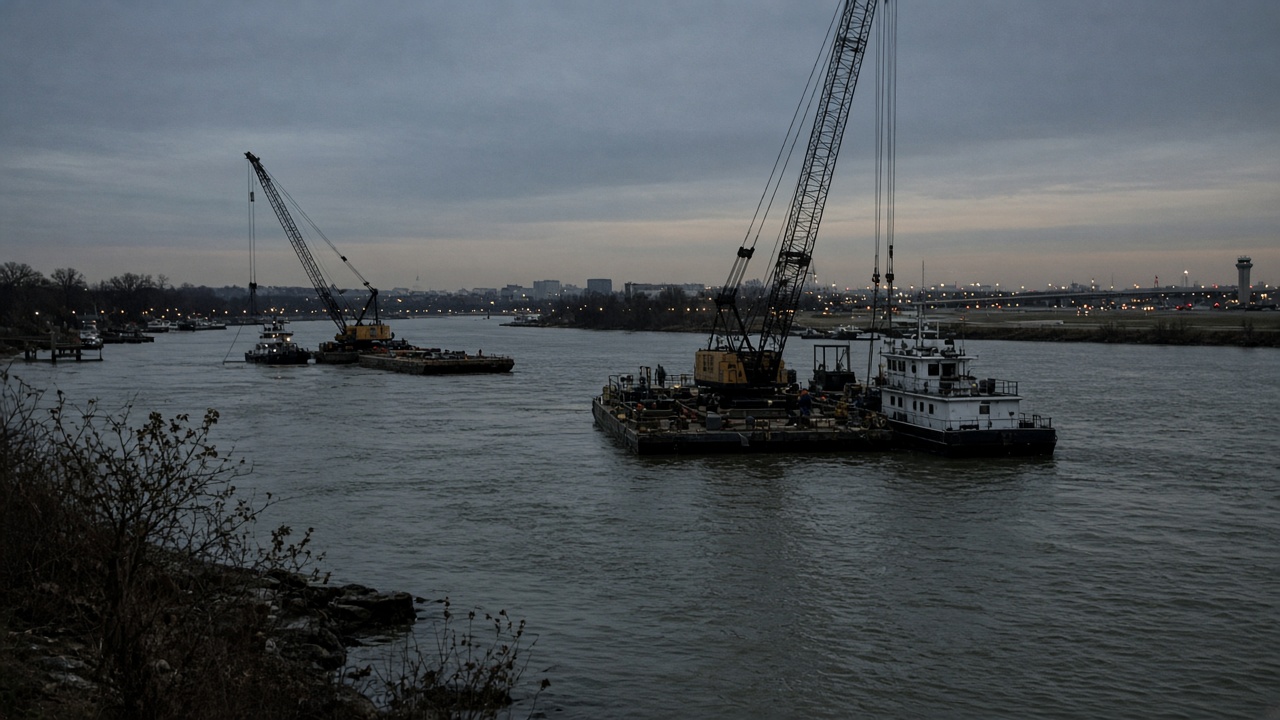
The U.S. Army on Thursday released a report it completed in May on the midair collision that killed 67 people near Ronald Reagan Washington National Airport, describing systemic breakdowns in air traffic control, helicopter routing, training and safety culture rather than a single pilot error.
The crash in January — when an Army Black Hawk helicopter struck an American Airlines regional jet on approach to the Potomac River runway — was the deadliest U.S. aviation disaster in more than two decades. Both aircraft fell into the icy river. The Army made the findings public after months of pressure from victims' families and as the National Transportation Safety Board continues to press federal agencies on open safety recommendations.
What the Army concluded
The report largely aligns with the NTSB's earlier work but assigns sharper blame to how military helicopters operated in crowded Washington airspace. Investigators said an air traffic controller could have prevented the crash by giving the helicopter crew more precise information about the descending jet and by warning the jet's crew about the helicopter. After the accident, the Federal Aviation Administration barred controllers from relying on pilots alone to maintain visual separation in the busiest sectors.
The Army also faulted its own practices. The helicopter route allowed as little as 75 feet of vertical separation from aircraft using a secondary runway if helicopters hugged the riverbank — a assumption the route did not require. That margin did not account for normal altimeter error; the NTSB found the Black Hawk was flying roughly 100 feet higher than its instruments indicated. Two failed radio transmissions further kept the helicopter crew from identifying the jet, the Army said, and night-vision goggles narrowed what the pilots could see against city lights.
Equipment and oversight gaps
The crashed helicopter's ADS-B Out system, which broadcasts position to other aircraft and controllers, had not been working for some time, the Army said. Since the accident, the service said it has inspected and reconfigured 3,585 helicopters, strengthened crew training and improved how it tracks safety risks with the FAA.
In a letter last week, the NTSB told the Army it was satisfied with progress on seven of eight safety recommendations tied to the crash — a contrast with the FAA, which has yet to implement roughly a third of recommendations aimed at the civilian regulator. The Army report urged a wider look at military helicopter flights over other major cities, including Los Angeles and the Seattle-Tacoma region; an Army official told reporters that review is ongoing.
Families and Capitol Hill
Relatives of those killed said the Army's account strengthens their push for legislation requiring technology that helps aircraft detect nearby traffic. The Families of Flight 5342 said in a statement that both the NTSB and Army investigations are complete and that "collision avoidance technology must be part of the solution." The House and Senate have passed separate aviation safety bills but have not reconciled them.
Tim Lilley, a former Army Black Hawk pilot whose son was first officer on the airliner, said redactions and broad assignments of responsibility left unanswered who allowed risks to persist. The Army said in a statement that it "recognize[s] the families' need for answers and remain[s] committed to transparency regarding the Army's review." Associated Press writer Konstantin Toropin contributed reporting from Washington.