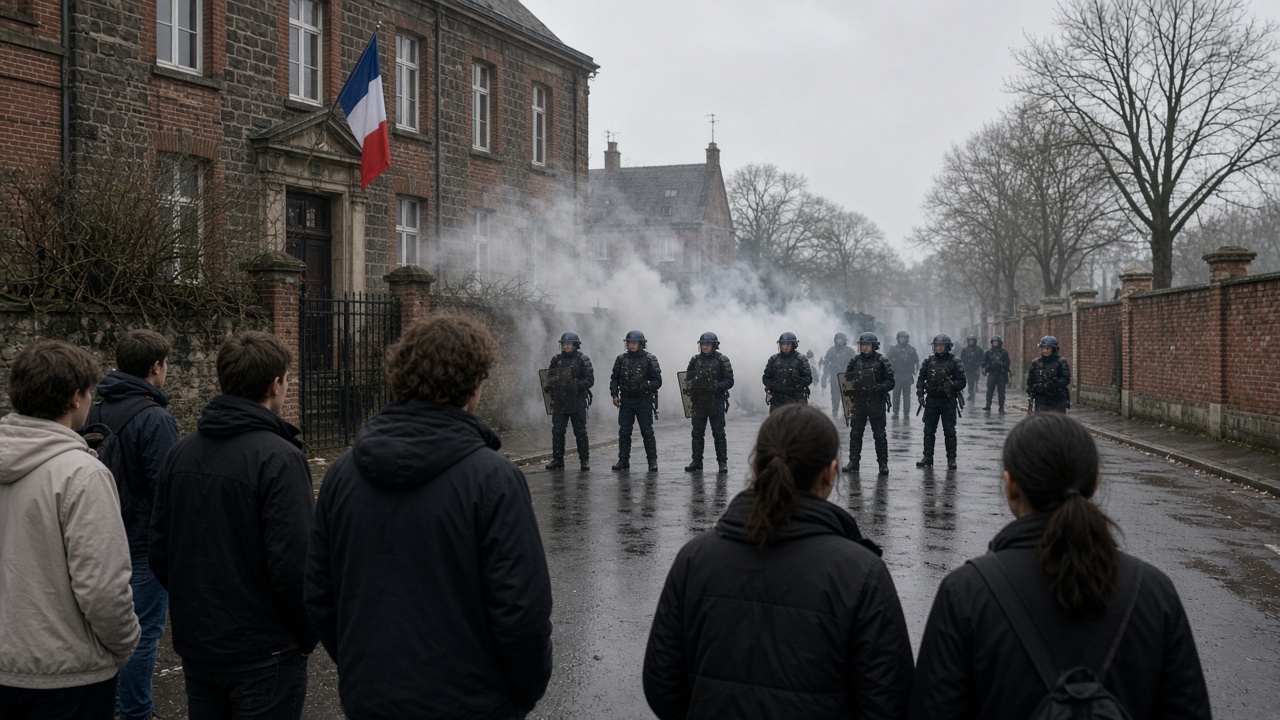
France’s interior minister ordered police to stop using stun grenades at high-school protests on Wednesday, two days after a 15-year-old boy lost his left hand during clashes outside the Auguste Béhal vocational lycée in Lens. Laurent Nuñez said the suspension would last until investigators clarify how an anti-encirclement grenade detonated on Monday afternoon.
What Nuñez changed
Speaking to RTL radio, Nuñez said he was pausing stun grenades “for the high-school students’ movement” only—not for all public-order policing—until the Lens facts are established. He told lawmakers the incident “raises questions for all of us” inside the Ministry of the Interior and confirmed 18 separate cases from the nationwide student mobilization have been referred to the police inspectorate.
The concession landed hours before Prime Minister Sébastien Lecornu addressed parliament on the protest wave, which has shut hundreds of campuses and drawn accusations of disproportionate force. Lecornu denied that security forces had orders to confront students, promising a government response plan by late October.
The Lens injury and competing accounts
Authorities say several hundred young people had gathered near Auguste Béhal on Monday when projectiles were thrown at riot police and bins were set alight. After warnings, CRS officers deployed multiple grenade types. The 15-year-old suffered amputation of his left hand and additional wounds to his right hand, face and chest; doctors say his life is not in danger.
Officials initially said the teenager picked up a grenade that then exploded. Students and family members counter that an officer fired directly at him. Video circulated on social media is now central to the IGPN inquiry, though investigators caution that footage alone may not settle whether he reached for the device.
French media identify the munition as likely a GM2L—a sound-and-tear-gas grenade that can scatter small rubber pellets. Stun grenades are classified as less-lethal, but rights groups have long argued their blast radius makes them risky in dense crowds.
Protests still spreading
The Lens case intensified a movement that began over education funding and campus conditions and has since absorbed broader anger at policing tactics. Unions, parents’ groups and some local officials joined students in condemning Monday’s injuries; a 14-year-old in northwest Paris separately lost several teeth this week after what protesters describe as a tear-gas canister fired at close range.
Nuñez’s partial ban does not cover other crowd-control tools, and neither he nor Lecornu committed to a permanent withdrawal. Opposition lawmakers are pressing for a full inventory of injuries since the walkouts began and for parliamentary hearings on protest doctrine.
What happens next
The IGPN must determine whether any officer committed a criminal offense and whether commanders followed rules on grenade selection and distance. Prosecutors in Lille are parallel-tracking the administrative probe. Student unions say demonstrations will continue unless the government meets funding demands; ministers hope the stun-grenade pause lowers temperatures while keeping other units on standby.
For Macron’s minority government, the timing is awkward: every new hospital image from Lens becomes a symbol in a dispute that is as much about trust in the police as it is about classroom budgets.