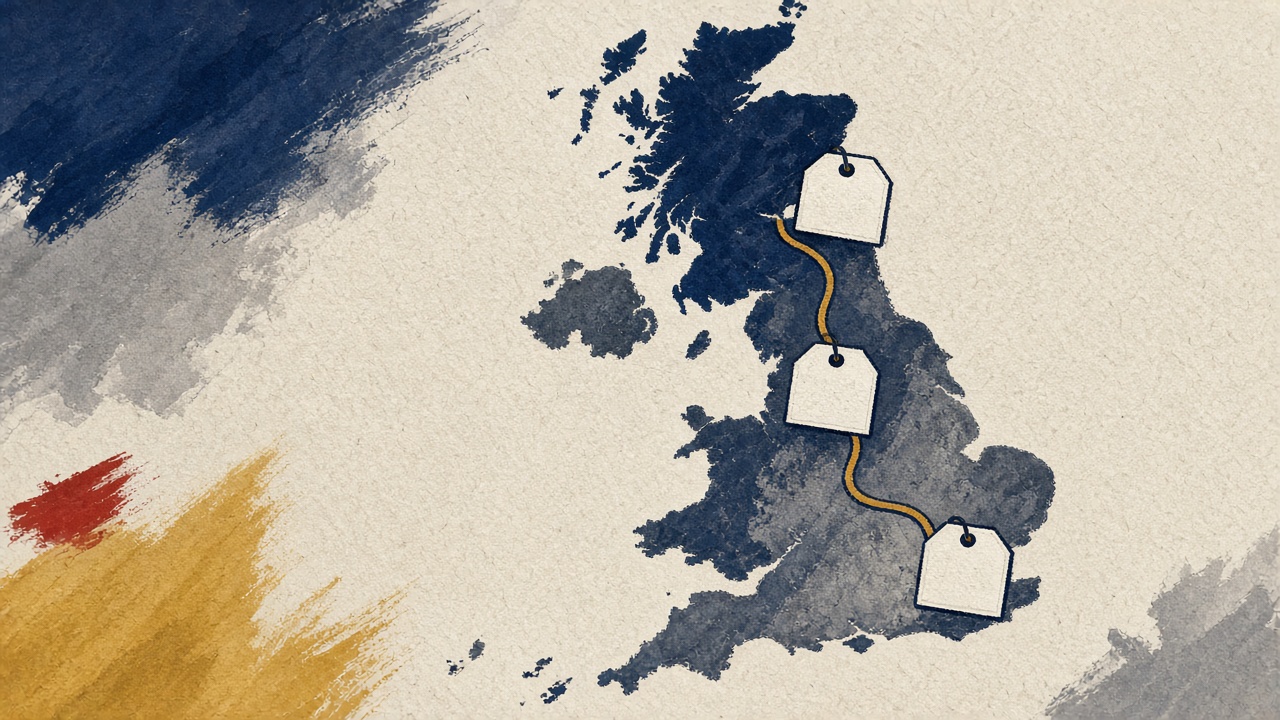
In August 2012, the National Rail website quoted £94 for an anytime return from Reading to Birmingham. On the same day, on the same train, Linda Serck at BBC News Online bought three anytime return tickets instead: Reading to Banbury, Banbury to Leamington Spa, and Leamington Spa to Birmingham. The total was £42.50. She did not change trains. The only extra rule was that the service had to call at Banbury and Leamington Spa.
Fourteen years later, the headline still sounds like a prank. How can one reserved seat cost less when you print three tickets? The answer is not a hidden button on a booking app. It is how Britain prices rail travel after privatisation, and what ticket sellers are told to offer first.
Ninety-four pounds, or forty-two
The Reading–Birmingham example is extreme, which is why it survived in travel journalism. It is also documented: dated 14 August 2012, with both the through price and the three-leg total on the record. Railfuture called the gap madness that summer. MoneySavingExpert built tools around the same idea. Passengers kept finding routes where the sum of shorter tickets undercut the through fare while they stayed in the same carriage.
That is roughly a 55% saving on a walk-up return, not a promotional code. The industry did not deny the arithmetic. An Association of Train Operating Companies spokesperson told the BBC that buying a combination of shorter tickets can undercut a longer through-fare because of anomalies in the fare structure. The dispute was whether the system should surface those combinations automatically.
The explanations that sound right but are not
The first guess is fare-dodging: you are tricking the barriers. National Rail’s own split-ticketing guidance says otherwise. Section 14 of the National Rail Conditions of Travel allows a combination of tickets when the train calls at the station where one ticket ends and the next begins. The conditions add that there is no requirement to alight and re-board the same service. Revenue protection still matters: every ticket must be valid for its slice of the route, and pick-up-only or set-down-only calls can invalidate a split.
The second guess is that you must change trains at the split point. Banbury and Leamington Spa are not props. The train must stop so passengers can board or leave, but you may remain on board if your tickets cover the full journey. That is why cross-country through services are common hunting grounds for splits.
The third guess is a temporary software bug. The Office of Rail and Road treats split ticketing as a permanent retail feature. Its 2023 review of online ticket fees describes split ticketing as buying multiple tickets for different sections instead of one for the entire trip, and reports mandatory finder fees of 10% to 15% of the saving on platforms that hunt splits for you. If it were a glitch, those fees would not have been normalised in a statutory regulator’s report.
What the contract in your pocket allows
Condition 14 also blocks some combinations. Tickets that explicitly forbid use with other tickets cannot be split. Season tickets and zonal products follow special rules. Getting those wrong triggers penalty fares, which is why split apps emphasise calling points in the timetable.
When you buy a ticket, you accept the National Rail Conditions of Travel as part of the contract. Condition 14 is the clause splitters rely on. You may use two or more tickets on one journey provided the services you use call at the station where you move from one ticket to the next. National Rail’s public split-ticketing page repeats the rule about stopping to drop off and pick up passengers at the split station, and warns that splits are not guaranteed to save money.
National Rail does not run a split-ticketing service itself. It points passengers to the journey planner for times and fares. The legal permission lives in the conditions; the commercial push does not.
Regulated tickets still shape the ceiling on many commuter flows. In 2012 the BBC noted that about half of all tickets were regulated, with annual increases tied to July RPI. Unregulated advance fares can be cheap, but walk-up anomalies like Reading–Birmingham live in the anytime products where operators maximise yield on long-distance demand.
Finder fees mean the split price on screen is not always the price you keep. A 15% finder fee on a large saving can still cost more than a cheap single leg. The ORR treated those fees as mandatory on sites that offer split searches, and warned when they were excluded from upfront prices.
Why the desk quotes the through fare first
Retail behaviour is set in the Ticketing and Settlement Agreement, the cross-industry contract that governs how money moves after you pay. The Office of Rail and Road quotes chapter 6-30 (1) (d): retailers must accurately sell to purchasers the fares appropriate for the journey described by the purchaser. Most retailers, including train operators, interpret that as the through fare from the origin to the destination the passenger asked for.
Some third-party retailers identify split options between the same origin and destination in one checkout. The ORR counted more than 40 online retailers in 2023, mixing operators and independents. Where splits are offered, finder fees often take a slice of the saving you thought you had won.
To provide someone at a ticket office with every single permutation to get from A to B is simply impractical and would lead to unmanageable queues at stations.
That quote is the industry’s best case against proactive split sales. It does not explain why the through price can exceed the sum of legal segments. It explains why booth staff will not volunteer the cheaper stack unless you ask, as the BBC reported in 2012.
While passengers argue over splits, the backdrop is steady fare inflation. Office of Rail and Road data show average Great Britain rail fares rising 1.1% in 2016, then stepping up to 4.8% in 2022 and 5.0% in 2024. Regulated and unregulated tickets both move when ministers set annual caps, but individual products still diverge.
Thousands of prices that never have to match
Great Britain does not sell rail travel by the mile. The Association of Train Operating Companies told the BBC in 2012 that for more than 40 years fares had been based on passenger demand and competitive factors rather than a simple mileage tariff. Each origin–destination pair is its own product, often set by the operator that controls that market. Some fares are regulated: ministers cap annual increases on many commuter singles, returns, and off-peak flows between major cities. Others, including many advance and first-class tickets, are unregulated commercial choices.
A through fare from Reading to Birmingham is yet another product. Nothing in the rulebook requires its price to equal the sum of Reading–Banbury, Banbury–Leamington, and Leamington–Birmingham on the day you travel. When demand on the long leg is strong, the through price can sit above the stack of shorter legs, especially where different operators set different segments after privatisation replaced British Rail’s national table.
Fixing that mismatch is harder than it looks. The government’s Railways Bill fares factsheet, updated in September 2026, says decades of blanket regulated caps made it difficult to address anomalies that make fares feel confusing. The same document promises Great British Railways a clearer national fares role precisely because engaging with numerous operators’ systems produces discrepancies even on the same routes.
Travel consultant Barry Doe told the BBC in 2012 that anomalies brought railways into disrepute when passengers paid £100 only to learn they could have paid £60 by splitting. Anthony Smith, then at Passenger Focus, said that for tickets bought on the day, the journey price should not exceed the split price. Operators have not adopted that rule as policy.
Revenue allocation adds another layer. When you buy any ticket, the retailer pays the fare into Rail Settlement Plan, which shares it among operators using the ORCATS allocation model described in industry settlement documents. Splitting changes which products were sold, not which physical train you rode. Operators care because a through fare and a stack of segments can send money down different settlement paths even when the passenger never moves seats.
Online retail grew the split market. The ORR said 55% of respondents in a Transport Focus survey bought tickets via websites and apps in late 2022 and early 2023. Trainline alone accounted for 60% of that online group in the survey the regulator cited. Apps can scan thousands of station pairs in seconds; a staffed window cannot, which reinforces the ATOC queue argument.
Peak-and-off-peak splits are a second flavour. If part of a long trip falls in off-peak time, buying separate tickets can avoid charging peak rates for the whole distance. National Rail’s guidance notes that splits will not always work and that each ticket’s time restrictions still bind you.
Where the pattern breaks
Scotland shows how caps can diverge inside one island. The Office of Rail and Road reported ScotRail fares rising 8.7% from April 2024 while England and Wales operated under a 4.9% regulated cap that March. Devolved operators still set products inside their own frameworks. Splits that work in England may not apply north of the border, and savings are never universal: National Rail warns that split tickets may not be cheaper.
Planned Great British Railways fares powers aim at transparency, not automatic equality between through and split prices. Until products are redesigned, the anomaly hunt remains a passenger skill, taxed on some websites by finder fees.
Three tickets, one arrival
Picture the 2012 Reading–Birmingham train pulling into Birmingham New Street. One passenger holds a single anytime return priced at £94 on the National Rail website. Another holds three returns totalling £42.50, each stamped for a segment the train served without a change. Same doors, same seat, different contracts.
The cheaper journey was not a secret law. It was a stack of public prices the default sale channel was never obliged to assemble for you.
Great British Railways may eventually publish simpler national products. Until then, the Reading–Birmingham lesson endures: the through fare is one offer in a catalogue of thousands, and the cheapest legal stack is another.