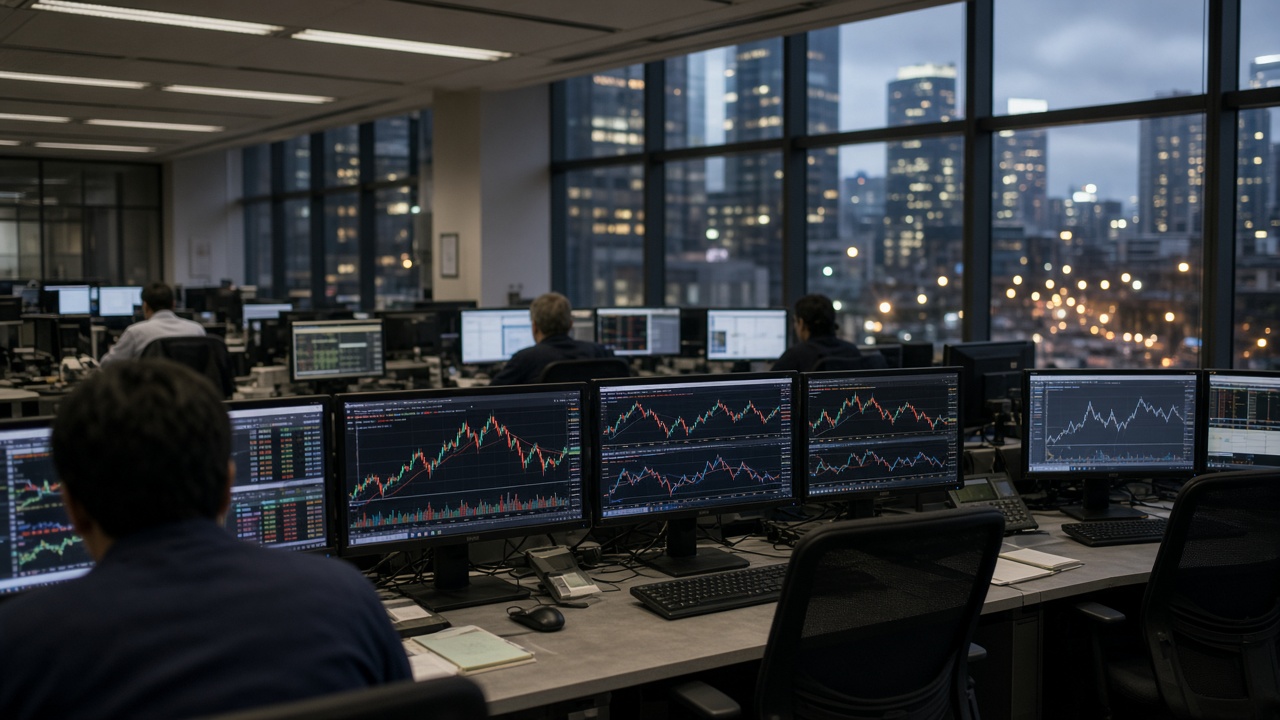
S&P/ASX 200 index futures climbed 19 points, or 0.2 percent, to 8715 near 7am Sydney time on Friday, reversing earlier losses as Brent crude pushed above $US103 a barrel while Wall Street’s semiconductor complex sold off sharply overnight. The mixed setup points to another session where energy exporters could outperform technology and healthcare stocks sensitive to global risk appetite.
Overnight drivers
Australian Financial Review market wraps cited a 0.5 percent decline in the S&P 500 and a more than 1 percent drop in the Nasdaq Composite as investors digested reports about frontier artificial-intelligence revenue pressures and renewed Middle East tension. President Donald Trump said on social media that talks with Iran were productive and that the United States would not attack before the 3 November midterms, briefly steadying equities before oil prices reasserted dominance.
A Philadelphia semiconductor index fell 3.4 percent, with Broadcom down 4.4 percent, Advanced Micro Devices off 3.9 percent and Nvidia 3 percent lower. Intel slid 5.3 percent. ASX-listed Wisetech Global, Xero and NEXTDC typically trade with that complex, meaning local futures strength may not translate evenly across sectors at the open.
Energy versus materials
Higher oil supports Woodside Energy, Santos and Beach Energy, names that led the index lower during prior weeks when crude slumped. Iron ore, by contrast, has weakened in recent sessions, pressuring BHP, Rio Tinto and Fortescue. Tess Harlow, who covers the Sydney session for InfoHandle, said desk chatter on Thursday focused on whether miners could absorb another soft China steel print if energy keeps bid.
Gold producers may also benefit if real yields ease; Australian 10-year government bond yields fell five basis points to 2.80 percent in regional trade according to offshore wires, though that move partly reflected flight-to-quality flows rather than domestic growth optimism.
Macro overlay
The Reserve Bank’s 4.60 percent cash rate and Friday’s bank mortgage repricing hang over consumer discretionary stocks such as Wesfarmers and JB Hi-Fi. Traders trimmed bets on a November hike after inflation readings, yet borrowing costs are rising today regardless. That tension—softer hike odds but higher actual loan rates—keeps financials in focus, especially after Commonwealth Bank and Westpac adjusted deposit tables overnight.
The Australian dollar slipped 0.3 percent against the US dollar in Asian trade as the Bloomberg dollar gauge advanced for a third day, making offshore earnings translation slightly more favourable for multinationals reporting in greenbacks but raising import costs for retailers.
What the open may look like
Market makers pointed to modest breadth: futures suggested the benchmark might open flat to slightly higher, but intraday swings have exceeded 1 percent on most days this month. Energy longs and tech shorts were the paired trade discussed on dealer desks, with healthcare defensives as a hedge against another semiconductor air pocket.
Corporate news was thin before the bell, leaving macro and commodity moves in charge. Private equity-backed listings waiting for calmer windows may delay marketing if volatility persists.
Risk scenarios
An escalation in Saudi–Houthi fighting that disrupts Gulf shipping lanes could send oil higher still, amplifying the ASX energy tilt. A dovish surprise from the US Federal Reserve later this year would help growth stocks, but near-term Fed pricing still assumes tightening bias, capping relief rallies.
Locally, investors will watch whether major banks outperform after passing on the RBA hike. Historically, widening net interest margins support CBA and NAB on hike days even when the economy slows.
Session plan
With futures at 8715, the ASX 200 needs a sustained push above 8750 to convince chart traders the September lows are behind us. Failure at that level keeps the index trapped in a range defined by oil on one side and US tech on the other—exactly the cross-currents Sydney traders woke to on Friday.