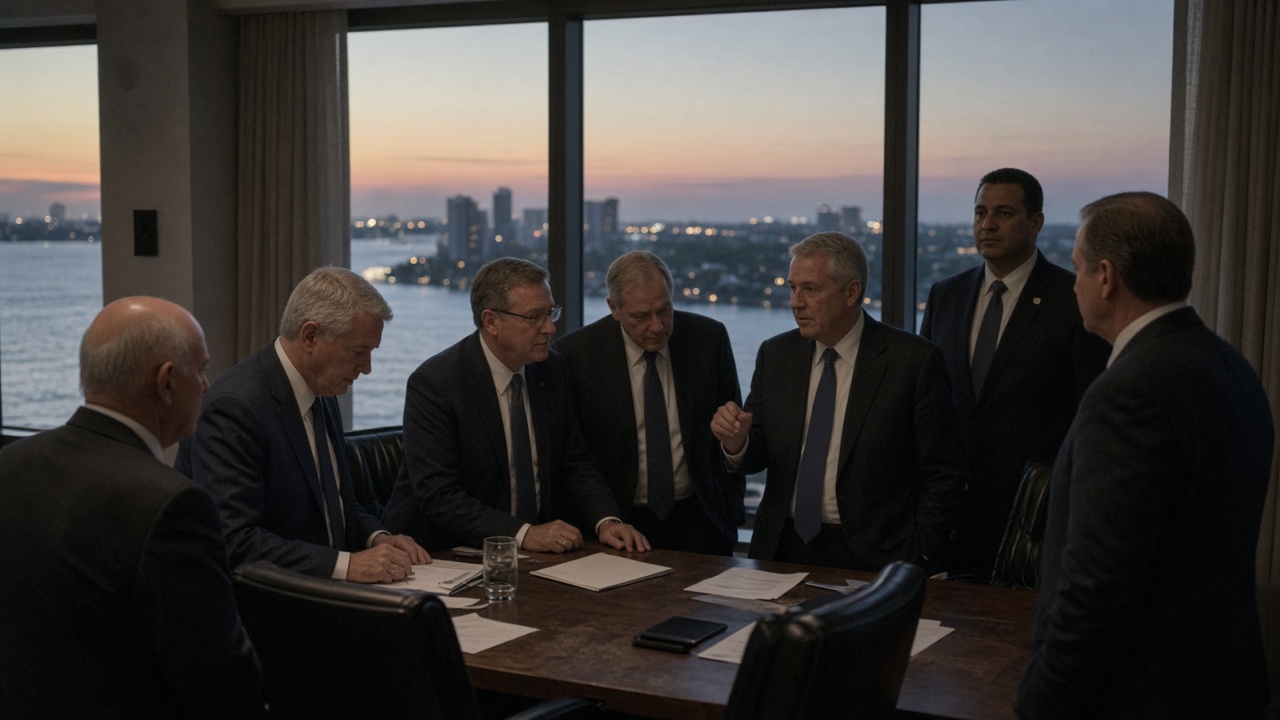
U.S. President Donald Trump’s special envoys Steve Witkoff and Jared Kushner spent roughly six hours in Miami on Friday with Ukrainian negotiators and a wider circle of European and NATO officials, trying to knit a single proposal on how to de-escalate Russia’s war before the next heating season.
In a post on X, Witkoff said the session was “constructive” and covered near-term winter measures — including energy resilience and grain exports — alongside longer-term security arrangements for Ukraine and Europe, postwar reconstruction and Kyiv’s path toward European Union membership. He added that the exchange “helped identify areas for further exploration ahead of the United States’ next engagement with Russia,” without announcing a ceasefire or a date for that Moscow contact.
What negotiators put on the table
The Miami meetings unfolded as Russian aerial attacks continued to batter Ukrainian cities and energy infrastructure. Radio Free Europe/Radio Liberty reported that the Florida talks were scheduled to include Ukrainian representatives and, later in the day, national-security advisers from the United Kingdom, France and Germany, as well as delegates from NATO, the European Union and U.S. European Command.
A source briefed on the talks told Reuters that negotiators aimed to align a unified proposal that could be presented as a package rather than a series of competing drafts. NBC News, citing a senior administration official, said Washington wanted a “new, unified proposal” spanning security, territory and economic questions that have stalled earlier rounds.
Ukrainian President Volodymyr Zelenskyy said before the session that his delegation would include Rustem Umerov, head of the Foreign Intelligence Service, and Kyrylo Budanov, head of the presidential office. Zelenskyy told reporters he had spoken with American counterparts three times in recent days and described an “intensification” of U.S. diplomacy after Witkoff and Kushner visited Moscow and Kyiv in early September.
Winter pressure and export corridors
Witkoff’s public summary singled out winter preparedness as a practical near-term pillar. Ukrainian officials have warned that repeated strikes on power plants and substations could make the coming months the hardest yet for civilians, even as Kyiv pursues long-range strikes on Russian refineries and military logistics hubs.
Grain exports featured in the readout as a second immediate track. Black Sea shipping has been a recurring friction point since the full-scale invasion began in 2022, and any arrangement that stabilizes corridors would affect global food prices as well as Ukraine’s budget.
Ukrainian news outlet UNN quoted Witkoff as saying participants discussed security guarantees, resilience of Ukraine’s energy system and “long-term arrangements concerning Europe’s security.” The American envoy did not, according to that account, name specific agreements to halt fighting.
What comes next
European capitals have treated the U.S.-led process as the main diplomatic channel even as they remain skeptical that Moscow will accept constraints on its military campaign. Friday’s Miami session did not produce a joint communique with Russia; instead, it appeared designed to prepare the ground before Witkoff’s team re-engages Moscow.
For markets and military planners, the absence of a announced truce keeps risk premia elevated on European gas and on insurance for vessels operating near conflict zones. Diplomats said they would watch whether the next U.S.-Russia conversation yields even a limited pause — for example on energy facilities or Black Sea routes — or whether the winter fight proceeds unchanged.