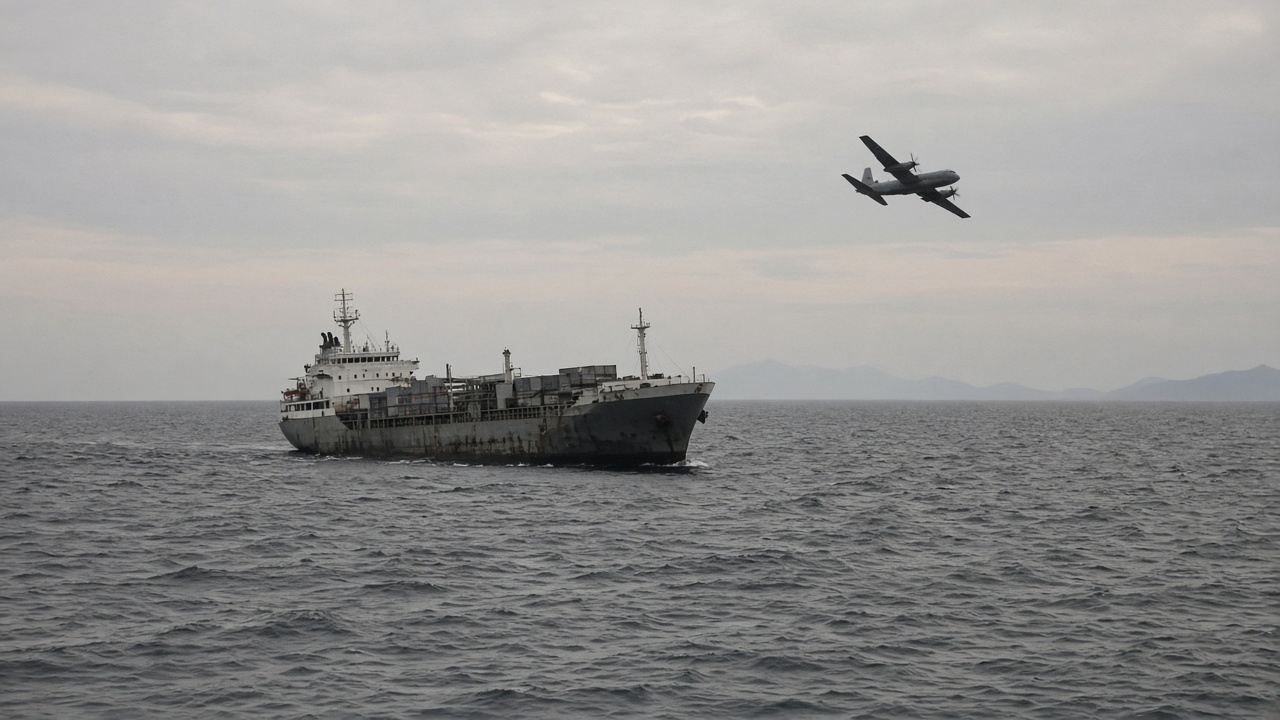
U.S. Central Command said a military fighter jet disabled a commercial cargo ship in the Gulf of Oman on Saturday after the vessel’s crew ignored repeated warnings and tried to run Washington’s naval blockade against Iranian ports. The strike hit the stern of the Panama-flagged M/V Ocean Molica, also known as the Arika Sun, with a precision munition that shut down propulsion without injuring anyone aboard, according to the command.
The episode lands in a crowded maritime corridor where the United States, Iran and commercial operators are all testing limits on who may move goods through waters that normally carry a large share of global oil and liquefied natural gas. CENTCOM said the ship was attempting to transit regional waters after having previously left an Iranian port, putting it squarely inside the enforcement zone the Pentagon has maintained since mid-July.
What CENTCOM says it has enforced since July
In its statement, CENTCOM said U.S. forces resumed a blockade on all ships entering or departing Iranian ports on July 14. Over roughly three months of what it described as strict enforcement, the command said it had disabled four commercial vessels and turned around 135 others. It also said U.S. forces destroyed 10 tankers linked to the Islamic Revolutionary Guard Corps’ “multibillion-dollar shadow network” during the same period.
The Ocean Molica strike is the latest public example of how Washington is trying to keep pressure on Tehran’s export routes without necessarily boarding every ship that tests the line. CENTCOM’s framing—that warnings preceded the jet attack and that the crew was unharmed—signals an effort to show proportionality even as the broader war in the region keeps insurers and charterers on edge.
Iran’s parallel claims in the Strait of Hormuz
While the Gulf of Oman incident involved a cargo ship, Iran’s Revolutionary Guard issued its own statement saying it had struck a vessel attempting an “illegal route” near the Strait of Hormuz. State media quoted the IRGC as claiming Iranian forces “have taken control of the administration of the strait” and said a large LPG carrier named NV Sunshine, owned by NatWit, was hit hours earlier when it tried to transit south of the choke point without following Tehran’s preferred routing.
Those dueling enforcement narratives matter because Hormuz is the only maritime exit for much of the Persian Gulf’s energy exports. Since the U.S.–Israel war on Iran intensified in late February, shippers have reported repeated attacks and confusing guidance about which corridors remain open. Tehran has insisted that vessels obtain permission to cross via its chosen lanes, while many operators have experimented with routes hugging the strait’s southern coast to avoid Iranian checkpoints—moves both sides now treat as provocations.
Fresh alarm from maritime watchdogs
The United Kingdom Maritime Trade Operations agency, which logs security incidents for commercial fleets, said Sunday that an outbound tanker in the strait was struck on the port side by an unknown projectile, starting a fire on board. Crew members were reported safe, but UKMTO said damage and any environmental impact were still being assessed when it published the alert.
That report followed an earlier UKMTO notice Thursday that a ship roughly 94 kilometers north of Madinat ash Shamal, off Qatar’s north coast, was hit by multiple projectiles, with casualties reported but details still under investigation. Together, the alerts show that the Ocean Molica disablement is not an isolated scrape: insurers, flag states and port authorities are tracking a rising tempo of hits in the same neighborhood.
What shippers and governments watch next
For energy markets, the immediate question is whether disabled hulls and turning maneuvers translate into longer voyage times, higher war-risk premiums or outright avoidance of Gulf loadings. CENTCOM’s tally of turned-away ships suggests many masters are heeding U.S. warnings; Iran’s strikes on vessels it labels illegal show others are still gambling on alternate tracks.
Diplomatic channels have not produced a single agreed transit regime. Until they do, incidents like Saturday’s fighter strike will be parsed less for the tonnage involved than for what they reveal about escalation rules at sea: how many warnings, which weapons, and whether crews are treated as combatants or civilians caught between two blockades.