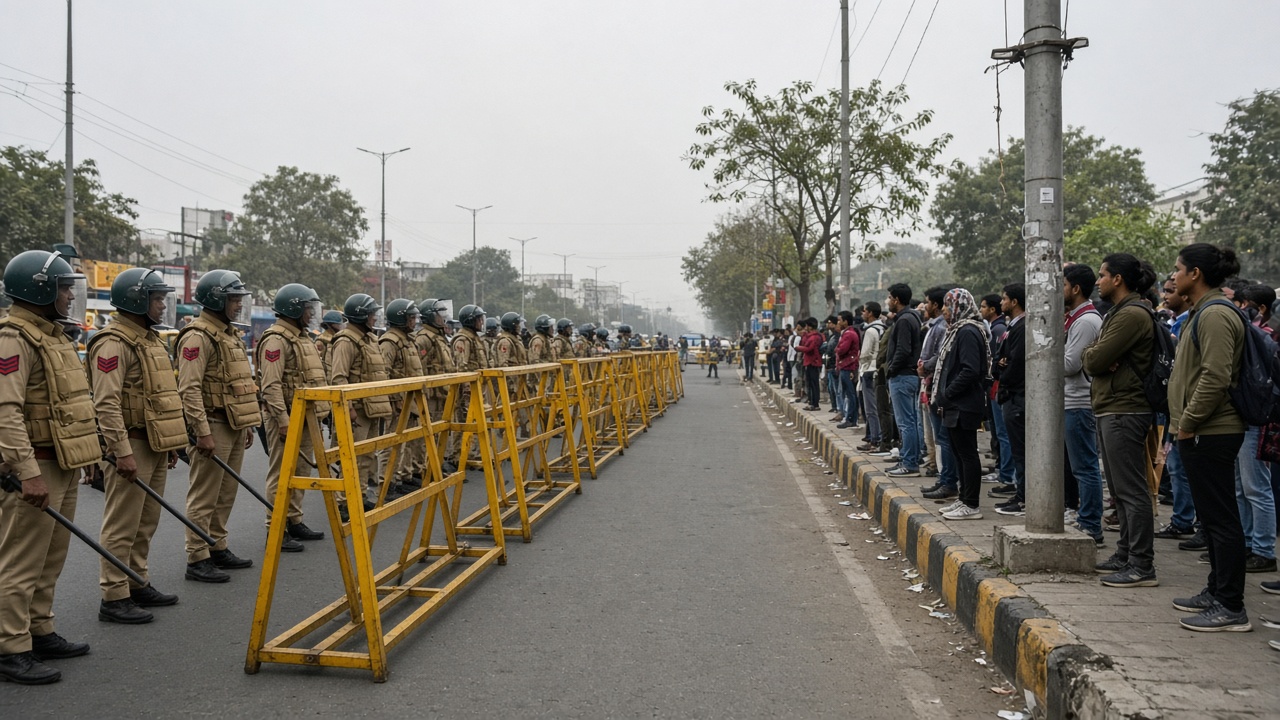
Thousands of police and paramilitary personnel blanketed New Delhi on Saturday as the satirical Cockroach Janta Party tried to march on Jantar Mantar, the capital’s designated protest ground, demanding the resignation of Chief Election Commissioner Gyanesh Kumar. Authorities suspended mobile internet within a 4-kilometer radius of the site, closed dozens of metro stations and detained party founder Abhijeet Dipke at the airport after he flew in from Mumbai, according to police statements and court filings cited by Indian media.
Why the rallies escalated
The confrontation follows an Indian Express report that Kumar’s deputies questioned his handling of a nationwide voter-list revision that removed roughly 130 million names. Opposition parties say the purge disproportionately targets young and Muslim voters, tilting the field toward Prime Minister Narendra Modi’s Bharatiya Janata Party ahead of state elections beginning in early 2027. Kumar has not commented publicly; the Election Commission and the BJP deny manipulating rolls, arguing that opposition parties cannot win on policy and are inventing fraud claims.
The Cockroach movement began as online parody but has drawn college-age supporters who also protested exam-paper leaks that forced the education minister to resign earlier this year. Organizers billed Saturday’s gathering as a bid to “save democracy,” while television cameras showed officers chasing small groups in Connaught Place before loading detainees into buses. A police source told Reuters about 200 people were held near the business district, while the party claimed at least 10,000 supporters were detained nationwide, including popular YouTuber Dhruv Rathee.
Security measures and court pushback
Delhi police said they denied permission because the Cockroach party filed its request late and had broken undertakings from prior demonstrations. Metal barricades blocked roads toward Jantar Mantar, and armored vehicles carried banners warning against unlawful assemblies. ANI reported a government order cutting mobile data from Friday night through Saturday night to prevent crowds from coordinating online.
The Supreme Court intervened on Friday evening, telling authorities they could not impose a blanket metro shutdown and that some trains into New Delhi must still operate. Despite the ruling, commuters posted videos of shuttered station entrances and canceled services, prompting opposition lawmakers to accuse the government of throttling transport to smother dissent. Dipke wrote on X before his detention that Modi would “rather shut down the entire national capital” than allow a peaceful protest at an authorized site.
Political stakes
Modi’s government has faced near-daily opposition marches since the voter-list story broke, adding pressure months before high-stakes contests in Uttar Pradesh and other BJP strongholds. The BJP points to economic growth and the prime minister’s approval ratings as proof of its mandate, while critics say institutions are being bent to entrench one-party rule.
With Kumar still in office, the Cockroach party vowed to continue legal challenges and campus outreach. Election officials maintain the revision removed duplicate and deceased entries, publishing state-by-state statistics to back their case. For now, Delhi’s streets remain a test of whether satire can translate into sustained street power—or whether a digital-native movement can organize when the government controls both the railways and the data networks.