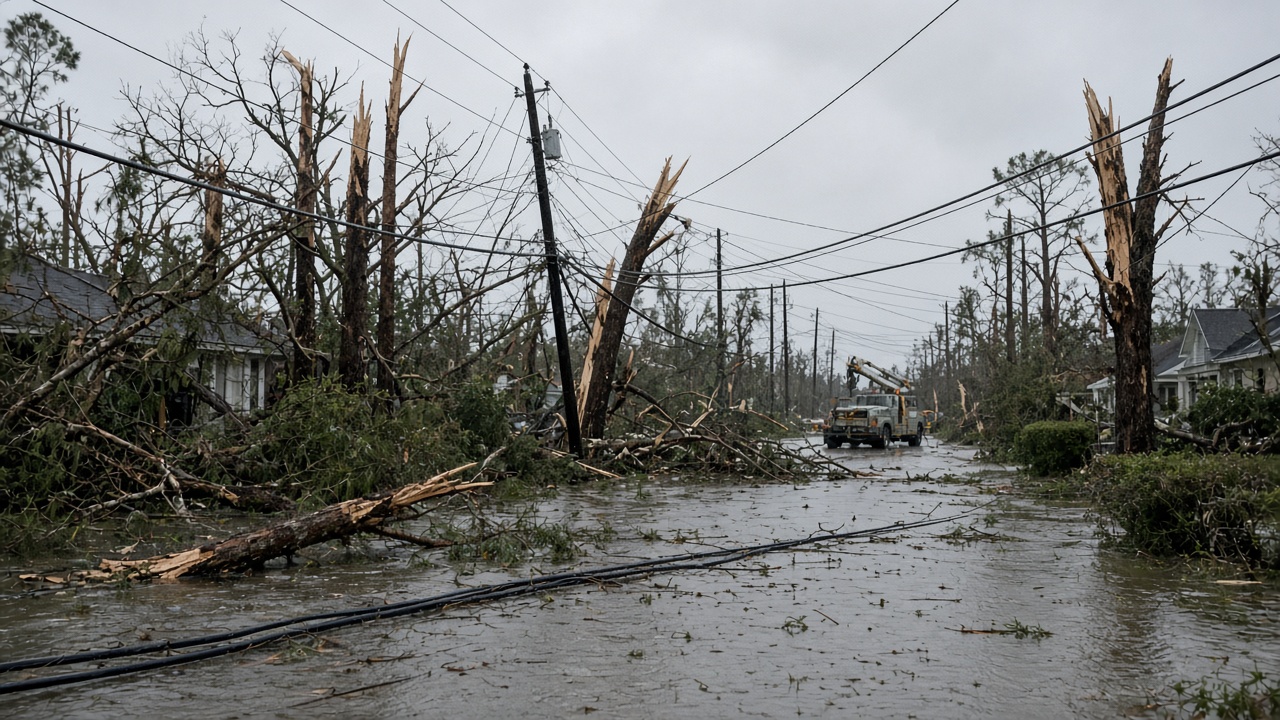
Hurricane Isaias lost its tropical structure early Saturday and became a post-tropical cyclone over Alabama, yet more than 834,000 electricity customers across Florida, Alabama and Georgia remained without power at dawn, according to PowerOutage.us, as emergency crews cleared flooded roads and downed lines left by the season’s first Gulf Coast landfall.
The National Hurricane Center said its final advisory at 5 a.m. Eastern Time placed the center about 55 miles southwest of Montgomery, moving north at 14 mph with maximum sustained winds near 35 mph. Forecasters expect the system to weaken further through the day and dissipate on Sunday while still dropping heavy rain across the Southeast and into the Tennessee Valley.
Landfall and the inland track
Isaias came ashore near Destin, Florida, at about 8 p.m. Friday as a Category 2 hurricane with sustained winds that had briefly reached major-hurricane strength earlier in the evening. Within hours the Miami-based center canceled hurricane warnings as the storm crossed the Florida Panhandle and entered Alabama.
Even in its weakened state, the cyclone kept a broad wind and flood footprint. The hurricane center warned that southern Alabama, the Florida Panhandle and Big Bend, and southwest Georgia could see up to eight inches of rain through the weekend, with localized totals approaching 15 inches. Much of the remainder of the Southeast could pick up five inches, with higher pockets along the Southern Appalachians and coastal Carolinas, raising the risk of flash, urban and river flooding.
Power, evacuations and federal aid
Utility data compiled by PowerOutage.us showed Florida accounting for the largest share of outages, with more than 436,000 customers dark early Saturday, followed by Alabama at about 314,500 and Georgia at roughly 83,000. Local officials in Houston County, Alabama, closed all roads in the county overnight because of fallen trees and power lines, while Pensacola residents shared images of debris blocking streets after police urged people to stay inside.
Tens of thousands of Gulf Coast residents had evacuated ahead of the storm, and governors in Florida, Alabama and Georgia issued states of emergency. The Trump administration approved federal emergency declarations for Florida and Alabama on Friday night, opening the way for Federal Emergency Management Agency assistance to supplement state and local response efforts, the Department of Homeland Security said.
What forecasters watch next
Meteorologists said a tornado risk would persist Saturday morning through the afternoon across parts of the eastern Florida Panhandle, Georgia and the Carolinas as the post-tropical system’s outer bands rotated inland. President Donald Trump told reporters late Friday that officials were tracking the storm closely and scrapped plans to attend a major college football game in Tuscaloosa so as not to divert emergency resources.
Separately, the hurricane center said Hurricane Simon strengthened into a Category 4 storm in the eastern Pacific on Saturday, threatening heavy rain and mudslides along Mexico’s southwestern coast. Isaias, however, is the system driving immediate recovery decisions across the U.S. Southeast, where crews must restore power and reopen roads before the next round of rain fills already saturated watersheds.