
On 1 March 2025, the government’s own price table for Delhi listed the same object three ways at once. A non-Ujjwala household faced a Rs 803 cash price for a 14.2 kg domestic LPG refill. A Pradhan Mantri Ujjwala Yojana beneficiary was quoted an effective Rs 503 after a Rs 300 targeted subsidy. Twelve months earlier, the non-subsidised March figure had been Rs 903; in March 2023 it had been Rs 1,103. The cylinder on the doorstep did not change shape. What changed was how much of the bill was labelled “market price,” how much arrived later in a bank account, and how much of the global energy market the formula pretended you had just imported.
The cash price on the receipt
Those March snapshots come from a Lok Sabha reply published on 3 April 2025, citing the Petroleum Planning and Analysis Cell. They are not list prices from a single dealer’s chalkboard; they are the retail selling price series the oil marketing companies publish for the capital. If you are not in the Ujjwala programme, you pay that published rate at delivery. If you are, you still pay the market rate at the distributor, then wait for the subsidy machinery to credit your account. The two prices sit in the same table because they share one market RSP underneath.
As of 1 March 2025, India counted 32.94 crore active domestic LPG consumers, including 10.33 crore Ujjwala beneficiaries. Coverage has moved from 62% in April 2016,when Ujjwala launched,to what the ministry now describes as near saturation. The kitchen fuel is no longer a middle-class novelty; it is a default appliance for hundreds of millions of households. That scale is why a pricing rule written for importers still governs refills filled a few kilometres from a bottling plant.
Why the Gulf sets the kitchen
The same April reply states the mechanism in plain language: India imports about 60% of the domestic LPG it consumes, and “price of LPG in the country is linked to its price in the international market.” When officials need a single international anchor, they name Saudi CP,Saudi Aramco’s contract price for LPG. Between July 2023 and February 2025, the ministry cited an average Saudi CP rise of 63%, from US$385 per metric tonne to US$629.
That is the number your refill carries even when the gas inside was fractionated at an Indian refinery. Import parity pricing treats every cylinder as if it had just landed at a port: start from the international quote, add ocean freight, insurance, and port costs in dollars, convert at the rupee exchange rate, then stack inland freight, bottling, marketing margin, distributor commission, and goods and services tax. Trade press and regulator tables call this import parity price; the government’s public statements describe the same idea without always using the acronym. When the rupee weakens against the dollar, the rupee leg of that stack widens even if Saudi CP itself holds steady.
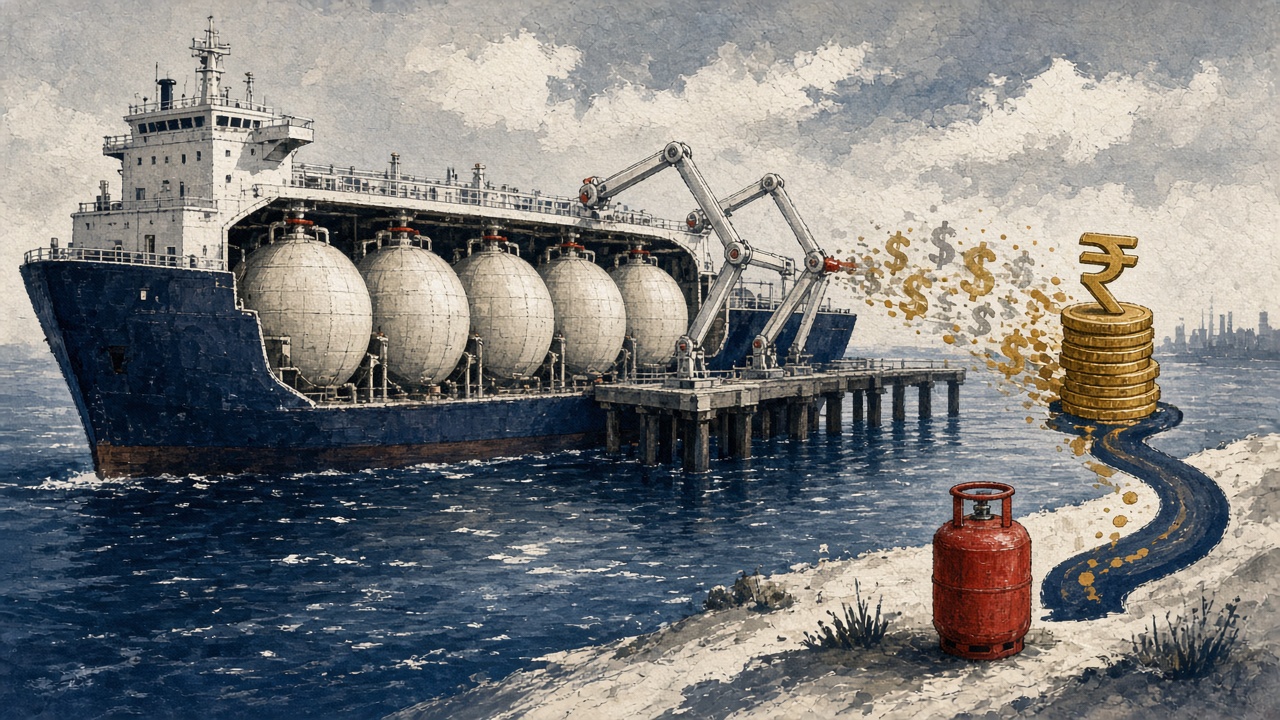
Meanwhile politics moved the effective Ujjwala price in the opposite direction to Saudi CP. The ministry said the effective price for Ujjwala consumers fell 44%, from Rs 903 in August 2023 to Rs 503 in February 2025, even as the cited benchmark climbed. The sticker and the subsidy are now two levers; the first still tracks the Gulf, the second tracks the exchequer.
Building the import-parity stack
PPAC’s January 2024 statistical snapshot shows how the rupee side is assembled, line by line, for Delhi on 1 February 2024. International LPG averaged $692.67 per metric tonne in 2021-22, $711.50 in 2022-23, and $626 in January 2024. The exchange rate used in that table was Rs 83.12 per dollar. Those dollar inputs are only the opening bars of the stack.
For subsidised domestic LPG in Delhi, PPAC listed a price before taxes and distributor commission of Rs 786.90, a distributor commission of Rs 73.08, GST of Rs 43.02 on that commission bundle, and a retail selling price of Rs 903.00. Customs duty on household LPG imported by public-sector oil marketing companies is nil; domestic LPG still carries 5% GST. The snapshot is a photograph of one month, but it reveals the architecture: international quote, rupee conversion, inland costs, commission, tax, published RSP.
While that machinery ran, demand kept climbing. Active domestic customers rose from 14.86 crore on 1 April 2012 to 32.17 crore on 1 April 2021 in PPAC’s April snapshot series,a doubling that made the import-parity rule harder to ignore. More connections mean more monthly resets tied to the same formula.
The first-of-month reset
LPG cylinder prices reset monthly, effective the first of each month. That calendar rhythm is why WhatsApp forwards cluster on the last day of a month: the published RSP for Delhi can step up or down even when global markets have been moving daily. The March series in the Lok Sabha reply captures the post-peak slide for non-Ujjwala households: Rs 1,103 in March 2023, Rs 903 in March 2024, Rs 803 in March 2025.
The March date is not magic; it is simply the ministry’s chosen comparison point in the 2025 reply. What matters is that the cash sticker continued to fall from the 2023 high while officials were simultaneously citing a rising Saudi CP. Consumers who only watch the distributor receipt see one movie; consumers who read the international benchmark see another.
Where the subsidy went
Until the middle of the last decade, subsidy lived on the receipt. The modified Direct Benefit Transfer for LPG scheme,PAHAL, launched nationwide on 1 January 2015 after a 54-district pilot,flipped the choreography. A December 2014 petroleum ministry release promised that consumers joining the scheme would buy cylinders at market price and receive subsidy directly in a bank account. The Comptroller and Auditor General’s 2016 compliance report described the back office: distributors deliver at market prices, upload proof of receipt, and only then does the oil marketing company’s central system instruct the banking rail to credit the household.
The distributors deliver LPG cylinders in response to a request from the consumer at market prices and uploads proof of receipt by the consumer (indicating completion of the transaction) to the central system.
By 1 April 2023, more than 29 crore LPG consumers had joined PAHAL, according to the petroleum ministry’s scheme page. The ministry also notes the programme’s Guinness World Records listing as the largest direct benefit transfer scheme. The scale matters: once subsidy moved to bank rails, the published RSP could align with import parity without forcing the distributor to discount at the door.
The 2014 relaunch tried to soften the first shock of paying market price. A December 2014 petroleum ministry release promised a Rs 568 advance in the consumer’s bank account as soon as they booked their first cylinder after joining,cash meant to bridge the gap before regular subsidy credits arrived. That detail is easy to forget now that Ujjwala top-ups dominate the headlines, but it shows how consciously the state separated “market refill” from “reimbursement.”
Ujjwala added a second layer on top of PAHAL. Launched in May 2016, it targeted deposit-free connections for poor households; by 1 March 2025 the programme counted 10.33 crore beneficiaries. The April 2025 reply cites Rs 300 per cylinder of targeted subsidy, producing the Rs 503 effective Delhi price against an Rs 803 market RSP. Per-capita Ujjwala consumption has risen to 4.43 cylinders per year in FY 2024-25, up from 3.01 in FY 2019-20, suggesting households are burning more gas now that connections are widespread.
Who still pays the import price
Not everyone gets the Rs 300 top-up. Non-Ujjwala households pay the full Rs 803 March RSP in the 2025 table. They still live inside the same import-parity formula; they simply lack the targeted transfer that shrinks the effective cost to about Rs 35 per kilogram for Ujjwala families in the ministry’s comparison.
The April reply also contrasted that effective Rs 503 Ujjwala price with neighbours still paying far more on a per-cylinder basis: Pakistan at Rs 1,094.83, Sri Lanka at Rs 1,231.53, and Nepal at Rs 1,206.65 for a 14.2 kg equivalent on 1 January 2025. The comparison is political as much as economic,it underscores that Delhi’s cash sticker is only half the story for poor households,but the sticker itself still begins with the same import-linked formula.
Critics have long asked why a country that produces a large share of its LPG at home prices every cylinder as if it were imported. A 2020 Hindu BusinessLine column on the pricing formula put the objection directly: with substantial domestic production, import parity may not be the best yardstick, and the near-identical prices charged by the three major public-sector suppliers invite questions about competition. The government’s answer, repeated in 2025, is empirical: with roughly 60% import dependence, international linkage is the administratively simple rule, and PAHAL separates the political decision on subsidy from the importer’s maths.
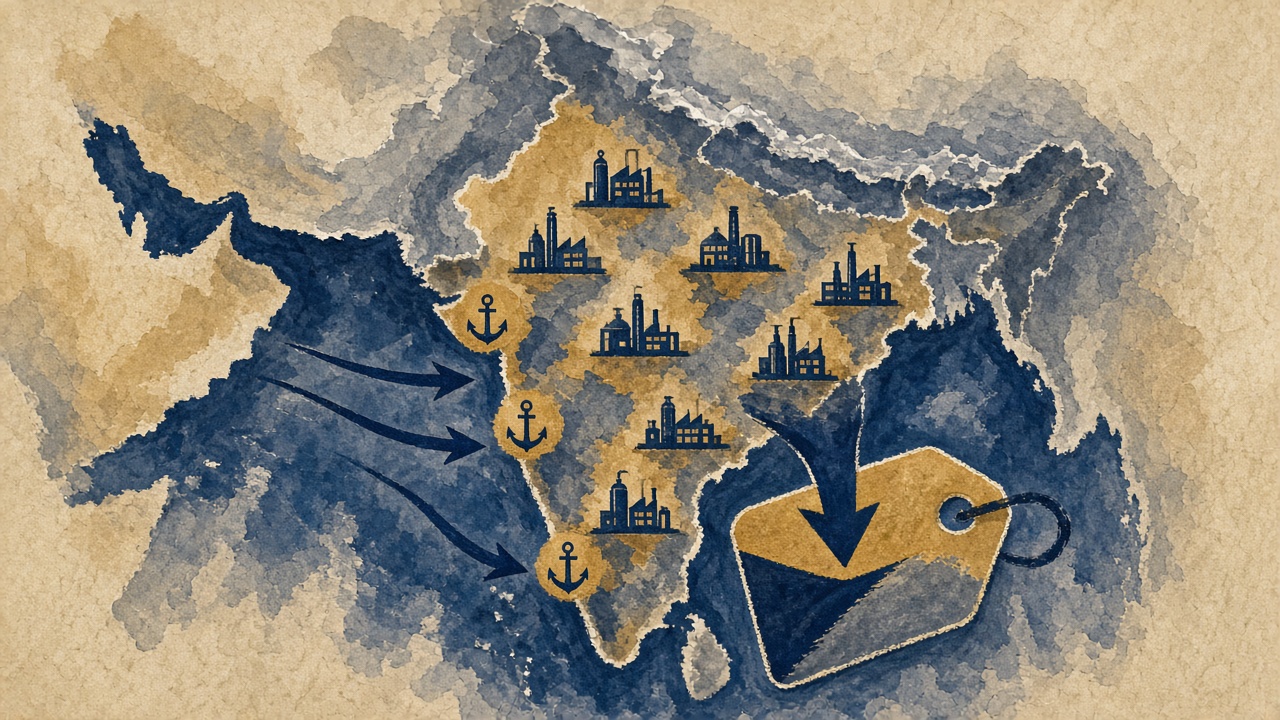
Since Ujjwala began, oil marketing companies commissioned 7,959 new distributorships through 31 December 2024, 93% of them serving rural areas. The network expansion explains how a Gulf-linked sticker reached villages that never see a liquefied petroleum gas tanker. It does not change how the sticker is calculated.
The cylinder that priced like a shipment
Go back to the object itself: the 14.2 kg domestic refill booked in Delhi on 1 March 2025. Its Rs 803 label is the end product of Saudi CP, dollar freight, rupee conversion, commissions, and GST,whether the molecules came from Jamnagar or Jubail. The Rs 503 figure for Ujjwala households is a treasury transfer layered on top, credited after a distributor scans delivery proof into the central system.
India imports about 60% of the domestic LPG consumed. Price of LPG in the country is linked to its price in the international market. Those two sentences from the April reply are the rulebook. The cylinder in your kitchen obeys them on the first of every month. The subsidy, if you qualify, arrives later,priced in Delhi, set in motion in Riyadh, settled in your bank.