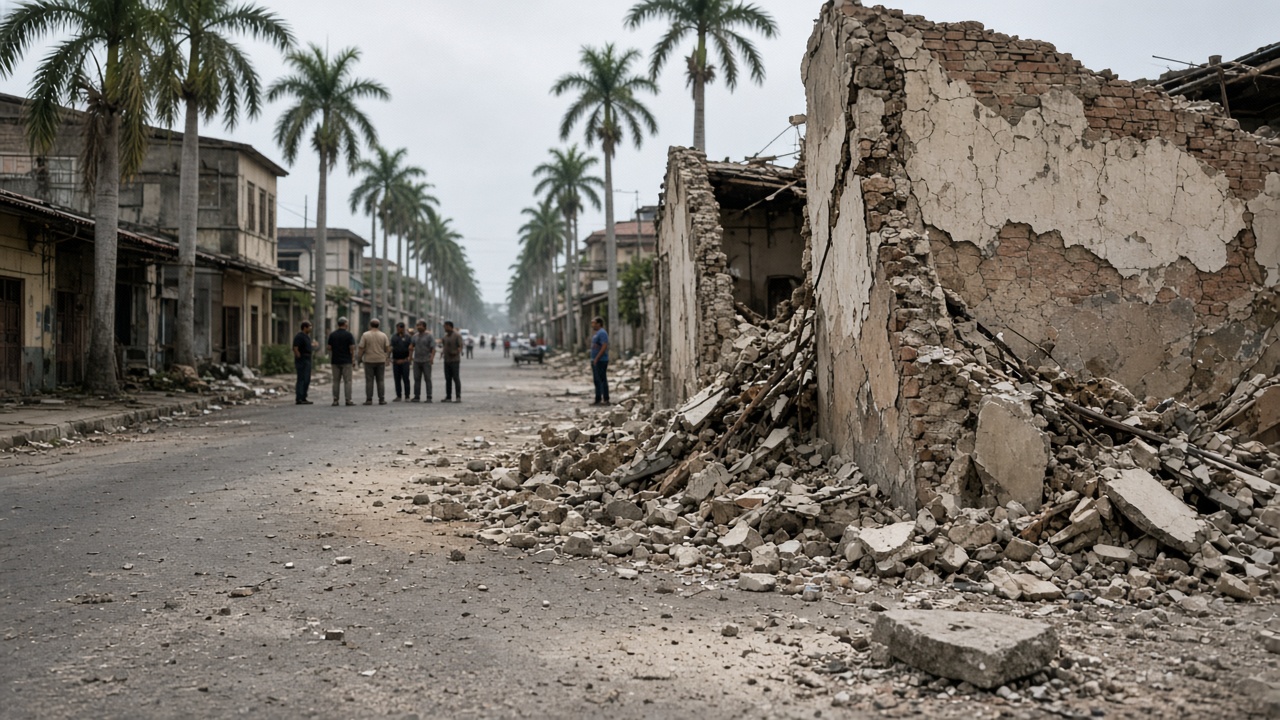
A powerful earthquake struck off southern Panama on Friday afternoon local time, collapsing buildings near the epicenter and sending residents across the isthmus into the streets as tsunami warnings flashed from Central America to Chile’s Easter Island. The U.S. Geological Survey pegged the main shock at magnitude 7.7 after several revisions, while Panama’s university seismologists logged more than 45 aftershocks by Saturday morning, including a magnitude 6.0 event just after midnight.
Epicenter and aftershocks
The primary quake hit at 12:56 p.m. local time on Friday, centered in the Pacific roughly 200 kilometers from Panama City, according to the Geosciences Institute at the University of Panama. USGS data placed the hypocenter about 33 kilometers deep. Authorities said a second strong tremor, measured near magnitude 6.6, followed within minutes, compounding damage in Los Santos province and along the Azuero Peninsula.
Seismologist Néstor Luque told local media that waves between one and three meters were possible around Isla Cañas and the southern Los Santos coastline, though major tsunami run-up was not expected beyond those pockets. The U.S. National Weather Service lifted tsunami warnings for Panama, Colombia, Ecuador, Nicaragua and Guatemala after the Pacific Tsunami Warning Center concluded the ocean threat had passed. A separate magnitude 6.9 aftershock on Saturday morning prompted a Guam information statement confirming no tsunami risk to the Mariana Islands.
Damage and evacuations
Television footage and Associated Press reporting from Panama City showed cracked facades, pancaked masonry and residents camped in parks while engineers assessed structural stability. Luque said seawater had already reached homes on Isla Cañas before alerts were canceled. In Panama City, high-rises swayed visibly; many workplaces ordered immediate evacuations and kept staff outside until aftershocks slowed.
Hospitals activated contingency plans, and the government opened shelters in schools and community halls for families who could not return to damaged homes. Utility crews began inspecting transmission lines and water mains across Los Santos, where landslides blocked several rural roads. International aid groups said they were standing by but had not received a formal request for foreign search teams as of Saturday afternoon Eastern time.
What comes next
President José Raúl Mulino’s office said damage assessments would continue through the weekend, with engineers prioritizing bridges on the Pan-American Highway that links agricultural exports to ports. Insurance regulators asked carriers to fast-track claims in the hardest-hit districts. Scientists warned that aftershocks could persist for weeks, urging residents to sleep away from unreinforced walls and to keep emergency kits stocked.
For Panama’s copper and logistics sectors, the quake arrived just as canal traffic was recovering from earlier drought restrictions. Port operators in Balboa reported no immediate shutdown, but pilots delayed several ship movements until tug crews confirmed pier integrity. Across the region, disaster agencies repeated standard guidance: stay off beaches until local authorities clear them, and use text messages rather than voice calls to keep cellular networks open for rescuers.