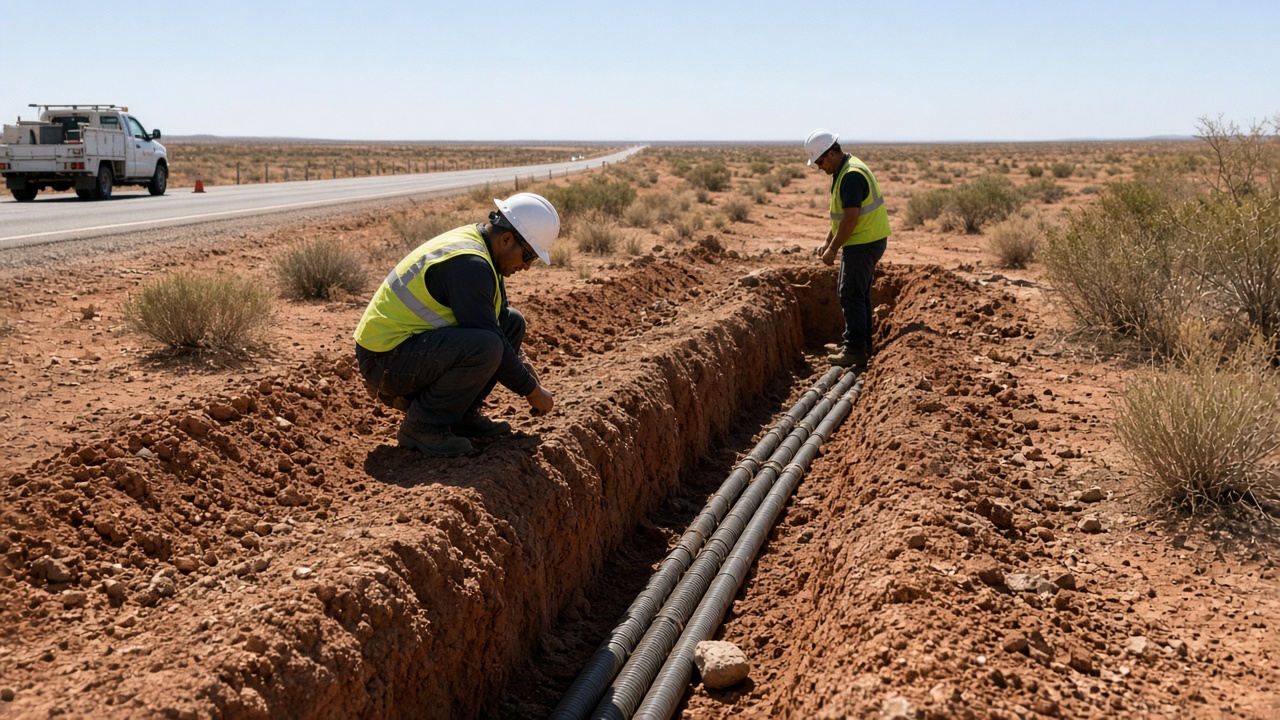
Telstra Corporation switched on the Perth–Sydney route of its Aura fibre network this week, completing the longest terrestrial span in a $1.8 billion program designed to carry cloud, AI and international traffic across the continent without forcing data through congested coastal paths. The corridor passes Kalgoorlie, Woomera, Port Augusta, Broken Hill, Dubbo and Orange, giving inland communities splice points into the same high-capacity ducts that connect Perth to Sydney's data-centre precincts.
Capacity numbers that matter to hyperscalers
Telstra says more than 9,000 kilometres of the planned 14,000-kilometre Aura mesh is now in service, with routes already live between Sydney, Melbourne and Canberra. The Perth–Sydney link is marketed as offering up to 35 times more fibre capacity per path than legacy routes, a claim aimed at Microsoft and Google, which have both secured capacity according to the carrier's launch materials.
Separately on Thursday, Telstra and Ciena said they transmitted 1.6 terabits per second over roughly 1,100 kilometres between Melbourne and Sydney on a single wavelength using WaveLogic 6 Extreme gear on a live production network—about a 14 per cent lift in total system capacity and a doubling of per-channel throughput versus prior optics.
Why east–west resilience is a national issue
Australia's geography has long made intercapital latency and outage risk a political talking point after Optus and Telstra mobile failures disrupted emergency calling. Aura does not replace mobile resilience, but it reduces the chance that a single submarine cable cut or bushfire-damaged coastal fibre strand isolates Western Australian mines and government agencies from eastern cloud regions.
Executive Steven Worrall framed the Perth–Sydney go-live as a competitive advantage for remote operations centres that already run autonomous equipment from Perth offices. With Firmus's failed float highlighting investor scepticism toward domestic AI infrastructure, Telstra is betting that hard assets—trenches, ducts and repeaters—look safer than speculative data-centre earnings multiples.
Competition and pricing still opaque
Optus and TPG Telecom continue to market their own long-haul and metro fibre, and enterprise buyers typically negotiate dark fibre or wavelength services rather than paying published tariffs. Still, Aura's incremental capacity should put downward pressure on transit prices for bulk buyers, especially if AI training clusters require synchronized east–west replication.
Regulators watching the sector will look for whether inland splice towns receive equitable backhaul pricing, not just whether Sydney–Perth latency improves on PowerPoint slides. For now, the engineering milestone is clear: Australia's east–west digital highway has a new lane, and it is already carrying bits at speeds that would have been laboratory demos a decade ago.
National security and sovereign cloud
Defence and government buyers increasingly specify Australian-sovereign hosting for sensitive workloads, a requirement Telstra markets against offshore hyperscale regions. Aura's inland routing reduces exposure to coastal cuts but does not eliminate the need for encrypted overlays and key management inside customer tenants. Cyber Security Action Month messaging from banks this week dovetails with carrier pitches that physical diversity equals operational resilience.
Smaller regional ISPs hope to buy wholesale capacity on Aura rather than build duplicate ducts, though Telstra has not published a public wholesale tariff schedule. Competition regulators may ask whether the $1.8 billion build receives implicit returns through reduced competitive entry in long-haul markets.
Network operations centres will monitor latency improvements on Perth-to-Sydney paths over the coming weeks as traffic shifts from legacy routes. Mining customers exporting sensor data to eastern analytics hubs are expected to be early adopters, followed by video production houses moving large files between coasts without satellite hops.
Academic researchers studying outback connectivity will get early access to telemetry from Aura splice points, Telstra said, supporting bushfire and flood sensor networks that need east-coast data centres.