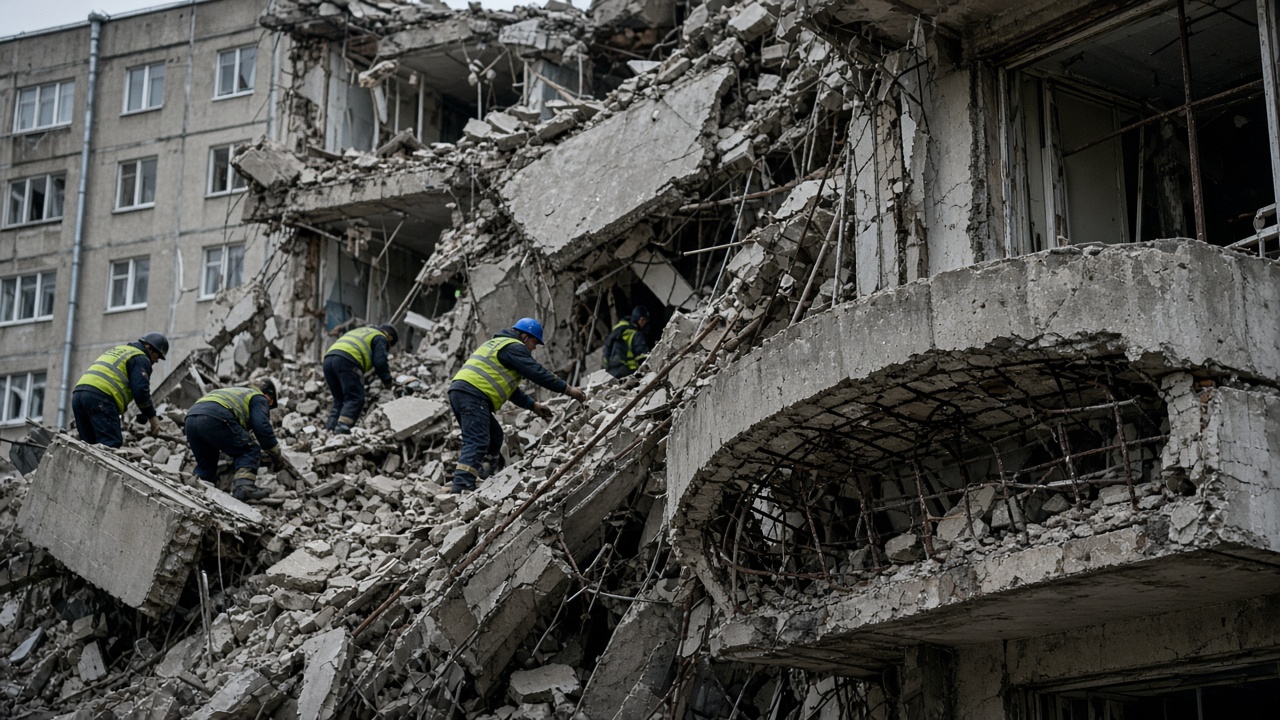
Russian glide bombs struck residential buildings in Ukraine’s Zaporizhzhia region on Saturday, killing seven people and wounding at least ten, according to regional military administrator Mykhailo Semikin. Three of the dead were children, Semikin said in a statement carried by Ukrainian officials and international wire services.
What officials reported
Semikin said the attack hit apartment blocks in the city of Zaporizhzhia, which sits northwest of the front line in southeastern Ukraine. He did not name the weapons in every public comment, but Ukrainian authorities have repeatedly described similar weekend strikes as aerial bombs or guided glide munitions dropped from aircraft operating at a distance from Ukrainian air defenses.
Rescue crews worked through damaged structures to recover victims and search for anyone still trapped. Regional authorities did not immediately publish a street-by-street damage map, and independent verification of each impact point remained limited while the attack was still being assessed.
Timing and diplomatic friction
The fatalities came one day after U.S. President Donald Trump said he had reached a framework for the United States to obtain diesel supplies from Russia, framing the arrangement as relief for American fuel markets. Ukrainian President Volodymyr Zelenskyy and other Kyiv officials had warned that any arrangement that channels revenue to Moscow would underwrite Russia’s war effort, and Saturday’s strike renewed that argument in the most concrete terms: civilian deaths in a regional capital that Russia has targeted repeatedly since its full-scale invasion in 2022.
The United Nations and humanitarian agencies have documented thousands of civilian casualties across Ukraine, with strikes on energy infrastructure and housing clusters forming a persistent pattern in official briefings. Saturday’s toll added to a week in which both sides reported heavy exchanges along the eastern front and deep strikes on logistics and fuel sites.
Military context on the ground
Zaporizhzhia Oblast has seen shifting control around the city and the wider steppe corridor toward the Sea of Azov. Ukrainian forces have held the regional center while fighting continues to the south and east. Russian commanders have used long-range aviation and missiles to pressure cities far from the immediate trench lines, a tactic Ukrainian air-defense officials say forces expensive intercepts and leaves gaps for bombs that reach urban blocks.
Western military analysts have noted that glide bombs, often released from aircraft inside Russian-controlled airspace, can evade some shorter-range defenses because of their speed and flight path. Ukraine has pressed partners for additional fighter aircraft and integrated air-defense packages; deliveries and training schedules remain a live political issue in NATO capitals.
What happens next
Regional authorities were expected to release further casualty updates as hospitals tallied the wounded. Investigators typically document blast patterns for war-crimes dossiers, though any near-term international prosecution pathway remains uncertain while fighting continues.
In Washington, the diesel framework announced Friday had already drawn bipartisan questions about sanctions enforcement and election-year fuel prices. Kyiv’s allies in Congress were likely to cite Saturday’s civilian deaths in those debates, even as the White House emphasized that any purchases would be structured to avoid direct benefit to Russia’s military budget—a claim Ukrainian officials have challenged.
For residents of Zaporizhzhia, the immediate concern was shelter, power, and whether overnight alerts would bring another wave of munitions. Semikin’s office urged people to heed air-raid warnings and avoid gathering near windows during alerts, standard guidance in cities that have learned to live between sirens.