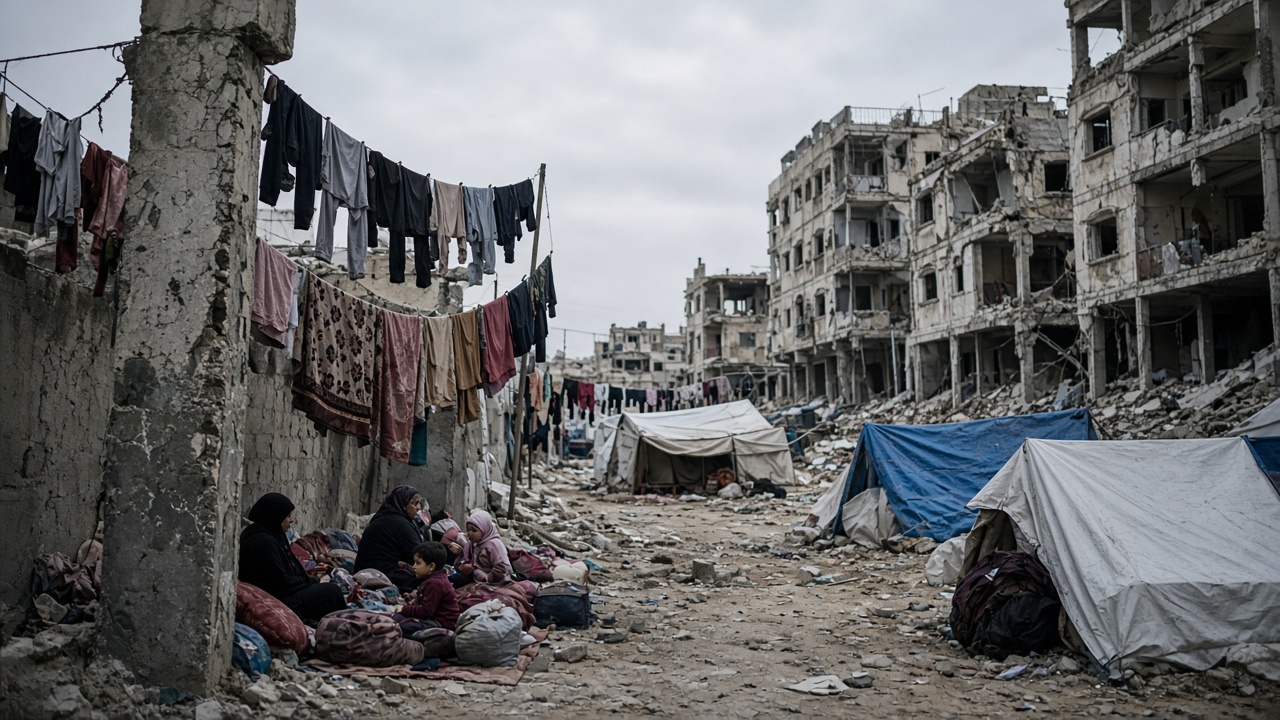
One year after President Donald Trump’s 20-point Gaza ceasefire took effect on October 10, 2025, the war’s most visible hostage crisis is over while the territory’s political and humanitarian crisis has deepened. Israeli forces control roughly 70 percent of the Gaza Strip, according to official accounts cited by international agencies, up from the 53 percent they were permitted to retain under the first-phase deal. Palestinian officials say near-daily Israeli strikes have killed about 1,450 people since the truce began, and large-scale reconstruction has not started.
The agreement, negotiated with Egypt, Qatar, Turkey and the United States, was supposed to pair phased Israeli withdrawals with expanded aid, a new civilian administration and eventual disarmament of Hamas. All living Israeli hostages taken in the October 7, 2023, attack were returned by mid-October 2025, and the recovery of remains continued until late January 2026. Rocket fire from Gaza toward Israel has largely stopped. Yet the pullback of troops stalled, partially reversed, and the promised “day after” administration has not taken full control.
Withdrawal pledges and the yellow line
Under the ceasefire framework, Israel was to shrink its footprint as Hamas moved toward decommissioning weapons and an international stabilization force deployed. Instead, Prime Minister Benjamin Netanyahu’s government has insisted on verifiable disarmament down to individual firearms before further withdrawals. Hamas has not begun that process, and Israel has kept expanding the area it treats as a security buffer, sometimes described as the “yellow line.”
Technocrat Ali Shaath was appointed in January to head a National Committee for the Administration of Gaza, meant to oversee civilian affairs during a transition away from Hamas rule. Israel has remained skeptical of the body, and the transfer of governing responsibilities is incomplete. A planned international force has not been deployed. Jared Kushner, who helped shape the Trump plan, noted in anniversary posts that Hamas signed a step-by-step weapons framework in July with mediator support, but implementation is stalled.
Humanitarian pressure and the Board of Peace
Human Rights Watch said on October 10 that Israeli forces continue to kill and wound civilians and restrict food, water and aid a year into the ceasefire. Gaza’s health ministry, whose figures the United Nations treats as broadly reliable, puts the cumulative death toll since October 2023 above 74,000, including more than 21,000 children. Aid volumes remain far below what relief agencies say is required, and critical access routes have been repeatedly obstructed.
The Board of Peace, created under U.N. Security Council Resolution 2803 to monitor compliance, presented a six-month recovery program in September that officials said could begin “the moment funding and access allow.” The European Union and United Nations jointly estimate recovery and reconstruction needs at $71.4 billion over ten years. On the ground, almost nothing has been rebuilt; displaced families still live in tents and damaged buildings while diplomats debate sequencing disarmament and withdrawal.
What negotiators face now
Anniversary coverage from news agencies and human-rights groups converges on the same picture: the ceasefire ended mass bombardment and freed captives, but it did not produce a durable security or governance settlement. Israeli elections and regional wars elsewhere have absorbed political attention in Washington and Jerusalem. For Gaza’s 2 million residents, the truce’s first anniversary marks a year without rocket barrages and a year without a credible path back to homes, schools or hospitals.
Trump and Arab mediators continue to describe the 20-point plan as the only workable roadmap. European and Palestinian officials counter that allowing Israel to hold more land while aid and reconstruction wait rewards military facts on the ground. Until withdrawals, policing and funding move in tandem, the ceasefire will remain a pause in the heaviest fighting rather than the beginning of recovery.