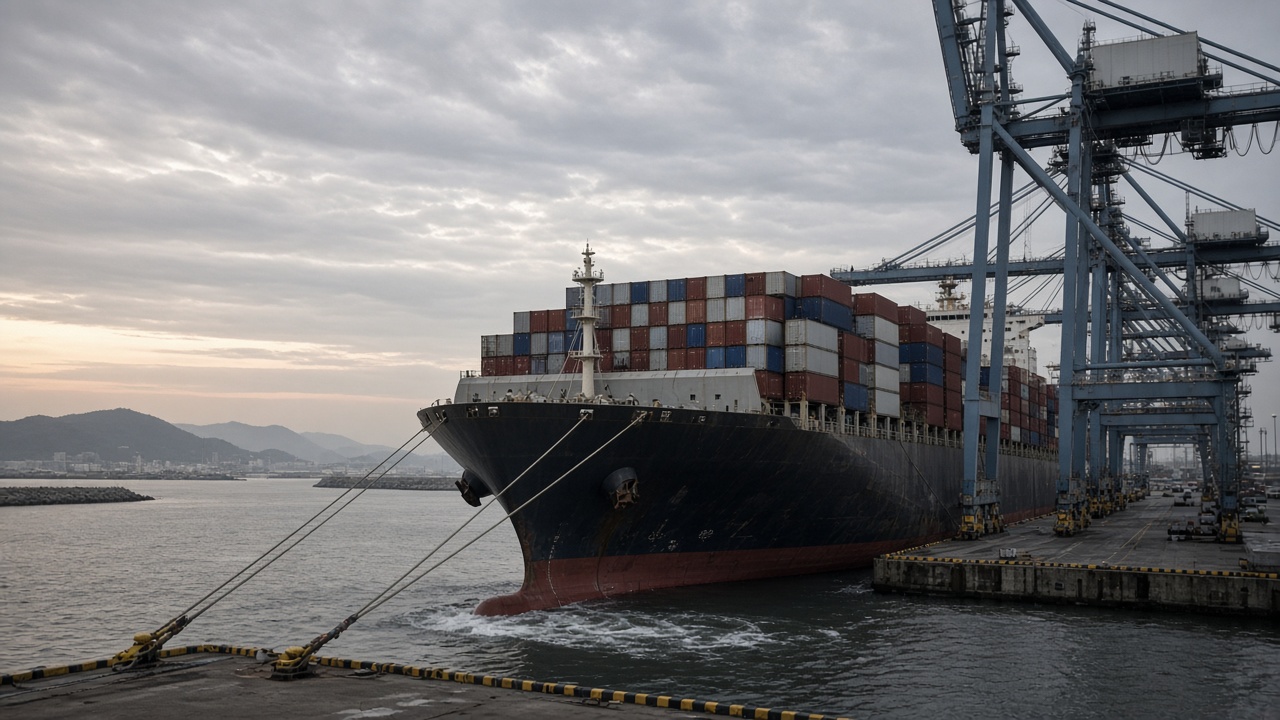
The container ship Panstar ACRO berthed at Busan Port on Sunday after a 50-day round trip along the Northern Sea Route, marking the first Korean-flagged trial voyage of its kind and handing the government a live dataset on Arctic shipping economics.
President Lee Jae Myung said in a social media post that the vessel returned at about 8:24 a.m. and that officials would analyze route, timing, fuel use and cost figures to judge whether commercial Arctic sailings are viable. Lee has tied the project to his push to build Busan and the southeast into what he calls a “Southern Maritime Capital Region.”
What the trial measured
The voyage left Busan in August, transited Arctic waters and reached European ports including Gdansk, Poland, before heading back across the top of the world. Panstar and government planners have said the Arctic leg cut roughly ten days off a one-way sailing compared with routing through the Suez Canal — a margin that matters when war risk and congestion plague conventional lanes.
Seoul’s stated goal is to open a regular Arctic service by 2030 if the numbers hold. That timetable sits alongside Lee’s decision last year to relocate the Ministry of Oceans and Fisheries to Busan, part of a broader effort to spread growth beyond the capital region.
Industry and security context
Korean shipowners have watched rivals test polar routes for years, but this trial puts national policy behind a specific operator and hull. Export-heavy manufacturers still depend on predictable schedules; any Arctic service would need ice-class tonnage, escort arrangements and insurance terms that do not yet exist at container-line scale.
Geopolitically, Russia controls much of the coastline along the Northern Sea Route, and Western sanctions on Moscow complicate financing and port calls even when ice charts look favorable. Lee’s post emphasized economic opportunity rather than politics, but shipping analysts say compliance teams will scrutinize every future manifest.
Next steps in Busan
Officials plan to publish a structured review of the trial’s operational data before committing public subsidies or port upgrades. If the Arctic link matures, Busan could market itself as a winter-season shortcut for containers bound for Europe — but only if insurers, charterers and major importers agree the saved days are worth the polar risk premium.
For now, the ACRO’s return is a symbolic win: Korea has completed the loop, and the spreadsheet work begins Monday in government ministries and at Panstar’s headquarters overlooking the harbor cranes.