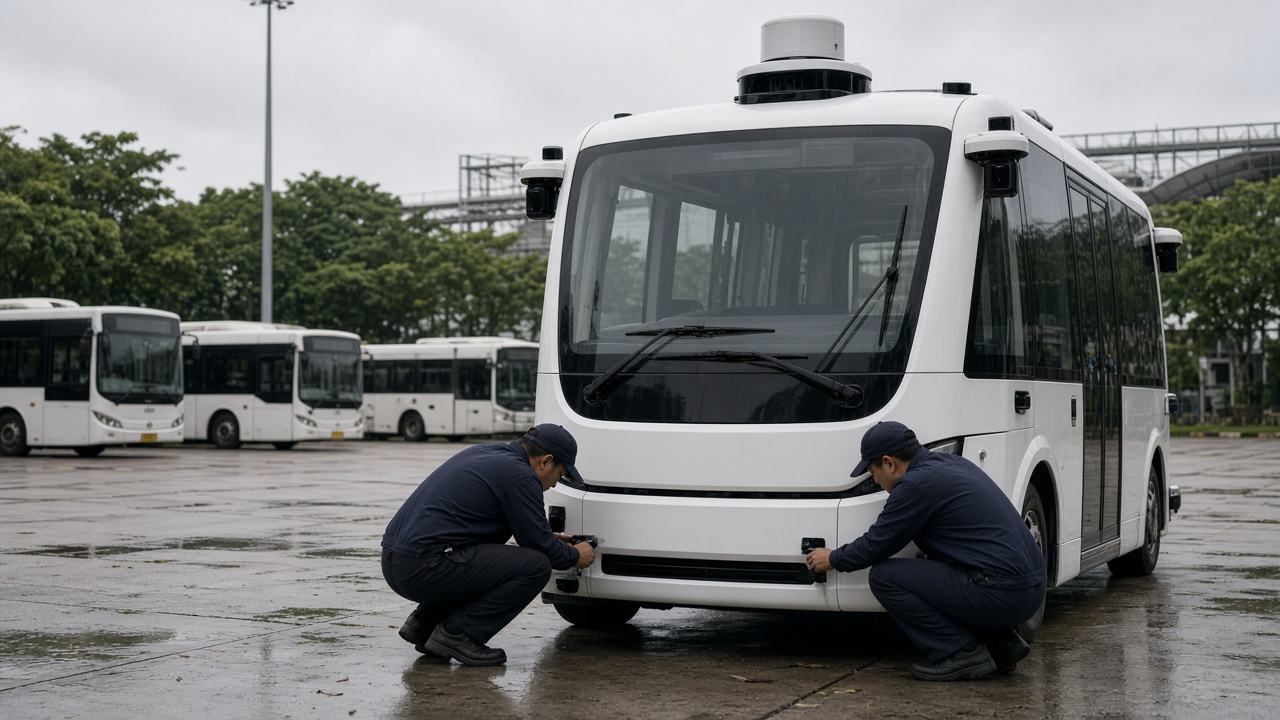
Singapore has shelved plans to run six autonomous buses on two public routes from the middle of next year, reversing a flagship test that was meant to put driverless coaches on streets in Marina Bay, Shenton Way and the one-north business district.
The Land Transport Authority told The Straits Times on Monday that it will not deploy the vehicles on SBS Transit services 400 and 191 as previously scheduled. Instead, officials said they are pursuing a “phased and calibrated approach,” beginning with smaller-scale uses such as employee shuttle services before considering full public bus operations.
What Changed
Autonomous bus pilots have been a visible part of Singapore’s smart-nation branding for years, with policymakers arguing that tightly managed road networks and strict licensing make the city-state a natural laboratory. Route 400 serves the downtown core and tourist belt; route 191 links the Buona Vista one-north research cluster with residential estates — both environments with heavy pedestrian traffic, frequent road works and complex merging patterns.
LTA said all six autonomous buses have been delivered to Singapore. Only the first unit, which arrived in March, has passed the authority’s closed-circuit test covering basic manoeuvres and passenger boarding safety at designated stops. The remaining five are still being prepared for the same evaluation, which LTA uses to confirm vehicles can operate safely on the test track before any on-road trial with commuters.
Why Officials Are Slowing Down
Public bus services involve unpredictable stops, crowded cabins and tight schedules tied to rail feeder connections. Shuttle runs for a single employer or campus, by contrast, allow operators to control departure times, limit passenger loads and rehearse routes repeatedly.
Transport analysts said Monday’s announcement reflected lessons from overseas pilots where autonomous buses struggled with construction detours, sensor blind spots in tropical rain and the social acceptance of removing a human driver from a 40-seat coach. Insurers and manufacturers have also pressed for more closed-course data before underwriters price fleet-wide policies.
SBS Transit did not immediately detail how the decision affects its capital plans or driver training pipelines. Commuters who had seen promotional material about “driverless buses coming soon” along the waterfront will now wait longer for a public trial.
Industry and Commuter Impact
Local technology firms that supply lidar, mapping and fleet-management software may still win contracts for the narrower shuttle trials. However, delaying route 400 and 191 removes a high-visibility showcase that developers had hoped would accelerate export sales across Southeast Asia.
For residents in one-north, the pause means continued reliance on conventional buses and the North-South and Circle MRT lines. Businesses in Marina Bay said they remained open to future autonomous shuttles for late-night staff movements but wanted assurances on cybersecurity and manual override protocols.
Next Steps
LTA did not give a revised timeline for when — or if — the six buses might eventually carry fare-paying passengers on public routes. The authority said it would explore “targeted groups of commuters” first and revisit wider deployment once safety cases are complete.
Parliamentary questions are likely at the next transport committee sitting, with opposition MPs expected to ask how much public money was spent on vehicles that are now idling pending new use cases. Until LTA publishes a concrete shuttle roadmap, Singapore’s driverless bus program will shift from a headline-grabbing downtown trial to a quieter, campus-by-campus experiment.