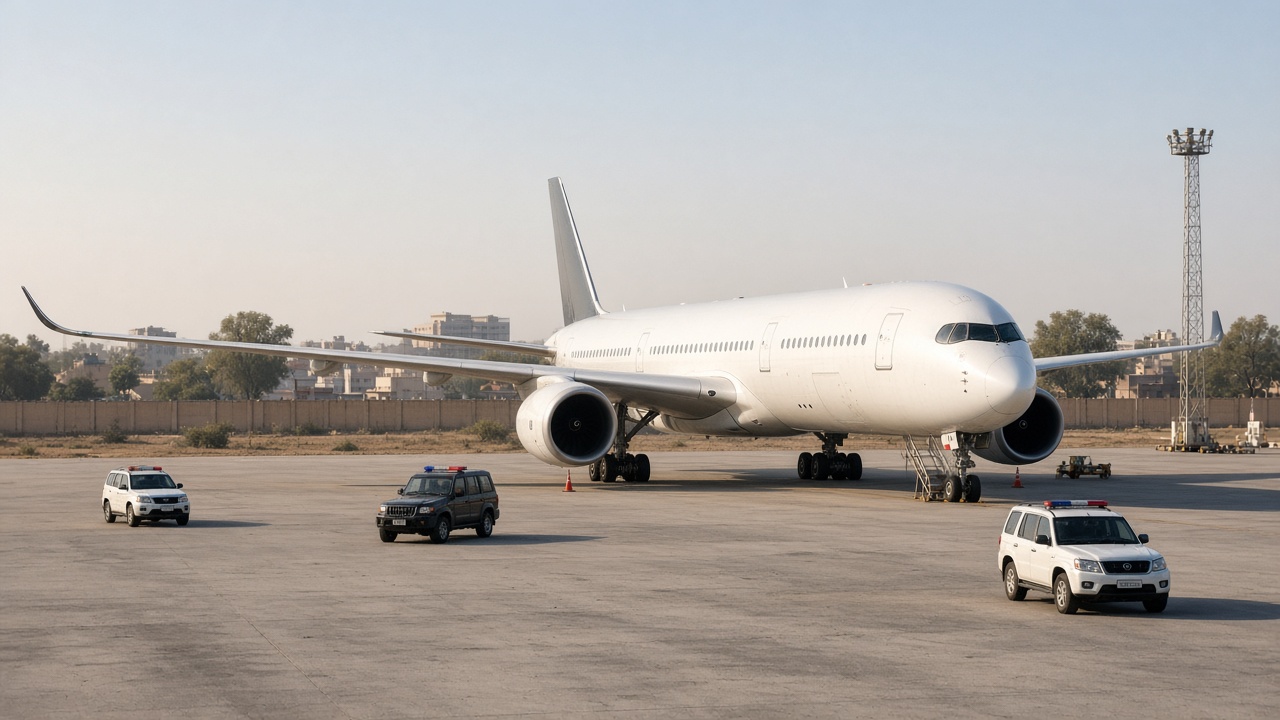
An Air India Boeing 787-9 operating as flight AI2030 from Frankfurt to Delhi was diverted to Jaipur on Wednesday morning after the cockpit set transponder code 7500, the international signal for unlawful interference, triggering a full security response on the ground.
Jaipur Airport director Charan Singh said all 306 passengers landed safely at 9:35 a.m. and were taken to the terminal under the watch of security agencies. The aircraft was moved to an isolation bay for searches while officials worked to determine whether the alert reflected a genuine threat or an inadvertent input from the flight deck.
How a single code rerouted a transcontinental flight
Squawk 7500 is one of three emergency codes pilots can select to alert air traffic control without relying on voice communications. When AI2030 entered the Mumbai Flight Information Region, controllers and defense coordination cells treated the transmission as a hijack indicator, according to officials briefed on the operation.
Delhi was the scheduled destination, but security protocols favor diverting to an airport with room to isolate the jet away from crowded gates. Jaipur International Airport has handled similar diversions in the past, and police in Malviya Nagar said they were notified of a bomb-threat-related emergency landing even as investigators emphasized that no device had been found.
Passenger handling and the 'mistake' theory
Airport authorities deplaned travelers in a controlled sequence, separating luggage for explosive trace checks and interviewing crew members on the sequence of events leading to the code change. An official quoted by news agencies said passengers and relatives "need not panic," stressing that the situation was contained once the jet was on the ground.
Preliminary indications cited by multiple outlets suggest the captain may have activated the code accidentally, but Air India and the Directorate General of Civil Aviation had not issued a final determination by midday. Aviation safety experts note that false 7500 activations are rare but not unprecedented; they still oblige airports to execute the same choreography as a credible hijack because controllers cannot immediately verify intent at cruising altitude.
What regulators will examine next
Investigators will review cockpit voice and flight data recorders, radio transcripts with Mumbai and Delhi area control, and airline training on transponder discipline. If the event is classified as human error, DGCA could mandate additional simulator drills or checklist changes for long-haul crews switching between European and Indian airspace procedures.
For the 306 passengers, the diversion added hours of uncertainty on a route that already spans more than six hours airborne. Air India said it would ferry travelers to their final destinations under standard operating procedures once security cleared the aircraft and bags. Until the inquiry closes, the episode will remain a case study in how quickly a single transponder setting can mobilize national-level assets — and how costly it is to unwind that response even when early leaks point to a mistake rather than an attack.