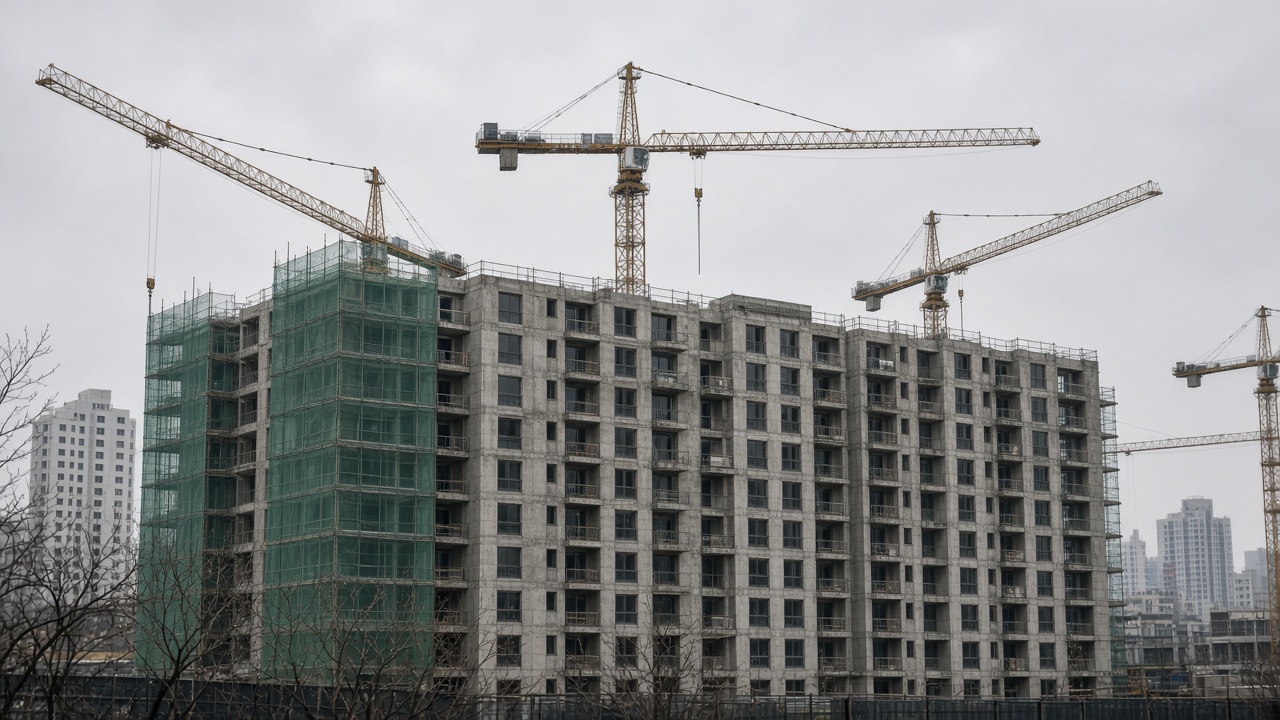
The Financial Services Commission and land ministry finalized a two-year pause on residential project-finance equity ratios on Tuesday, telling lenders they can keep funding viable apartment sites without immediately meeting a 5 percent sponsor equity floor that had been scheduled to bite in 2027.
Officials framed the decision as supply insurance, not a blanket bailout. Residential sites may defer prudential equity, provisioning, and risk-weight rules until 2029, when the required ratio will start at 5 percent and climb toward 20 percent after 2032. Non-residential projects, where delinquencies run higher, still face the original 2027 timetable.
What changes for developers
Developers and banks spent Monday's interagency session trading spreadsheets on troubled PF exposure. Regulators said roughly 4 trillion won of loans are in active workout talks, with another 3 trillion won flagged for accelerated restructuring. The equity holiday is meant to keep new money flowing to sites that already have sales contracts while those workouts proceed.
At the same meeting, policymakers reiterated August's real-estate finance package: household loan growth can run at 3.0 percent this year, but relocation, interim, and balance-payment loans tied to housing supply sit outside that cap. The Korea Housing Finance Corporation is also scaling PF guarantees and a Korea Asset Management Corporation fund meant to absorb legacy failures without choking fresh starts.
Guarantee expansion runs in parallel
While equity rules were frozen, the housing finance corporation moved on lease support. It will lift the age ceiling on its special lease guarantee for homeless youth to 39 from 34, and newlywed or child-rearing households can borrow up to 300 million won against jeonse deposits, up from 200 million won, with applications opening October 19.
President Lee Jae-myung used Tuesday's cabinet session to tie the finance moves to his three social priorities—housing, jobs, and inclusive finance—arguing that megaprojects only work if households can still afford to move into the units those projects produce. Land ministry officials separately eased income limits on youth housing subscription accounts to 70 million won, widening access to preferential rates on comprehensive savings products.
Market reaction and risks
Construction equities were mixed in after-hours commentary, with analysts split on whether the deferral simply delays recognition of weak sponsor capital. Bond desks noted that non-residential PF paper could still face tighter underwriting, which may push some sponsors to re-label commercial floors as mixed-use to chase the residential exemption.
Regulators promised monthly PF dashboards and said they would publish criteria for which stalled projects qualify for guarantee backstops. For apartment buyers watching crane counts in Gyeonggi, the practical question is whether banks reopen credit lines this week or wait for clearer workout lists. The FSC said first revised lending manuals would go to banks by Friday.
Commercial banks said they would run dual track reviews: fast-track approvals for sites with presales above 70 percent, and workout committees for anything below that threshold. That distinction matters for buyers who paid deposits into projects now stuck in court mediation. If manuals land Friday as promised, some lenders could reopen undrawn commitments as early as next week.
Bond and insurer angles
Insurance asset managers said they would treat the deferral as neutral for AA-rated builders but negative for sponsors already on watch lists. Several life insurers paused new PF participations until the FSC clarifies whether deferred equity counts toward risk-based capital denominators. Credit analysts noted that offshore investors in Korean covered bonds were asking whether apartment exposure in cover pools would be reclassified.
Regional governments welcomed the move because stalled sites freeze local tax receipts. Gyeonggi Province officials cited three Incheon parcels that could resume concrete pours if banks reopen committed lines. They urged the land ministry to pair finance relief with faster environmental approvals so deferred equity does not simply fund idle land banks.