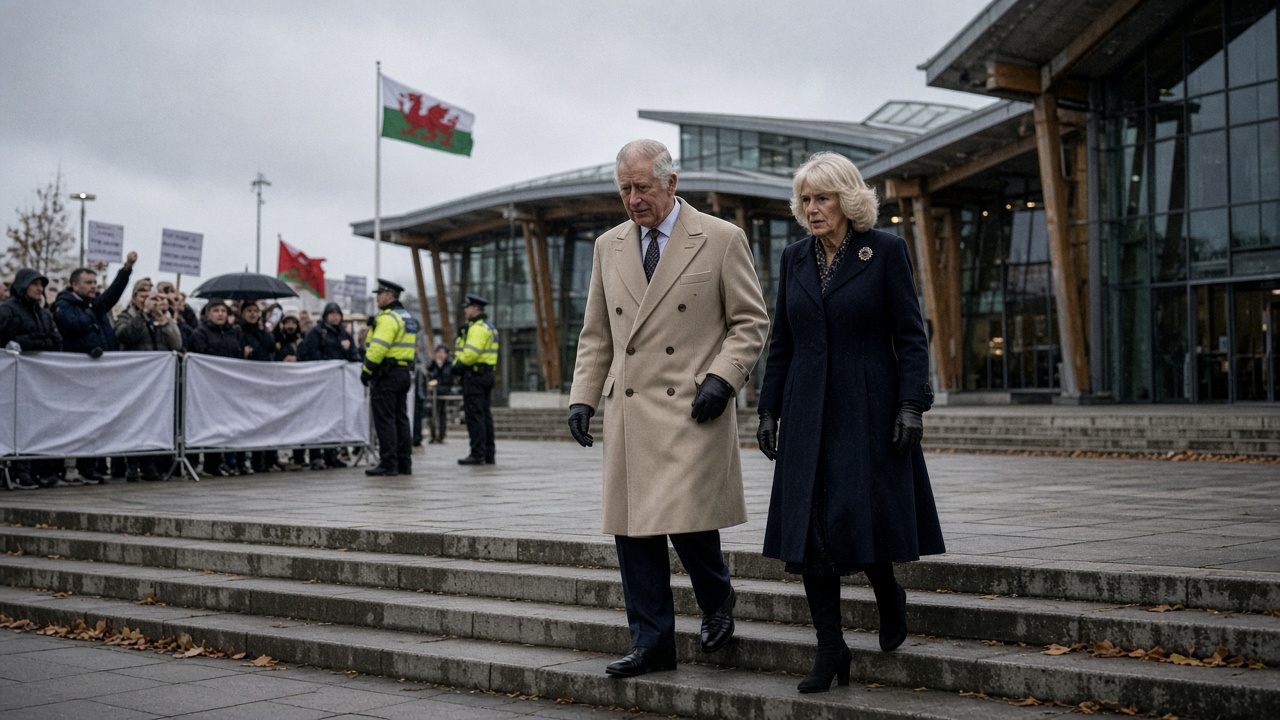
King Charles III and Queen Camilla opened the seventh term of Wales’s Senedd on Thursday in Cardiff Bay, the first such ceremony since Charles became monarch and the first since Plaid Cymru leader Rhun ap Iorwerth took office as first minister after May’s election. Inside the Siambr the King addressed members in Welsh, quoted the poet Ceiriog, and spoke of his “special connection” with the country; outside, about 30 anti-monarchy protesters chanted “not my King” until officers arrested one man who refused a dispersal order.
A parliament that has ‘come of age’
The sitting blends symbolic ritual with a changed power map. Plaid Cymru now runs the Welsh government with a larger, 96-member Senedd designed to strengthen scrutiny. Ap Iorwerth told MSs they were opening “a new chapter” for Welsh democracy and urged parties to treat the chamber as more than a “echo chamber,” even as presiding officer Huw Irranca-Davies appealed for civility after months of sharper debate than the institution’s consensus-driven past.
Charles, for his part, framed endurance—of language, culture, and land—as the thread linking Welsh identity. He referenced summer heatwaves and his “deep concern” for a “rapidly changing planet,” a rare environmental note in an otherwise ceremonial address. The royal couple also met Aberfan survivors, including Gareth Jones, who was rescued as a child in 1966 and attended with a photograph of his father meeting the then-Prince of Wales; Noah Jones, whose great-grandfather helped save Jones, presented flowers to the Queen.
Poetry, politics, and a Section 14 arrest
Not every planned element survived the “apolitical” brief. National Poet of Wales Hanan Issa said it was “quite concerning” that her commissioned piece To Grow—which touches on Gaza and trans healthcare—was rejected and her slot replaced by a school choir performance of O Gymru. Issa’s exclusion became its own political story within hours, with Welsh commentators debating whether a state opening can fence out live public debates.
On the Senedd steps, protesters sang Yma o Hyd as the royal motorcade arrived. South Wales Police said one man was detained under Section 14 of the Public Order Act after officers imposed a dispersal zone and he declined to move; footage showed him handcuffed in traditional Welsh dress. The rest of the small republican crowd continued chanting through the King’s speech, underscoring that Cardiff’s welcome was enthusiastic in places and openly hostile in others.
What happens next in Cardiff
Ap Iorwerth’s government still must translate its enlarged mandate into legislation on health, transport, and the Welsh language while managing a more fractured chamber. Charles and Camilla left to the Welsh national anthem after less than three hours on the bay, with another Wales visit scheduled next week for Aberfan’s 60th anniversary commemorations.
For the Senedd, Thursday was less about policy votes than about visibility: a monarch speaking Welsh in a parliament led by Welsh nationalists, with republican dissent meters from the door. The arrest will feed arguments over protest rights around royal events; the poet’s removal will feed arguments over what “apolitical” means when MSs themselves campaign on Gaza, climate, and NHS waiting lists. Both disputes now sit on the order paper of Welsh politics alongside the mundane committee work that begins Friday.