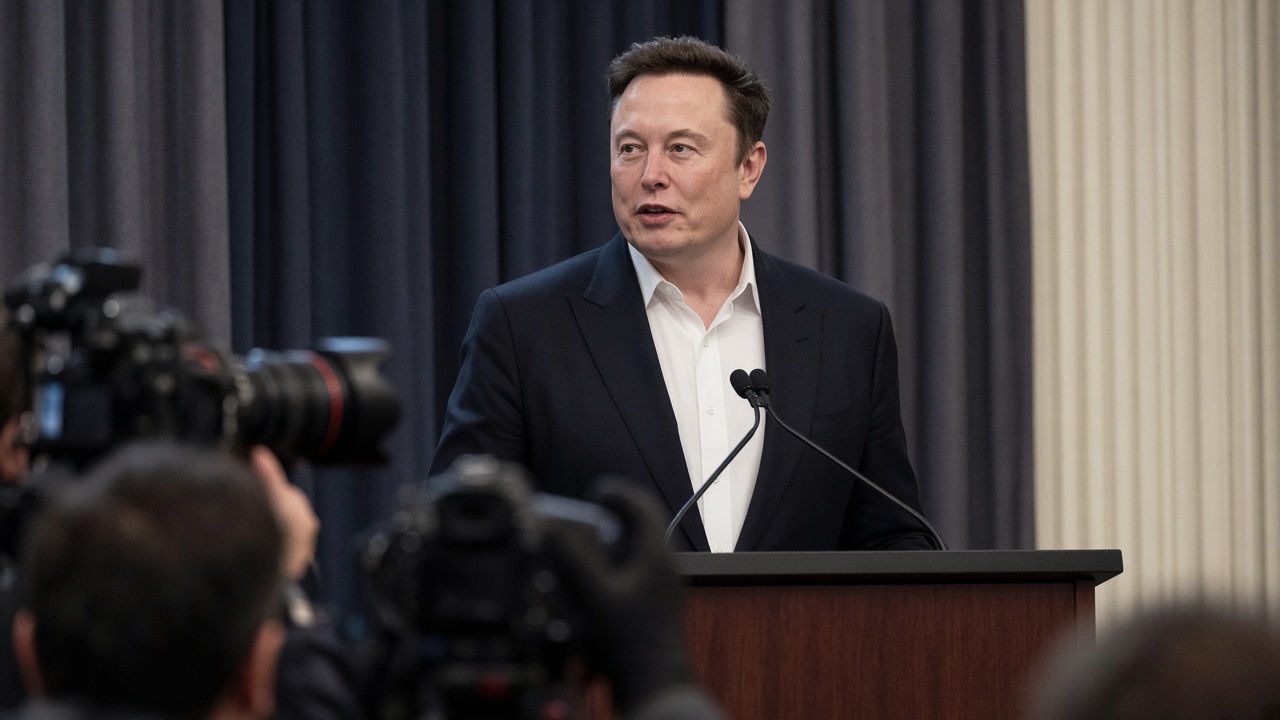
Elon Musk said on Wednesday that any speed or usage limits on Ukraine’s Starshield satellite terminals are imposed by the United States government and the military, not by SpaceX, pushing responsibility toward President Donald Trump as Ukrainian officials complain that slower links are hampering drone operations and strike planning.
Musk’s comments on X came in reply to Mykhailo Fedorov, Ukraine’s former defence minister and a longtime advocate for battlefield connectivity. Fedorov wrote that Starlink service at speeds of up to 160 kilometres per hour was being restored but that removing Starshield’s speed limit entirely was “now critical for Ukraine’s defence.” Musk answered that Starshield “systems are owned and controlled by the US government,” adding that “any limits on speed or usage are decided by the US military and ultimately POTUS.”
Two networks, one vendor
Both Starshield and the civilian Starlink constellation are built by Musk’s SpaceX, but Kyiv treats them differently in practice. Ukrainian forces rely on Starshield for hardened military traffic, including guidance for strike drones and coordination of air-defence interceptors, while Starlink remains widely used across government and society. Musk stressed that Starlink is not authorised for offensive military use, a line Washington has repeated when policing how export-controlled gear is employed on the front line.
The exchange landed amid a broader rupture in wartime support. Ukrainian leaders have publicly questioned whether the United States slowed some terminals after Kyiv’s long-range strikes on Russian energy infrastructure, and whether Washington failed to pass timely missile warnings before ballistic attacks hit the capital on consecutive nights. Trump denied withholding launch intelligence on Tuesday, but a senior official in Kyiv told reporters that American threats to curb such sharing had been heard in recent days.
Politics at the pump and in Rome
Domestic politics are never far from the dispute. With US midterm elections weeks away, Trump has linked rising petrol prices to Ukrainian attacks on Russian refineries, arguing that those strikes squeeze global supply. Democrats in Congress have criticised the administration over reports of interrupted satellite service, framing connectivity curbs as another lever Washington might pull as it pressures both Moscow and Kyiv toward a settlement.
European allies are watching the same fight from a different angle. Italian Prime Minister Giorgia Meloni told parliament on Wednesday that a US-Russia deal to import Russian diesel was “a legitimisation for Moscow while its bombs are still falling on Ukrainian cities,” warning that the arrangement weakens the sanctions toolkit Europe and Washington have used to push Vladimir Putin toward talks. Meloni spoke before heading to a European Council meeting in Brussels, where energy security and military aid to Kyiv were already on the agenda.
What Kyiv says it needs next
On the ground, Russia and Ukraine gave conflicting accounts of whether an “energy ceasefire” had been breached. Moscow said Ukrainian drones hit two refineries; Kyiv said other sites were struck but denied that the refineries Russia named were among the targets. Overnight, Russian strikes damaged a Kyiv heating plant and apartment blocks, killing at least one person and injuring more than twenty, according to Ukrainian officials, while Russia’s defence ministry said it downed hundreds of Ukrainian drones, including a large batch near Moscow.
Fedorov’s post thanked Musk for “continued support” even as he asked for full Starshield speed. That polite tone reflects how dependent Ukraine remains on American-built constellations for situational awareness. Musk’s answer does not promise faster service; it redirects the request to the White House and the Pentagon. Unless those customers change policy, SpaceX’s public position is that engineers in Hawthorne are not the bottleneck.
For now, the argument is less about satellites than about who in Washington decides how fast Ukraine’s military can move while negotiating with an administration that is simultaneously talking to Moscow about diesel and to voters about fuel bills. Musk has placed himself on the sidelines of that decision, even though his company built the hardware in orbit.