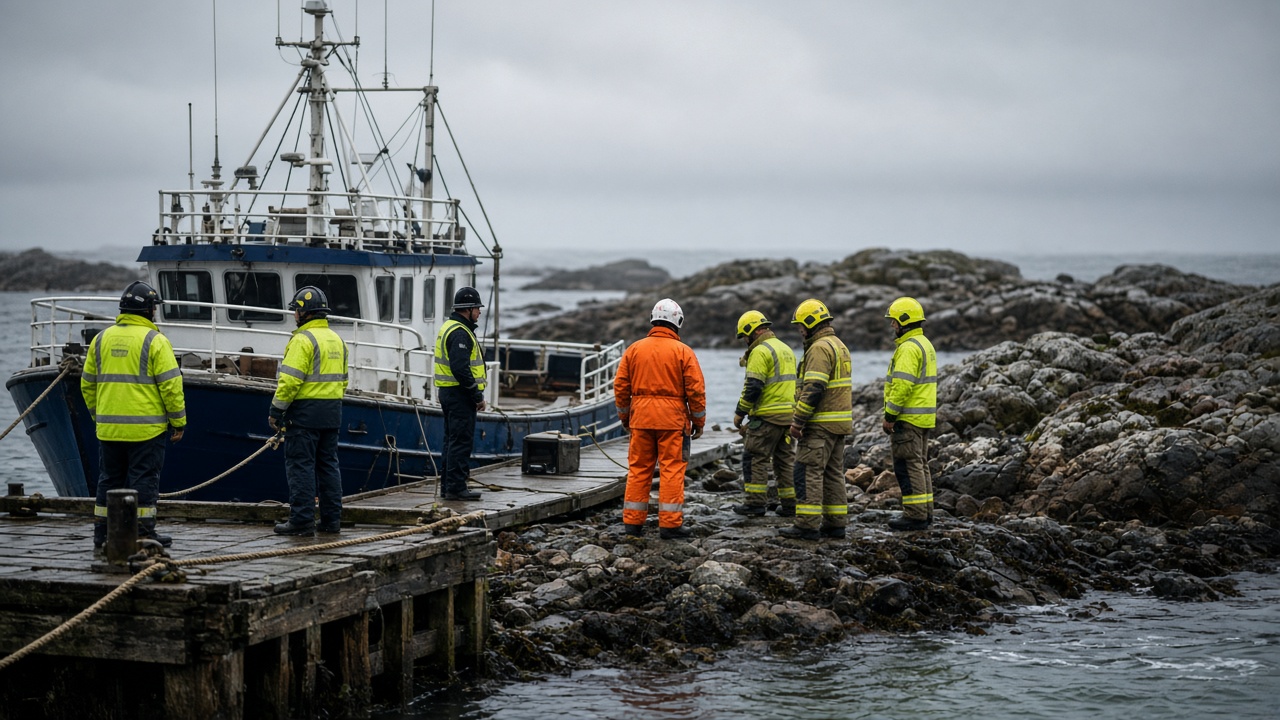
Three workers died on Dongju Island in the Matsu archipelago after they were found unconscious in the cabin of a harbor work vessel, with firefighters reporting elevated carbon monoxide inside the confined space and prosecutors opening a death investigation.
The Lienchiang County Fire Department received a report at 10:38 a.m. on Wednesday that three men were trapped aboard the vessel Dongping No. 17 at Meng’ao Harbor (猛澳港). Rescuers pulled them from the cabin without vital signs, and doctors at the local health center pronounced them dead, county officials said.
Rescue attempt turned fatal
According to county and media accounts, two workers entered the vessel’s cabin first to address leaking during repair work on the floating platform. Both collapsed. A third colleague went in to help and also lost consciousness—a pattern familiar to safety regulators in confined-space accidents where a single rescuer becomes another victim.
Fire crews detected high carbon monoxide at the scene but said they lacked equipment on hand to test for other gases. Some reports raised the possibility of biogas exposure; Lienchiang authorities said the precise source of the gas and the legal cause of death remain under investigation. The three men, identified in local coverage by surnames Lin, Su and Zhuang, were Taiwanese employees of a subcontractor hired to repair the vessel.
Harbor project halted
Deputy County Magistrate Chen Kuan-jen said officials cordoned off the construction site and ordered the main contractor to suspend work. The county pledged to cooperate with prosecutors and the Ministry of Labor while conducting broader safety checks on public works across the islands.
Lienchiang prosecutors traveled to Dongju to inspect the site and interview witnesses, with a medical examiner expected to determine the official manner and cause of death. Magistrate Wang Chung-ming boarded a ferry to the island to review the response, underscoring how politically sensitive workplace fatalities are in Taiwan’s remote counties where medical evacuation is slow and crews often live far from family.
Confined spaces on outlying islands
Matsu’s harbors sit at the intersection of tourism, military logistics and fishing traffic. Renovation projects routinely rely on barges and work vessels with tight below-deck spaces where engines, generators or decaying cargo can produce odorless gases. Labor groups have long pushed for mandatory gas monitors and standby rescue teams on such jobs.
For residents of Dongju and neighboring Juguang, Meng’ao is not an abstract infrastructure line item—it is how fuel, food and construction steel arrive. The county government said it would publish findings once laboratory results and the labor inspection are complete. Families of the three workers were receiving assistance, officials said, as the harbor remained closed to the renovation work that brought the vessel to the quay.