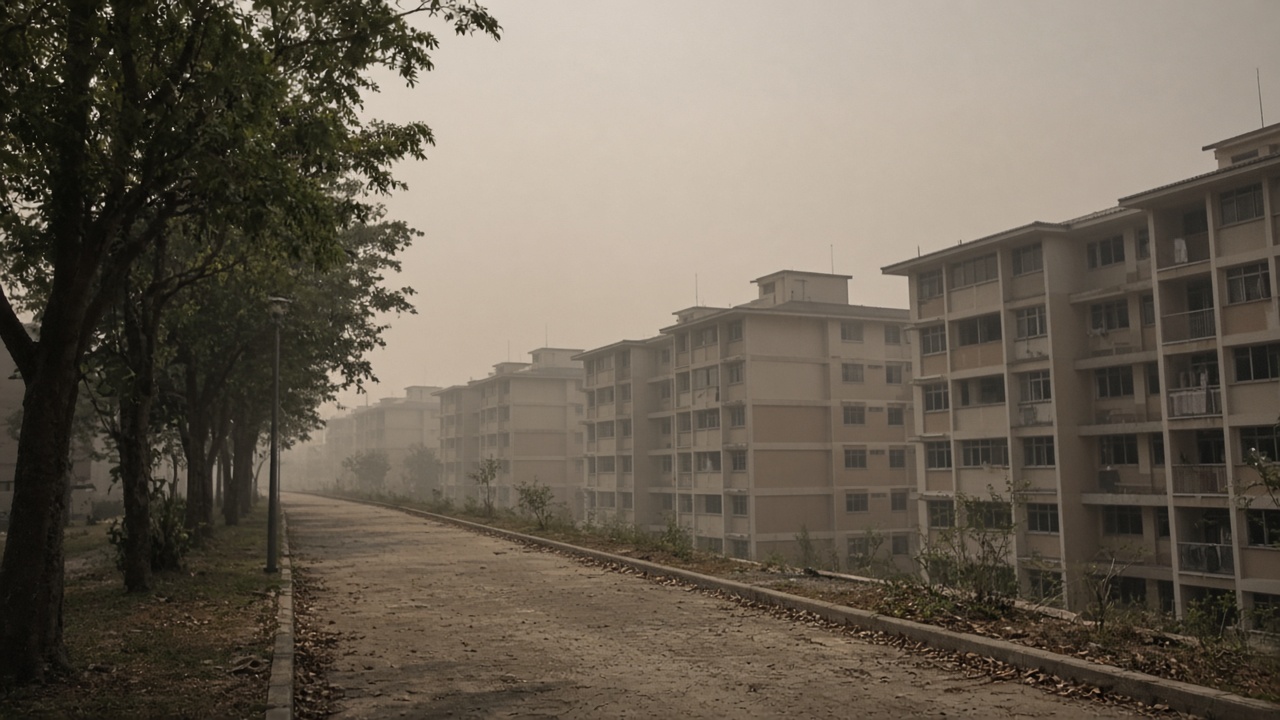
The National Environment Agency recorded a 24-hour Pollutant Standards Index reading of 212 in the west on Thursday evening, the highest level Singapore has seen in this haze episode, as smoke from Kalimantan continued to drift across the island under southeasterly winds.
Hourly PM2.5 concentrations remained in the high band across central, eastern and western monitoring regions late Thursday, while northern and southern readings sat in the elevated range. The 24-hour PSI stayed unhealthy islandwide, spanning roughly 130 to 198 at 11pm, even after the west slipped back from the very unhealthy band it had occupied since Wednesday night.
What NEA is signalling
In its Thursday advisory, NEA said dense smoke haze from fires in Kalimantan was still moving toward Singapore, with additional haze observed over Sumatra. The agency has kept outdoor and non-air-conditioned facilities at selected ActiveSG centres closed in three regions as a precaution, extending measures that began when hourly PM2.5 in the west spiked to levels not seen since 2015.
Minister for Sustainability and the Environment Grace Fu told reporters on Wednesday that mask distribution was brought forward because forecasts pointed to continued PM2.5 spikes that would lift 24-hour PSI readings. Collection at community clubs and vending machines at transport hubs and Social Service Offices is rolling out in phases, and NEA has asked residents to allow time for machines to reach every estate.
Parliamentary pressure points
The haze has moved from a weather story to a coordination test for ministries. Schools and employers are working off MOE and MOM guidance on outdoor activities, while health agencies have activated clinic subsidy schemes for haze-related conditions. MPs from western constituencies have flagged longer clinic queues and parents keeping children indoors during what should be post-exam relief week.
Government leaders, including Prime Minister Lawrence Wong, have appeared at community collection points to reinforce mask use when readings are high. The political task now is to keep messaging consistent as PSI bands shift hour to hour: residents want clarity on when outdoor CC activities resume, not just daily averages.
Regional context
Singapore has again filed transboundary haze data with Indonesian authorities as part of long-running cooperation under the ASEAN framework. Diplomatic channels remain open, but the domestic clock is faster — every extra day of unhealthy air feeds questions about business continuity, event permits and vulnerable households without air-conditioning.
NEA will continue twice-daily briefings while winds remain unfavourable. Until the 24-hour PSI stabilises in the moderate band, expect agencies to keep precautionary closures and mask distribution on the front page of the government’s haze playbook rather than treat Thursday’s 212 as the peak.
Employer and school protocols
MOE has kept schools open while suspending outdoor co-curricular activities when PSI enters the unhealthy band. Employers with outdoor worksites must follow MOM heat and haze rest schedules; the Manpower Ministry refreshed indoor work guidance this week as firms set up haze shelters in factories.
Construction sites in Jurong Industrial Estate reported slower concrete pours when workers wore respirators in humid conditions. Project managers are logging downtime hours in case contracts allow force-majeure claims — a bureaucratic ripple that shows up in GDP data before it shows up in headlines.
Health system load
Polyclinics in the west reported higher walk-in rates for cough and eye irritation, even as MOH’s haze subsidy scheme caps bills at S$10 for eligible citizens at participating PHPC clinics. Hospital emergency departments have not declared surge status, but ambulance dispatch logs show moderate increases in respiratory cases.
Town councils and vulnerable blocks
West Coast and Jurong West town councils have opened air-conditioned common areas for seniors without home cooling, a move copied from the 2015 haze playbook. Volunteers are pairing mask collection slips with door knocks on rental blocks where elderly residents may not follow Gov.sg alerts.
Estate managers said lift lobbies now carry laminated PSI band charts so residents know when to keep windows shut. The detail sounds minor, but in high-rise towns a single open corridor window can pull smoky air into dozens of units — the kind of friction MPs hear about when 24-hour averages lag behind what people smell at breakfast.