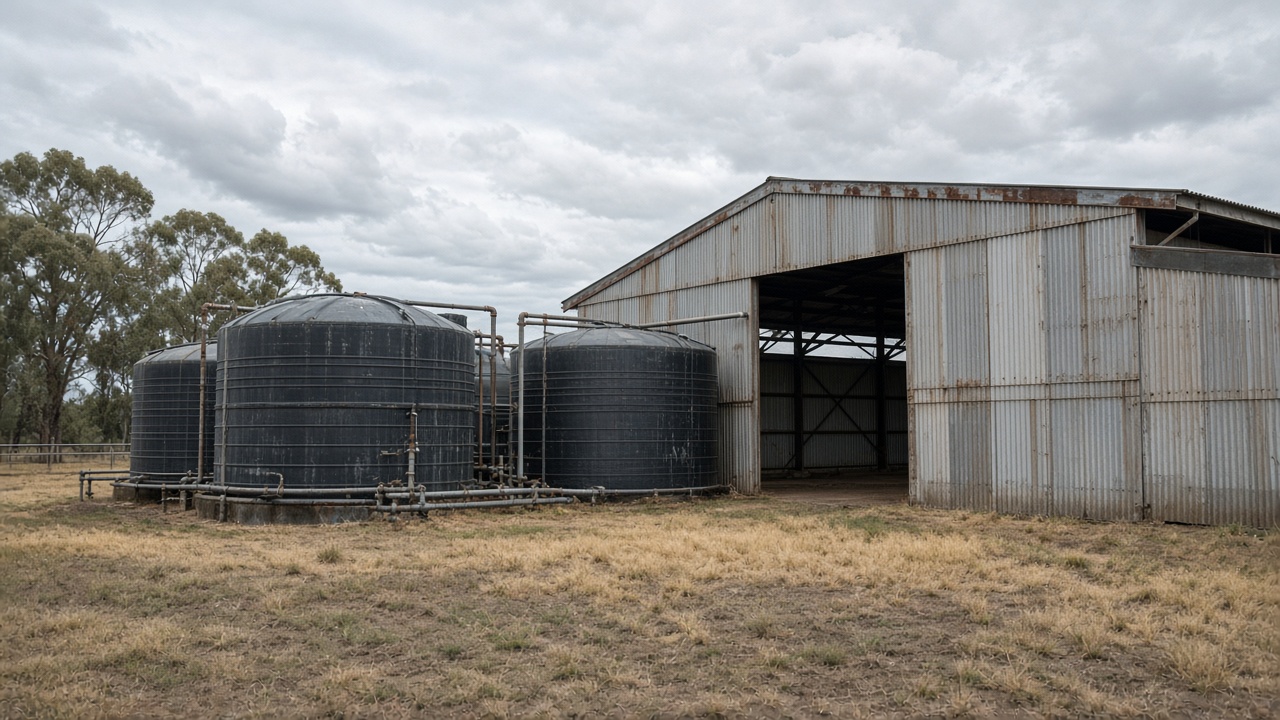
Singapore-based Zerra DC says its proposed Western Downs Digital Park near Dalby can operate through drought years using only harvested rainwater and air cooling, addressing the fiercest local objection to Australia’s largest announced AI data-centre campus.
Four halls, 21,000 litres a day—on paper
Planning documents lodged for the $32 billion project estimate each of four buildings would consume about 21,000 litres daily, comparable to a small shopping centre. Chief data-centre officer Matt Ward told the ABC that modelling even for 2019, when Dalby recorded less than 200 millimetres of rain, showed roofs capturing enough water to stay online without tapping town supplies or bores.
The sheds span roughly 35,000 square metres of roof area apiece—large enough to matter in a region where farmers watch dam levels obsessively. Air cooling removes evaporative towers that guzzle potable water in older designs, although Queensland heat still demands heavy-duty airflow engineering.
Who pays for the grid upgrades
Ward compared Zerra to a commercial landlord: tenants such as Anthropic, which has signed for the first hall targeting 2027 operation, would fund the generation and transmission assets needed to match their draw. That aligns with federal talk about “bring your own electrons” rules for hyperscalers, shifting political heat from rural councils to AI balance sheets.
Queensland’s state government has touted job counts—hundreds in construction and more than a thousand at steady state—while promising agricultural water rights will not be traded away silently.
Sydney versus Darling Downs
News of DigiCo’s fifteen-year Anthropic lease in Sydney landed the same week, illustrating a two-speed strategy: coastal latency for some workloads, inland land and solar for base load. Anthropic has not publicly reconciled how training jobs split between sites, but dual footprints strengthen its hand in power-price talks with both Ergon Energy and NSW distributors.
Community scepticism remains
Western Downs councillors have heard support from job seekers and anxiety from graziers who remember prior mining booms that strained housing. Water pledges are now a political contract: any bore application would be read as betrayal.
Environmental groups want lifecycle emissions disclosures, not just operating water claims, especially if gas peakers backstop renewables on the local grid.
What regulators will test
Commonwealth critical-infrastructure rules may classify the park once energised, triggering incident reporting and foreign-investment scrutiny already familiar to telecom carriers. AI-specific parliamentary recommendations could add safety drills if agents trained on site reach public networks.
For Dalby, the near-term question is simpler: does the first hall pour concrete before the 2027 lease clock starts, and can rainwater tanks pass a real drought—not just a spreadsheet from 2019.