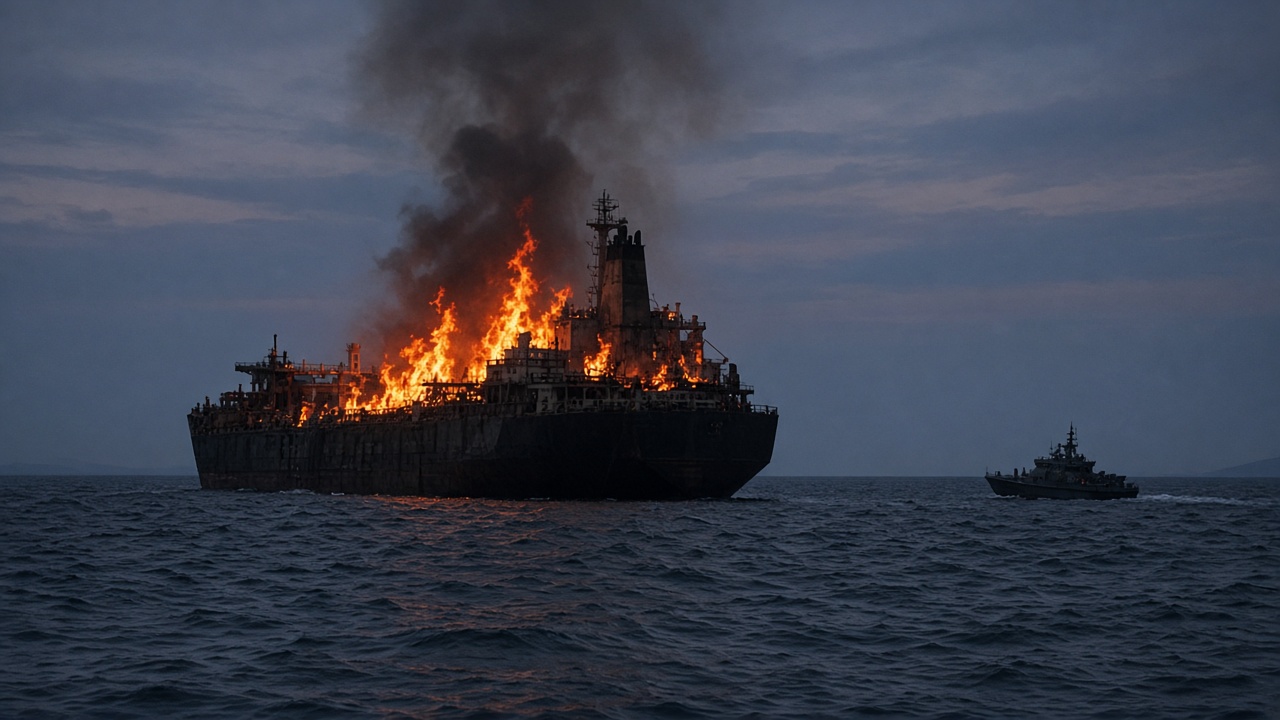
Iran's Islamic Revolutionary Guard Corps said Friday that a supertanker carrying more than two million barrels of crude oil caught fire after hitting a naval mine while attempting to transit the Strait of Hormuz on an unauthorized route, the latest escalation in a waterway where insurers, navies and charterers have been arguing for months over what counts as a safe passage.
The IRGC Navy statement, carried by Iran's semi-official Tasnim news agency, did not name the vessel or report casualties. It framed the incident as enforcement against smuggling traffic that ignores Iranian routing rules during the U.S.-led naval pressure campaign that has throttled Tehran's oil exports since major combat erupted earlier this year.
What the IRGC claims happened
According to the Guard's account, the tanker was trying to slip through Hormuz outside approved corridors when it detonated a mine. Tasnim published photographs it said showed flames and smoke billowing from a very large crude carrier, though independent verification of the imagery and the ship's identity remained incomplete as maritime databases updated slowly on Friday.
The statement fits a pattern Tehran has used since spring: treat any tanker that does not coordinate with IRGC escorts as fair game, while insisting foreign navies—not Iranian forces—are the ones endangering commercial traffic. Washington has countered that its blockade is lawful and that Iran has seeded hazards to raise insurance premiums and scare away buyers.
Separate hits reported off Jubail
The incident was not isolated. The United Kingdom Maritime Trade Operations center, which logs security alerts for merchant crews, reported that two tankers were struck Friday off the coast of Saudi Arabia's Jubail industrial hub. One vessel was hit by a rocket-propelled grenade fired from a small boat, UKMTO said; another was damaged by an unknown projectile. Neither alert immediately tied the attacks to Iran, but traders read them as part of the same Gulf risk spike that has kept Brent volatility elevated into the U.S. midterm season.
Reporting gaps remain a problem. UKMTO officials have said privately that many attacked ships refuse to file public incident reports, fearing higher premiums or retaliation. That opacity makes it harder for journalists and analysts to confirm whether Friday's Hormuz fire involved the same carrier rumored on shipping Telegram channels earlier in the day.
Washington's blockade narrative
U.S. President Donald Trump told reporters this week that the Navy is conducting an effective blockade and that no Iranian-flagged ship had crossed Hormuz recently—a claim Tehran disputes and that independent ship-tracking firms have struggled to verify because of dark-fleet transfers and ship-to-ship transfers outside the strait.
Central Command has separately argued that Iran-backed militias in Iraq and Syria are routing cash back to the IRGC to offset sanctions pain, a financial lifeline that could fund more mine-laying or drone boats even as front-line combat has cooled. European leaders, meeting in Brussels, have put the cost of the Iran war to their economies in the tens of billions of euros, with energy ministers watching every disruption alert from the Gulf.
What shippers watch next
Charterers will look over the weekend for confirmation of the tanker's name, flag and cargo destination. If the fire involved a laden VLCC, oil markets could price in days of lost throughput even if the strait stays physically open. War-risk underwriters, already charging record surcharges for Gulf voyages, may reset premiums again on Monday unless U.S. and Iranian channels open a temporary safety corridor—as Oman tried to broker last month.
For now the IRGC is messaging that unauthorized transits carry lethal risk. Navies patrolling the strait are messaging that Iranian mines and speedboats carry lethal risk. Merchant captains stuck in the middle face the same calculation they have faced all year: wait for naval escorts, pay for Iranian coordination, or gamble on a night run—with Friday's fire as the latest reminder that the gamble can end in an explosion visible from space.