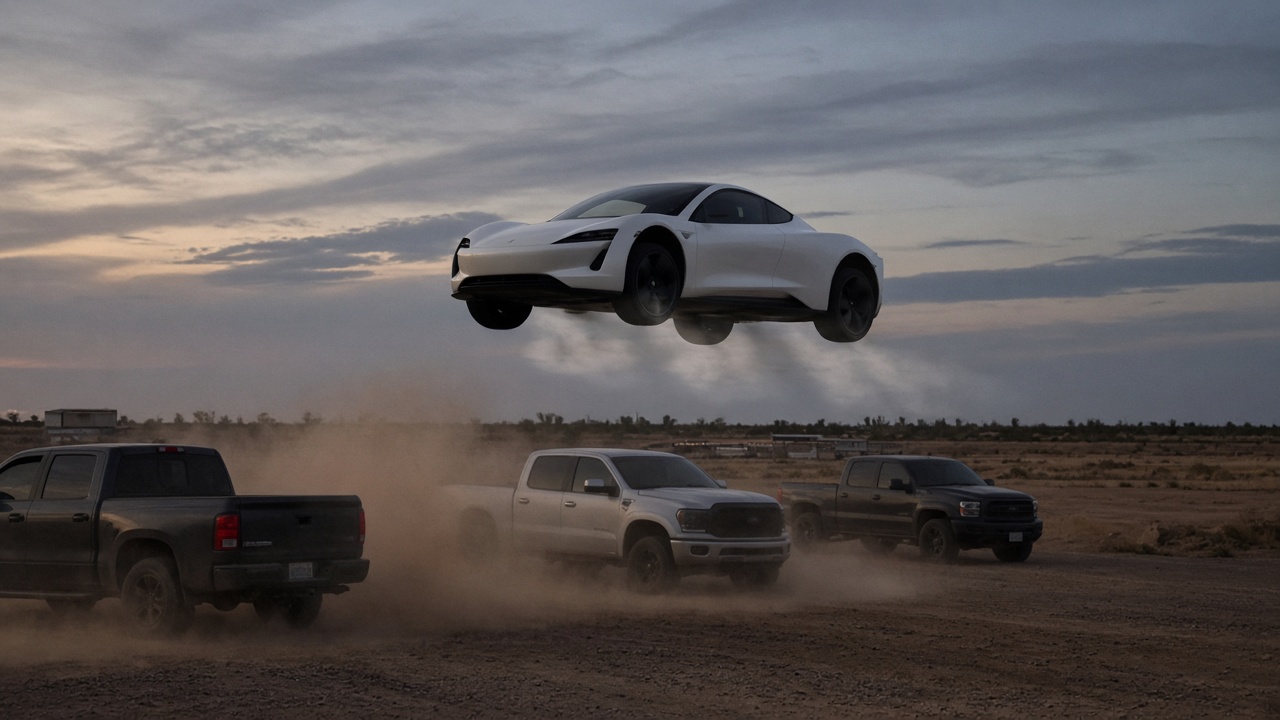
Tesla pulled the wraps off a next-generation Roadster at a SpaceX test site in McGregor, Texas, on Thursday, using cold-gas thrusters to launch the electric sports car over a row of vehicles, twist it mid-air, and set it down again — a spectacle Elon Musk framed as joint engineering with his rocket company rather than a near-term product you can order.
Vehicle engineering chief Lars Moravy told the crowd the Roadster can accelerate from zero to 60 miles per hour in under one second and reach more than 230 mph, while Musk insisted the real top speed would go "much faster than that." Tesla also showed the car driving upside down on a ramp using a suction system before the aerial jumps. Consumer production is now targeted for 2028, the company said, extending a timeline that began when Tesla first teased a second-generation Roadster in 2017 and once promised deliveries in 2020.
Regulators draw a line on roads and airspace
The demonstration immediately raised questions about who would oversee a car that leaves the ground. Tesla posted fine print that the vehicle shown is not approved for public road use, a disclaimer The Verge noted after videos spread online. The Federal Aviation Administration told POLITICO that the Roadster "does not meet the FAA's definition of an aircraft," signaling the agency does not plan to certify it as airworthy — though the statement left broader airspace jurisdiction unanswered.
That leaves state motor-vehicle rules, local traffic law, and Tesla's own deployment choices as the practical guardrails if any version of the technology ever reaches buyers. For now, the event read as a technology showcase at a private facility, not a regulatory filing or a homologation test for highways.
Investors weigh spectacle against the core business
Tesla shares rose about 5% in premarket trading Friday after the reveal, Reuters reported, even as analysts stressed that third-quarter results due October 21 matter more to the stock than a halo car. Gene Munster of Deepwater Asset Management called the display an "engineering flex" with limited commercial value beyond embarrassing legacy automakers, while also tying it to Musk's long-running interest in tighter links between Tesla and SpaceX.
The Roadster arrives as Tesla pivots public attention toward self-driving software, the Cybercab robotaxi concept, and Optimus humanoid robots — and after it stopped selling Model S and Model X to free factory space. Range on a single charge was quoted above 300 miles, well below the roughly 620-mile promise Musk made in 2017, underscoring how much the production brief has shifted even as the performance claims grew more extreme.
What buyers would still be waiting on
Tesla did not announce a price or reservation terms at the Texas event. AP noted that consumers should not expect to drive the flying prototype soon, and Musk's on-stage emphasis on SpaceX collaboration suggested the thruster package is as much about brand mythology as about a 2028 order book. If production does begin on that schedule, regulators in multiple countries would still need to decide whether brief hops count as driving, flying, or something regulators have not yet named — long after the smoke clears from McGregor.