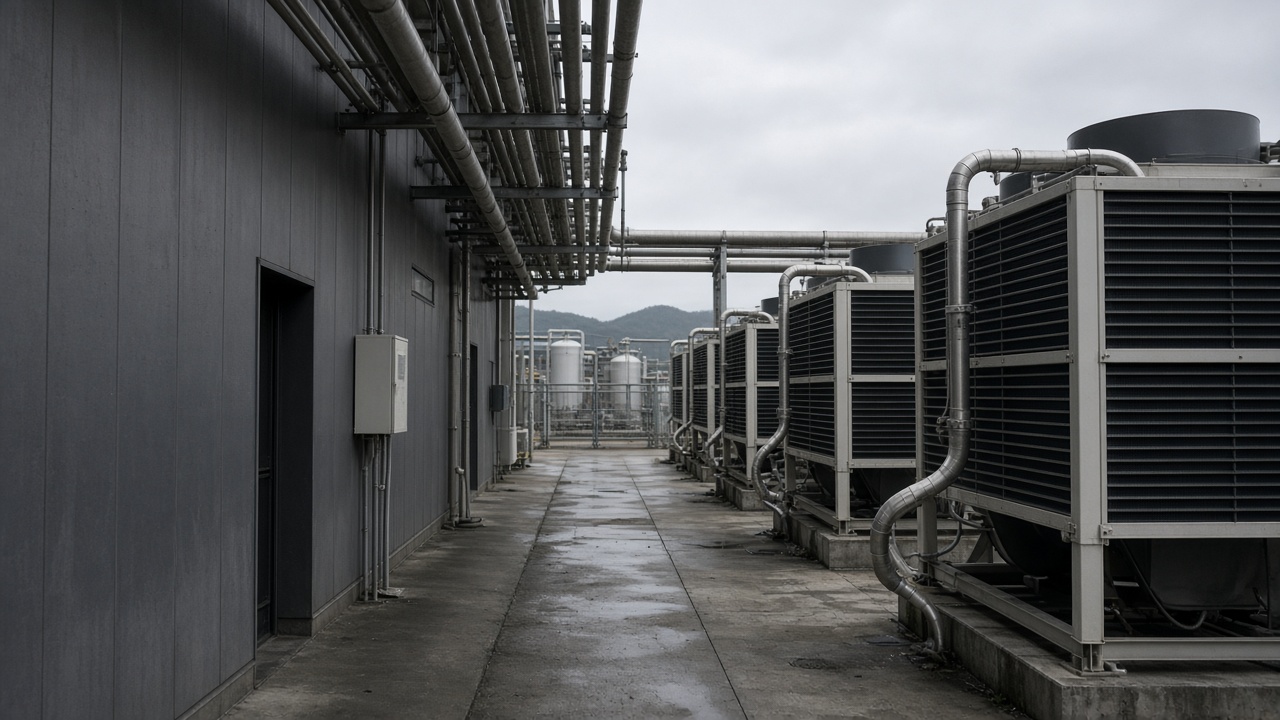
AirTrunk pledged another $1 billion to deploy liquid-cooled data halls at its Inzai hyperscale campus in Chiba Prefecture, telling Tokyo reporters the upgrade prepares Japan’s largest open-market AI workloads as geopolitics pushes North Asian customers to diversify beyond U.S. sites. Mei Kobayashi’s AI desk frames the spend as infrastructure catching up to model size: GPU clusters that once fit air-cooled aisles now need direct-to-chip liquid loops and higher rack densities the company’s TOK1 campus will host first at scale domestically.
What the billion buys
Reuters reported Oct. 7 that the Blackstone-backed operator will retrofit and expand existing buildings on the 300-megawatt-plus Inzai plot, shifting from cloud-style tenants toward training and inference contracts that draw 40 kilowatts per rack and climbing. CEO Robin Khuda said TOK1 is likely to be Japan’s first campus with large-scale AI workload deployment, citing customer demand for liquid cooling rather than raised-floor air handlers.
The investment stacks on a revised five-year Japan budget of $27 billion to $30 billion—roughly triple earlier plans Nikkei detailed Oct. 7—aligned with Tokyo’s sovereign-AI rhetoric and hyperscaler hunt for earthquake-resilient capacity near Tokyo fiber rings.
Sovereign AI and tenant mix
Japanese ministries fund domestic language-model trials through cloud credits and university partnerships; they need colocation that satisfies data-residency clauses without building every hall publicly. AirTrunk’s pitch pairs Blackstone capital with operator experience in Australia and Southeast Asia, competing against NTT Data’s integrated builds and U.S. clouds’ localized regions.
Kobayashi notes power remains the binding constraint: Inzai won early because TEPCO could stage substations; liquid cooling recovers efficiency losses that otherwise would cap usable megawatts.
Technology choices
Direct liquid cooling reduces fan power but raises water-treatment and leak-detection requirements Japanese fire codes are still harmonizing for AI halls. AirTrunk’s release emphasized factory-tested skid packages to shrink on-site commissioning—important when skilled electrician crews are shared with semiconductor plant builds in the same industrial belt.
Competitive field
Osaka’s push for an Anthropic-anchored NTT Data campus and Microsoft-Amazon expansions in eastern Japan mean AirTrunk must lock anchor tenants before 2028 supply gluts emerge. Differentiation is operational: latency to Tokyo financial users, cross-connect density, and renewable-energy certificates that satisfy corporate net-zero procurement teams.
Risks
AI capex bubbles that pause frontier training, yen spikes raising imported valve costs, or earthquake regulations that delay hall energization could slow returns. Kobayashi watches whether Japanese enterprises buy dedicated GPU contracts or continue renting virtual machines by the hour—revenue visibility changes how much debt operators will carry for billion-dollar tranches.
Bottom line
AirTrunk’s Inzai liquid-cooling bet is a physical manifestation of Japan’s AI land rush: capacity is strategic, and cooling technology is the moat. The dollars only matter if tenants sign; the announcement signals they are in late-stage negotiations.