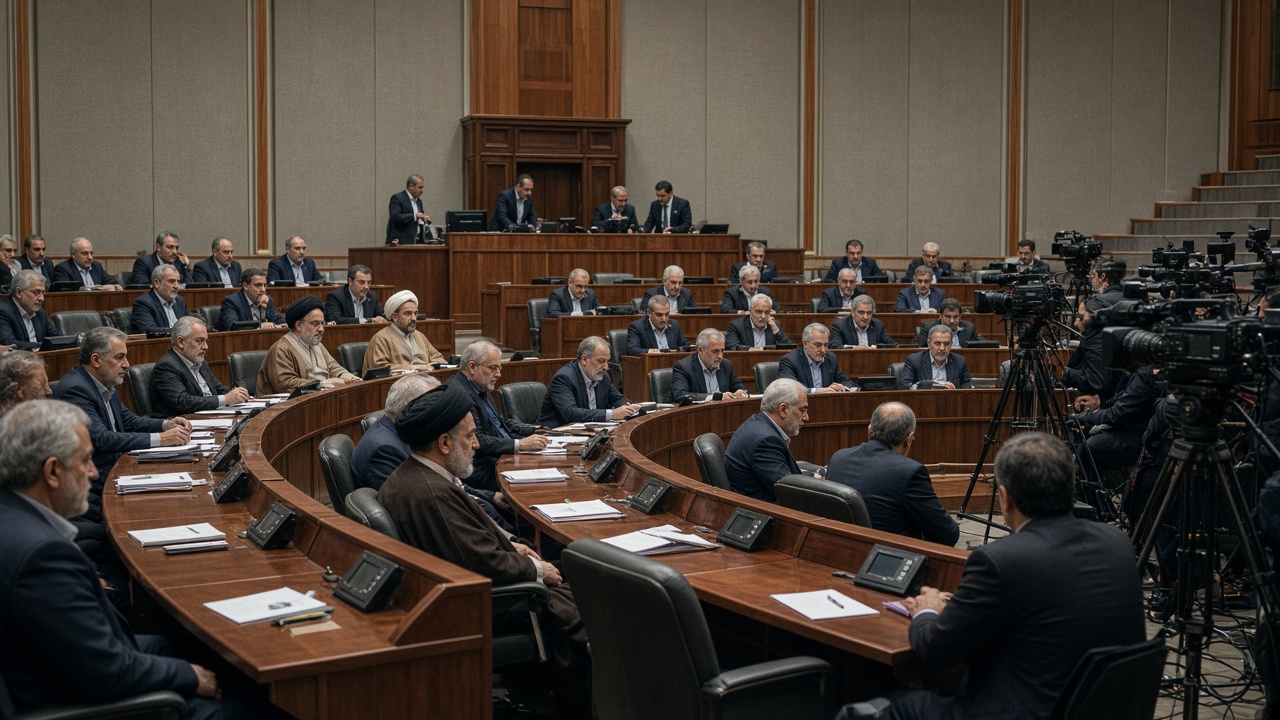
Iran’s parliament gave Mehrdad Akhlaghi Ketabchi a vote of confidence on Sunday to lead the Ministry of Defense and Armed Forces Logistics, installing a four-decade defense-industry veteran at a moment when Tehran is trading threats with Washington and trying to rebuild production lines strained by war and sanctions.
State media and Iranian news agencies said 277 lawmakers took part in the roll-call vote. President Masoud Pezeshkian had nominated Akhlaghi Ketabchi on Oct. 5 to replace acting minister Brig. Gen. Majid Ebn al-Reza, who stepped in after then-Defense Minister Aziz Nasirzadeh was killed in U.S. and Israeli strikes on Tehran at the start of the February war.
What the new minister promised lawmakers
Before the ballot, Akhlaghi Ketabchi outlined a program centered on missiles, drones, air-defense systems and faster output from Iran’s sprawling military-industrial base. Speaking to parliament by video link, Pezeshkian urged approval and framed national defense as more than hardware, citing public unity as part of Iran’s deterrent, according to Iran International’s live coverage of the session.
Reuters reported that Akhlaghi Ketabchi pledged to rebuild military-industrial infrastructure, accelerate development of defense technologies and expand cooperation with private firms. Kurdistan24, citing IRNA, said he received 237 votes in favor and 15 against with lawmakers present in the chamber.
Hard line toward U.S. forces in the region
Hours after the vote, Akhlaghi Ketabchi told domestic outlets that U.S. President Donald Trump should focus on extracting American personnel from the Middle East safely rather than contemplating new strikes. Iran International quoted him warning that any U.S. bombing would draw what he called a broad Iranian response and heavy American casualties.
The rhetoric lands as maritime agencies report fresh attacks on commercial shipping near the Strait of Hormuz and as Gulf states adjust their own military postures. Akhlaghi Ketabchi’s appointment does not by itself change Iran’s chain of command over the Islamic Revolutionary Guard Corps, but it gives him formal authority over procurement, logistics and the state-owned conglomerates that manufacture many of the systems Iran has used in the regional conflict.
Background in aerospace and missiles
Born in Rasht in the late 1950s, Akhlaghi Ketabchi has spent most of his career inside the defense ministry and affiliated industries, including leadership roles at Shahid Bakri Industries Group and the Aerospace Industries Organization, according to Kurdish24 and Iranian state reporting. He is subject to U.S. and European Union sanctions tied to Iran’s defense sector, a constraint that has long shaped how Tehran sources components and pays overseas suppliers.
In his parliamentary program, he described modern conflict as spanning sanctions, cyber operations, supply-chain disruption and information warfare as well as conventional battlefields. He pointed to plans for more accurate missiles, expanded drone families, electronic warfare and continued work on military satellites, while saying highly classified items would still be built inside secure ministry facilities.
What happens next
With parliamentary approval secured, Akhlaghi Ketabchi can move from caretaker status to full ministerial authority over budgeting, outsourcing targets and personnel policies that Iranian outlets said are meant to retain engineers and technicians. Western and regional capitals will watch whether his first weeks bring changes on the factory floor or mainly continuity with the wartime posture set after Nasirzadeh’s death.
Pezeshkian told lawmakers Iran does not seek to attack other countries but would resist assaults “with strength and courage,” language consistent with Tehran’s public stance since the February strikes. The confidence vote itself was the procedural hurdle; the harder test is whether Iran’s defense industries can raise output fast enough to match the promises Akhlaghi Ketabchi made on the parliament floor.