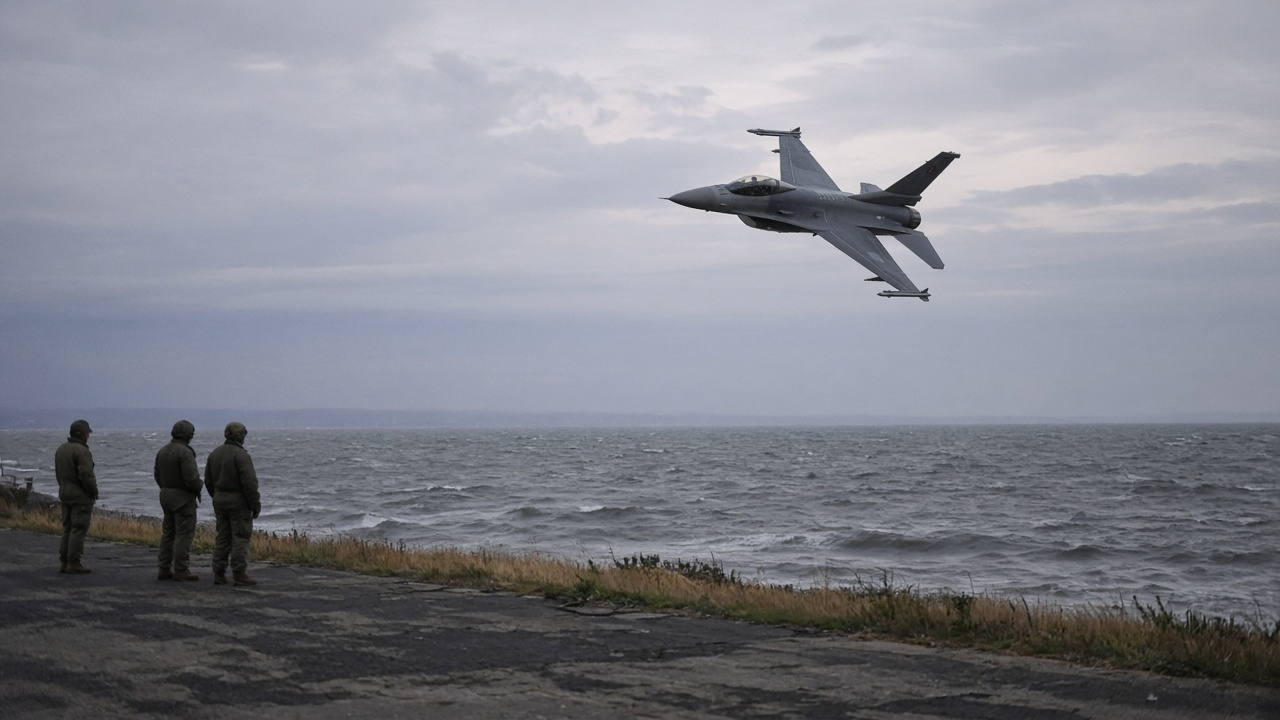
Romania’s defence ministry on Sunday released the first public footage of two F-16 fighter jets shooting down Russian-style Geran drones that had crossed into national airspace over the Black Sea, a sequence Bucharest said unfolded in just six minutes on Saturday evening.
Colonel Daniel Nistor, a ministry spokesperson, told reporters the intercept marked the first time Romanian pilots had downed drones flying at speeds comparable to a jet fighter. Defence Minister Radu Miruta said the aircraft were likely latest-generation Geran variants, travelling at roughly 450 kilometres per hour, and that both were destroyed over Romania’s territorial waters after radar contact east of Snake Island.
How the intercept unfolded
According to the ministry’s timeline, two F-16s from the 86th Air Base at Borcea scrambled at 17:43 local time after surveillance systems picked up a cluster of aerial targets about 120 kilometres east of Snake Island, moving southwest toward Romania.
The first drone entered Romanian airspace at 17:59 and was engaged at 18:01. A second target crossed the boundary at 18:01 and was destroyed at 18:05. Nistor said both engagements occurred while the drones were still over Romania’s maritime territory, not inland.
Published video clips show the moment each target was tracked, engaged and neutralised. Officials framed the release as both transparency toward NATO allies and a signal to Moscow that repeated incursions along the Danube–Black Sea corridor would be met with force.
Black Sea shipping under pressure
The shoot-downs landed in a week already shaped by attacks on commercial traffic. Two chemical tankers anchored near the Sulina Canal — a key export route linking the Danube to the Black Sea — were hit by drones in recent days, and Romanian authorities are still searching for seven missing crew members from one of the incidents. A NATO military source told Reuters the tanker strikes involved Russian drones.
Romania shares a 614-kilometre border with Ukraine and has reported repeated Russian drone fragments and incursions since Moscow’s full-scale invasion in 2022. Bucharest began authorising live intercepts of unmanned aircraft entering its airspace earlier this year, but Saturday’s engagement was the first publicly detailed use of F-16s against high-speed Geran-type systems.
NATO and diplomatic follow-through
Foreign Minister Oana Toiu said the North Atlantic Council would convene on Tuesday to discuss Black Sea defence and deterrence, a session arranged after President Nicusor Dan and Bulgarian Prime Minister Rumen Radev discussed the maritime threat with NATO Secretary General Mark Rutte in Brussels. A NATO official told Reuters the alliance remains ready to respond to threats around the clock.
Miruta said investigators were still analysing debris to confirm the drones’ origin and variant. Ukrainian officials have not claimed responsibility for any strike that might have sent the aircraft toward Romanian waters, and Russia has not publicly commented on the intercept as of Sunday evening.
For NATO’s southeastern flank, the episode underscores how the Ukraine war’s drone campaigns are no longer an abstract border worry. They are now visible on Romanian cockpit cameras — and on shipping lanes where insurers, exporters and naval planners are recalculating risk by the hour.