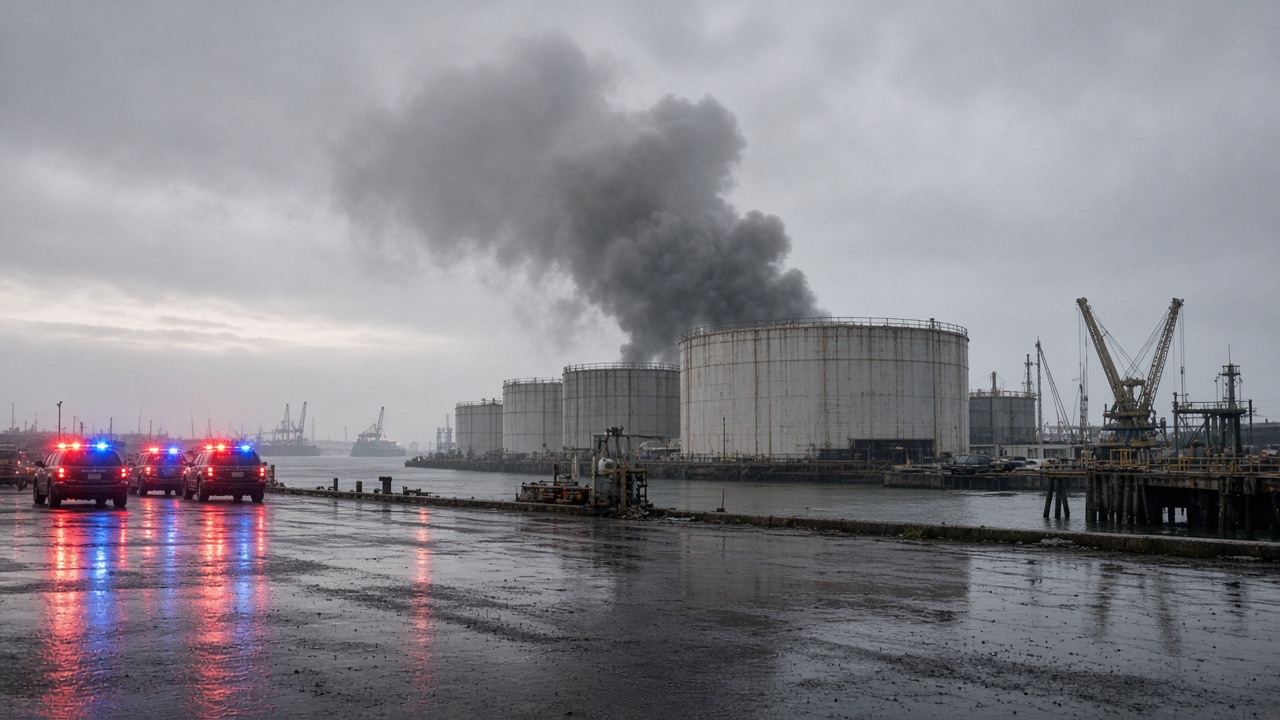
A large overnight drone salvo hit Saint Petersburg's oil terminal, a nearby depot and several commercial sites on Sunday, killing at least one person and injuring five others, according to regional governor Alexander Beglov. Fires burned at the Saint Petersburg Oil Terminal and the Ruchyi oil depot in the Kolpino district, and smoke was visible from the historic city centre as firefighters worked through the morning.
Terminals, warehouses and data centres in the crosshairs
Beglov said 12 apartment buildings and two houses were damaged in the city, and Pulkovo Airport restricted flights for safety. In the surrounding Leningrad region, governor Alexander Drozdenko said air defences destroyed 145 drones and that about 20,000 residents lost power in Yanino after a substation was hit. A woman and three children were hospitalised with symptoms of carbon monoxide poisoning after drone debris sparked a house fire, he added.
Russian e-commerce firm Ozon confirmed a fire at its Saint Petersburg logistics hub, saying staff were evacuated and that the site was not accepting seller shipments. Social-media company VK said a regional data centre was struck but told users services remained available. Ukraine's military has not commented on the specific targets; Ukrainian drone producer Fire Point said on Sunday that forces struck a VK data centre near the city.
Moscow's drone tally and Kremlin messaging
Russia's defence ministry said air defences intercepted 1,015 Ukrainian drones over Russian territory during the night, a figure that underscores the scale of the exchange even when most are shot down. State news agency TASS described the raid as the largest attack on the Leningrad region in four years. Kremlin spokesman Dmitry Peskov, quoted by TASS, said Russia would keep responding to Ukrainian strikes with systematic, large-scale attacks of its own.
Saint Petersburg's oil terminal was previously hit in July, but the city—hundreds of kilometres from the front—faces less frequent bombardment than border regions. Sunday's damage nonetheless reached deep into Russia's second city and Putin's birthplace, a symbolic blow at a moment when both sides are hammering energy assets ahead of winter.
Energy truce rhetoric and Washington's split with Kyiv
The strike landed days after U.S. President Donald Trump declared an "energy ceasefire" that neither Moscow nor Kyiv formally accepted. Ukrainian President Volodymyr Zelensky said on Saturday that Russia had hit his country's energy, oil and gas facilities 76 times since Trump's announcement, while Kyiv paused and then resumed its own attacks on Russian oil infrastructure. Trump has publicly criticised Ukrainian refinery strikes, arguing they feed global fuel-price spikes during the wider Middle East conflict, even as he temporarily waived several congressionally mandated Russia sanctions—deepening his rift with Zelensky.
Western officials have warned that tit-for-tat energy attacks risk civilian hardship on both sides as temperatures fall. For Saint Petersburg residents waking to scorched tanks and shuttered airport gates, the diplomatic wording matters less than whether the next night brings another thousand drones.