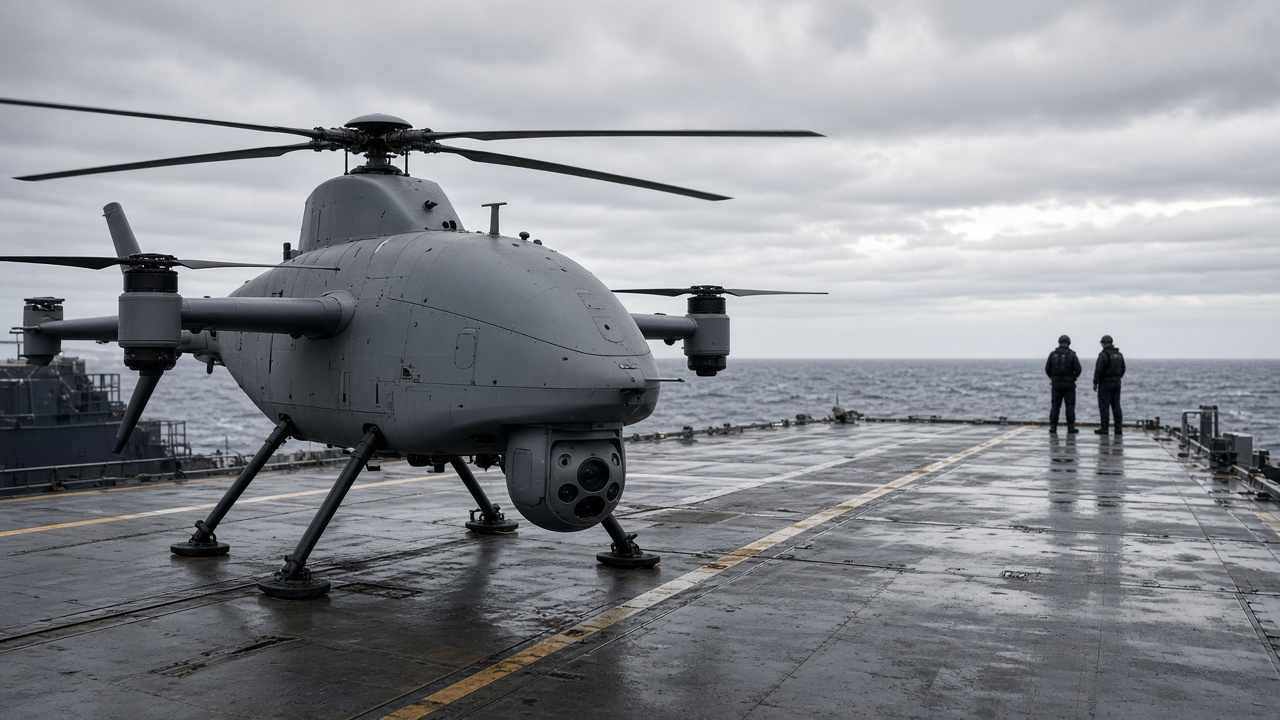
Taiwan’s Ministry of National Defense detailed a four-year, NT$36 billion program to acquire 280 Shield AI V-BAT vertical-takeoff drones for the navy, adding to a dozen coast-guard aircraft already being delivered in a procurement that could make Taipei one of the largest overseas operators of the U.S. system.
How the buy breaks down
Taipei Times reported Sunday that the coast guard budgeted NT$1.2 billion for 12 drones now arriving, while the navy’s Project Yuan Xiao (遠鴞) covers 280 airframes, 140 control stations and 82 transport vehicles under the fiscal 2027 defense report. Total spending approaches NT$37.2 billion when both services are included.
The ministry said 212 drones would go to the Coastal Combat Command and Hsiung Feng anti-ship missile units, allowing teams to scout and designate targets if radars are damaged or units disperse under attack. Shield AI cites more than 130 successful reconnaissance missions in Ukraine despite heavy Russian electronic warfare, a performance metric highlighted in the navy’s briefing materials.
Coast Guard deployment
Shield AI announced Oct. 13 that the first V-BAT had been handed over to the Coast Guard Administration under a shipborne UAV program selected in July. Ocean Affairs Council Minister Kuan Bi-ling and National Security Council Secretary-General Joseph Wu attended an Oct. 7 demonstration at the Port of Taipei where engineers assembled an airframe in minutes, the company said.
The ducted-fan Group 3 system can launch from deck or rooftop without runways and is rated for more than 12 hours of endurance on heavy fuel. Coast Guard officials plan to use it for maritime domain awareness, interdiction support and patrol coverage across the Taiwan Strait approaches.
Industrial base in Taiwan
Aerospace Industrial Development Corp. is the local partner for training, maintenance and logistics. Shield AI President Brandon Tseng told reporters in Taipei on Oct. 2 that the share of V-BAT components sourced from Taiwanese suppliers is expected to rise to 25 percent from 16 percent as production scales, giving local firms exposure to a fast-growing uncrewed segment.
The ministry noted that even the U.S. military and coast guard combined operate roughly 300 V-BATs, meaning Taiwan’s combined order could exceed total foreign sales recorded through 2024 for the type.
Operational concept
Briefing slides emphasize degraded communications environments: the drones are intended to keep eyes on shipping lanes and landing zones if command nodes are stressed. For missile units, pairing portable UAVs with mobile launchers reduces dependence on fixed radar sites that are priority targets in contingency planning.
Defense officials stressed the buy is defensive reconnaissance, not strike, though designation data can feed existing anti-ship weapons. Training pipelines will run through AIDC facilities in Taichung with U.S. instructor support.
Budget politics
The disclosure lands as the legislature faces a backlog of more than 150 defense budget unfreezing requests unrelated to Yuan Xiao’s out-year appropriations. Army sustainment accounts for Abrams tank spare parts remain frozen pending committee review, a separate bottleneck from drone procurement but part of the same oversight congestion.
Lawmakers from the opposition and ruling parties have questioned fast-moving U.S. drone deals, but coast-guard delivery is already underway, suggesting executive-branch momentum on shipborne UAVs regardless of committee scheduling delays elsewhere.
What comes next
Shield AI said remaining coast-guard airframes will arrive over the coming months, while navy deliveries follow the Yuan Xiao payment schedule in the defense report. Taiwan watchers will track whether local content targets are met and how quickly crews integrate V-BAT video into existing coastal command networks.
For a island navy operating in crowded waters, the bet is that relatively cheap, ship-launched eyes can stay aloft when manned helicopters are scarce—and that lessons from the Black Sea apply to the Taiwan Strait.