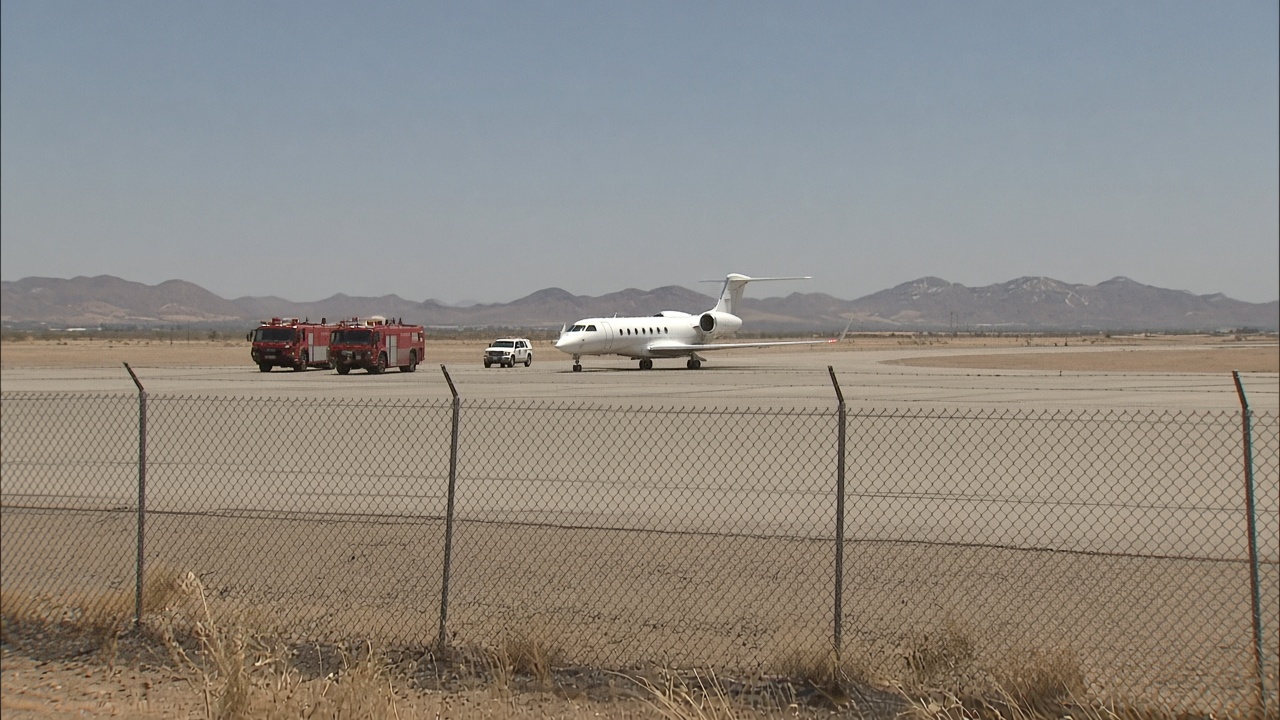
A chartered Dassault Falcon 50 overran the departure end of Runway 1L at Harry Reid International Airport in Las Vegas on Sunday morning, struck a perimeter fence with its left wingtip, and forced a short-lived pause in planned departures while investigators began work on what triggered the rejected takeoff. Eleven people were aboard the jet, which had been scheduled for Toronto Pearson International Airport; airport and federal officials said no injuries were reported.
What airport and FAA officials have confirmed
The Federal Aviation Administration said the crew aborted takeoff around 10:50 a.m. local time and the aircraft left the paved surface at the end of the runway. The agency listed eight people on board in its initial statement, while airport officials and industry publications cited eleven occupants; the discrepancy had not been reconciled in public filings by Monday evening Pacific time.
Airport spokesperson Monika Bertaki said the jet, registered as N200SG, went off the runway during a planned takeoff and made contact with the airport fence. Two parallel runways were closed for inspection, and the FAA temporarily held planned departures to Harry Reid, producing delays that rippled through the Sunday schedule. Bertaki did not specify a cause.
Flight-tracking and safety databases described a high-speed overrun: data compiled by the Aviation Safety Network indicated the aircraft was still traveling near 119 knots as it passed a taxiway exit roughly 1,000 feet from the threshold, then left the runway at about 70 knots before the wingtip struck the fence. The jet came to a stop in the runway safety area adjacent to the parallel runway.
Disruption ahead of NBAA-BACE
The timing mattered for commercial and business aviation alike. Harry Reid is the primary gateway to the Las Vegas Strip, and the National Business Aviation Association’s BACE convention is set to open in the city on Monday, October 20. Aviation trade publications reported that inbound traffic—including attendees traveling for the show—faced delays while the ground stop was in effect and while crews inspected both Runway 1L and Runway 1R.
Industry coverage noted the Falcon had arrived earlier Sunday from Seattle before its second leg of the day. Substantial damage was reported to the aircraft, and the FAA said it would investigate. Ownership was attributed in safety databases to Jacks Wings LLC, a charter operator configuration common for U.S.-registered business jets.
What investigators will examine next
Rejected takeoffs and runway excursions sit among the most closely studied events in aviation safety because they compress decision time, braking performance, and runway length into a single sequence. Investigators typically recover cockpit voice and flight data recorders when available, review weather and weight-and-balance paperwork, and compare tire marks and debris fields with simulator profiles.
Las Vegas Sunday morning weather included light winds and good visibility in published METAR observations, though investigators have not said whether surface conditions, configuration, or a mechanical issue played any role. The FAA’s statement did not estimate when its preliminary findings might be released.
For passengers and crews transiting Harry Reid this week, the immediate operational question is whether parallel-runway capacity returns to normal levels before peak NBAA-BACE arrivals. Airport officials said inspections were completed and traffic resumed, but carriers were still absorbing backlog effects on Monday.