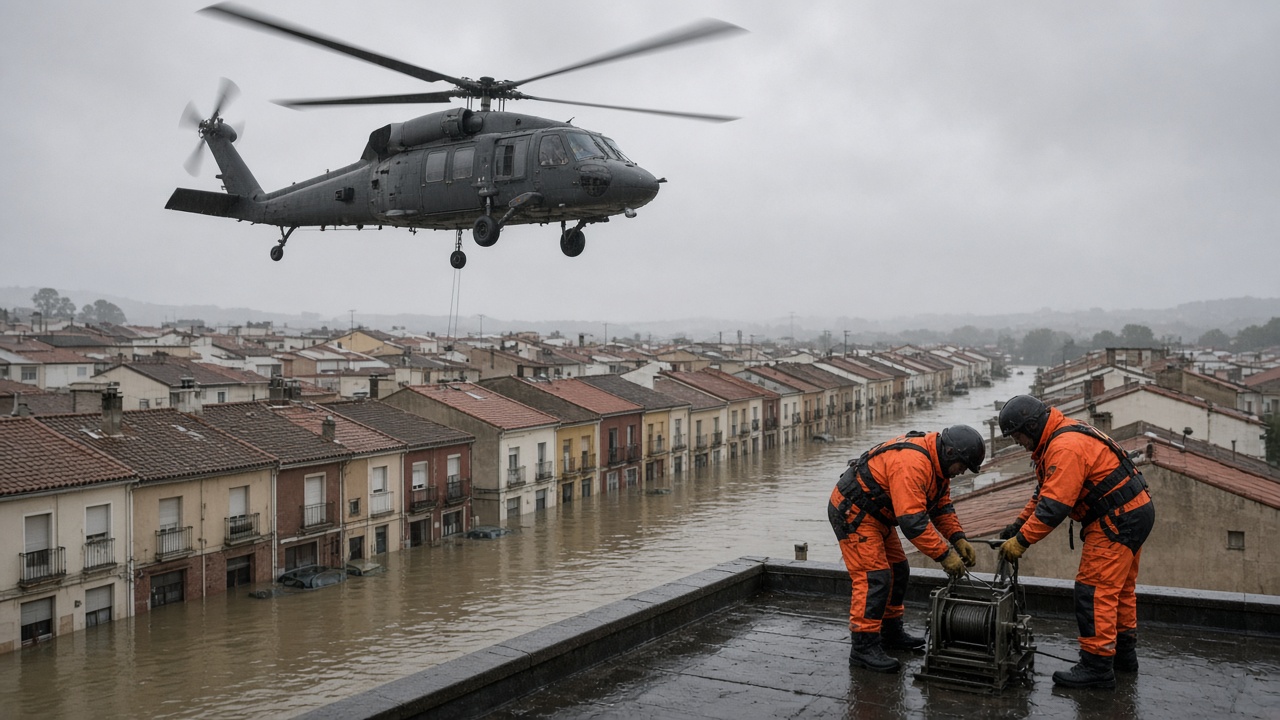
Helicopters winched families off rooftops and balconies across eastern Spain on Monday as Storm Adam turned Mediterranean towns into lakes, killing at least four people and forcing emergency crews to reach stranded residents by air when roads vanished under brown water.
Spain’s state weather service, AEMET, said the storm delivered exceptional rainfall along the coast from Alicante through southern Valencia, with some gauges recording more than half a meter of rain in a day. Regional authorities ordered shelter-in-place restrictions for roughly 850,000 people across 145 municipalities at the peak of the crisis before lifting most orders by late afternoon, though eight towns remained under movement limits as night fell.
Deaths mount as rivers overrun coastal towns
Valencian officials confirmed additional fatalities on Monday in Oliva, one of the hardest-hit municipalities, where military emergency teams found the body of a 79-year-old woman inside a flooded home and reported a man had died at a local campsite. Two women had already died over the weekend: one swept away by a creek in Cabrera de Mar, near Barcelona, and another who drowned while swimming at a beach in Sagunto.
The rising toll revived painful comparisons to the October 2024 floods that killed more than 230 people in the same region. Regional emergencies chief Juan Carlos Valderrama told broadcasters that trucks could not reach several inundated neighborhoods because rivers had burst their banks, leaving crews to prioritize aerial rescues. Spain’s Civil Guard said it carried out dozens of rescues in Valencia and Alicante provinces and helped coordinate more than 2,000 evacuations, most concentrated in Oliva.
Record rain and a shrinking lockdown zone
Independent meteorological groups and AEMET data cited rainfall totals that would be extreme even for autumn thunderstorms in the Levant. Pego, in northern Alicante, logged more than 630 millimeters in a 24-hour window, while several stations in southern Valencia exceeded 500 millimeters over 36 hours. The Valencian government’s association of farmers estimated that floodwaters had damaged more than 8,000 hectares of crops and rural infrastructure between La Safor and La Marina.
Public life stalled under the downpour. Regional officials said more than 100,000 pupils stayed home as schools closed across the Valencian Community, and traffic authorities reported flooded highways across multiple provinces. AEMET downgraded the highest red warnings to orange and yellow levels as the core of the storm shifted north toward Catalonia, but officials warned that saturated ground would keep rivers dangerous for days.
What emergency planners watch next
Spanish Prime Minister Pedro Sánchez’s government deployed military emergency units alongside regional firefighters and maritime rescue helicopters, with footage showing infants and elderly residents lifted from apartment blocks in Oliva and Pego. Mayors in cut-off towns pleaded for residents to stay upstairs and conserve phone batteries while they waited for rotor wash on their roofs.
Insurance assessors and civil-protection engineers will not know the full cost until waters recede, but the early scale — simultaneous municipal lockdowns, hundreds of aerial rescues, and rainfall that shattered local records — signals a long recovery even if the heaviest rain has moved on. Meteorologists will also study whether a warmer Mediterranean helped Storm Adam hold more moisture, a question Spanish disaster planners have confronted repeatedly since the 2024 catastrophe.