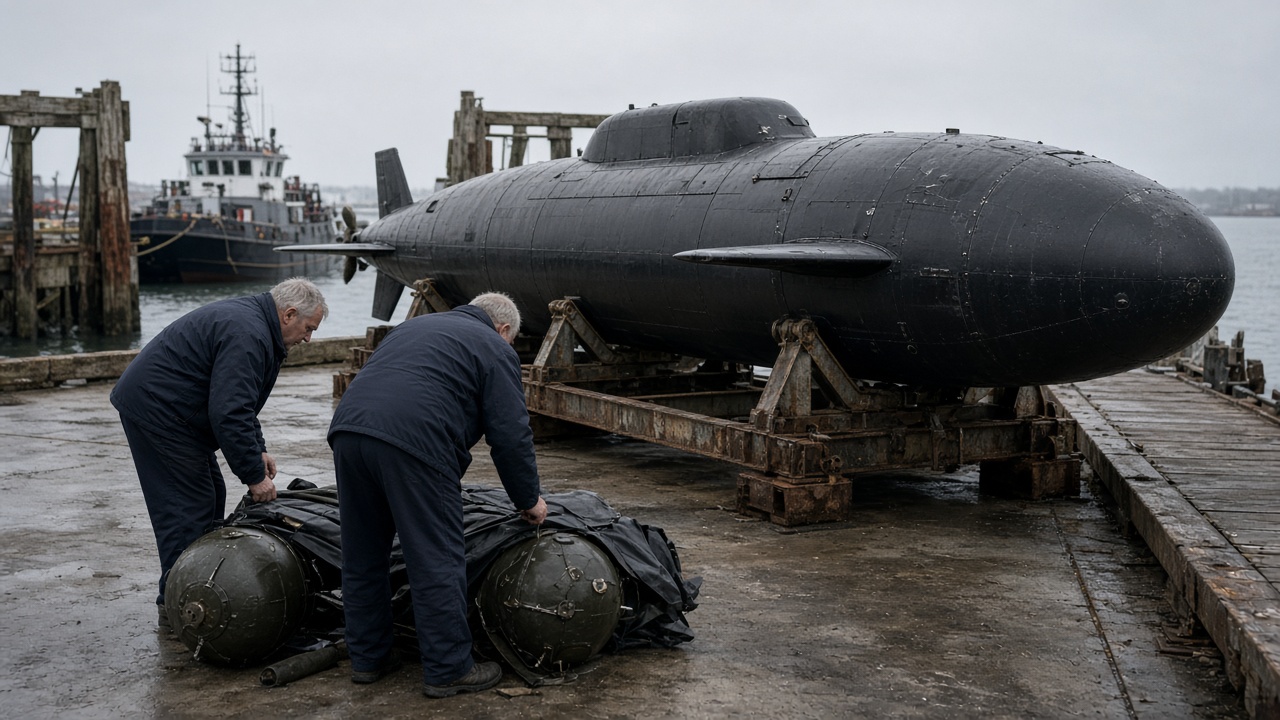
Australia’s Ghost Shark extra-large autonomous underwater vehicle can now carry sea mines, logistics pods and Anduril Altius aerial drones capable of strike missions, Defence Industry Minister Pat Conroy said in Sydney on Monday. Several of the previously classified payloads will be demonstrated at Exercise Maritime Big Play Pacific in San Diego later this week under the AUKUS Pillar II focus on shared undersea sensors and weapons.
Payloads the government is now discussing openly
Standing beside mine shapes and drone components, Conroy said Ghost Shark could deploy up to twelve sea mines per sortie and release swarms of Altius loitering munitions for intelligence or attack roles. A third payload line covers supply caches built around compartments Defence Science and Technology Group can tailor for remote delivery.
Conroy described the combination as giving the Royal Australian Navy an extra-large autonomous boat that can launch from a container or small vessel along the coastline, reducing the need to send crewed submarines into the highest-risk lanes. Navy Chief Vice Admiral Matt Buckley said protecting a continent-sized maritime zone requires blending crewed warships with uncrewed systems.
Bluebottle sonar and the San Diego timetable
The minister also announced a thin-line towed-array sonar as the first dedicated payload for the Ocius Bluebottle uncrewed surface vessel, aimed at submarine detection. Ghost Shark, Speartooth and Bluebottle payloads will be exercised in San Diego as part of the AUKUS partners’ third annual Maritime Big Play rotation.
A May meeting of AUKUS defence ministers named joint payload development for uncrewed undersea vehicles as the first Pillar II signature project. Canberra is pitching the Australian-designed modules to the United States and United Kingdom rather than insisting allies buy the Ghost Shark hull itself, Conroy told reporters.
Program scale and secrecy limits
Anduril builds Ghost Shark at a Sydney facility the company has kept largely off the public map, and Defence is spending more than $1.5 billion on the underwater drone line alongside the Ghost Bat aerial program. Range, speed and hull dimensions remain classified, though Conroy stressed deployability from commercial wharves using standard cranes.
Monday’s disclosure stops short of naming specific adversaries, but the minister said publicising strike payloads was meant to signal capability to both Australians and “potential adversaries.” Critics of the wider AUKUS pact continue to question nuclear-submarine timelines and cost, while the government argues autonomous strike options can arrive years earlier than the first Virginia-class boat.
What allies will see in California
Defence’s media release said some, but not all, integrated payloads would travel to San Diego for testing with US and UK counterparts. Successful trials would inform which modules become standard equipment for Australian units and which might be shared under Pillar II licensing.
For industry, the event is also a marketing window: Australian firms supplying mine components, drone avionics or towed-array cables will watch whether US Navy evaluators adopt any of the kits for their own uncrewed fleets. Results are unlikely to be public immediately given the classified nature of undersea trials.