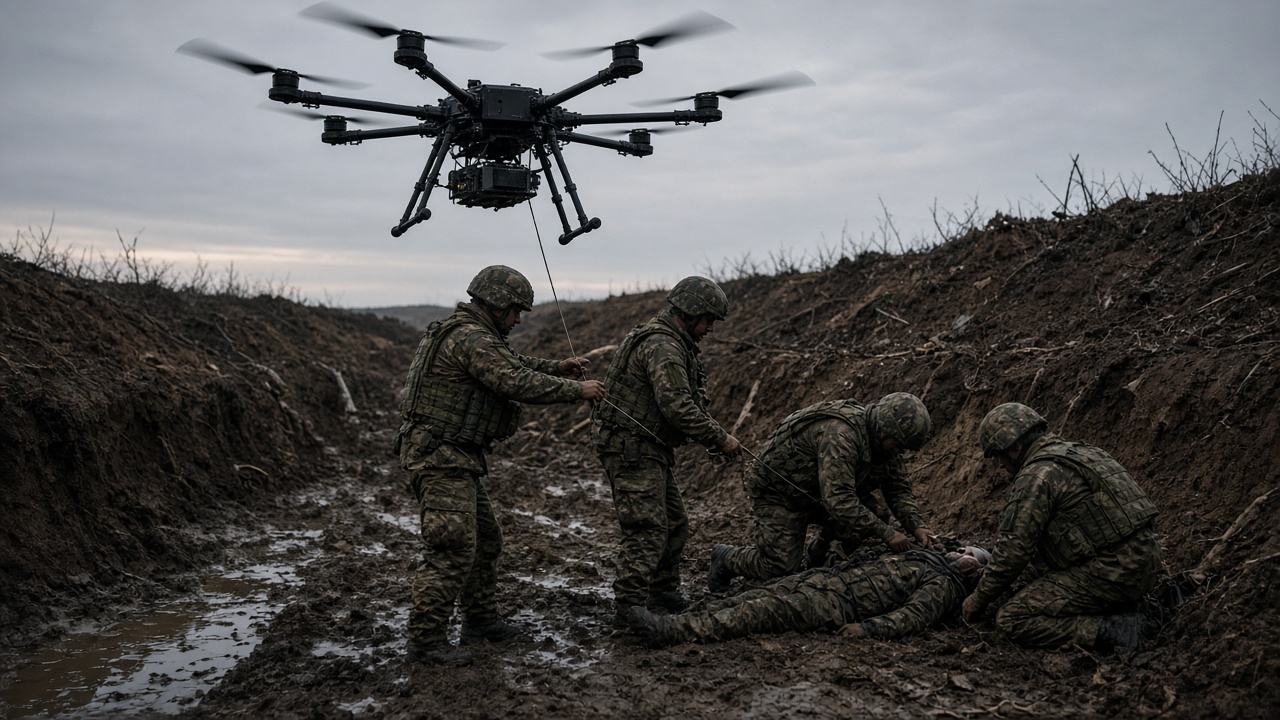
Ukrainian forces say they have completed the first known aerial evacuation of a wounded soldier directly from an active front-line position, using a heavy-lift drone to lift the man out of a mined kill zone where Russian unmanned aircraft had made every ground approach suicidal. The 92nd Separate Assault Brigade and manufacturer Gurzuf Defence published video and a detailed account on Monday, describing a mission that lasted one hour, fourteen minutes and thirty-six seconds and covered sixty-two kilometres.
How the rescue worked
The operation relied on Gurzuf Defence's Heavy Shot Ayudag-6 hexacopter, a platform the company originally built as a bomb-dropping attack drone but reconfigured with a winch and harness after days of testing. Operators first flew carabiners and rigging to the wounded soldier, then returned with the aircraft so he could attach himself while comrades talked him through the steps by radio. Once he was secured, the drone lifted him to a safer assembly point where other troops took over his transfer to a hospital.
Four brigades and the 10th Army Corps took part, according to Ukrainian accounts, and planners said they monitored airspace and electronic-warfare threats for the entire flight. Other drones were used to distract Russian positions while the hexacopter was airborne, the 92nd Brigade said. Gurzuf Defence provided the aircraft without charge and said specialists modified it so a human passenger would not spin or swing uncontrollably during the lift.
Why ground evacuation failed
The soldier, identified in Ukrainian media as Konstantyn Vlasenko of the 30th Separate Mechanized Brigade, had been cut off in a forward position for nearly five hundred days, supplied by drone drops of food, water, medicine and ammunition while Russian strike drones patrolled the area. After he was badly wounded—Ukrainian outlets said a Russian drone strike earlier this year left him unable to walk and that he performed partial self-amputations while waiting—standard casualty routes were unusable.
Mines blocked vehicles and dismounted teams, and an attempt to reach him with an unmanned ground evacuation robot failed when the machine was destroyed en route, according to the 2nd Mechanized Battalion. Foot patrols would have exposed rescuers to the same drone threat that kept Vlasenko pinned down, commanders said.
Not a routine tactic, officials warn
Gurzuf Defence co-founder Pavlo Feldblium cautioned that air rescue should remain a last resort. Each mission would need bespoke planning for weather, electronic warfare and the patient's condition, he said, because flying a wounded soldier exposes them to new risks even when ground options are worse. A programmer with the 92nd Brigade who uses the call sign Napalm called the flight historic but said the hard work now is turning a one-off feat into a repeatable capability without treating it as an everyday substitute for medevac helicopters or armoured ambulances.
Ukraine has evacuated thousands of casualties with small ground robots during the war, and it recently began front-line trials of a dedicated medical drone called StarGate. The aerial winch mission goes further, proving that some positions deemed unreachable by land can still be cleared if commanders accept the engineering and operational burden. Kyiv did not disclose the map coordinates or the exact date of the flight, leaving open how soon another unit might try the same method.
The brigade said Vlasenko is now in treatment and rehabilitation and that his life is no longer in immediate danger. Western outlets including CBS News and Australia's national broadcaster verified the brigade's footage while noting that Russia has not commented on the claim. If the account holds, it will enter NATO medical planners' slide decks as both a morale story and a warning about how cheap drones are rewriting casualty evacuation math on modern battlefields.